
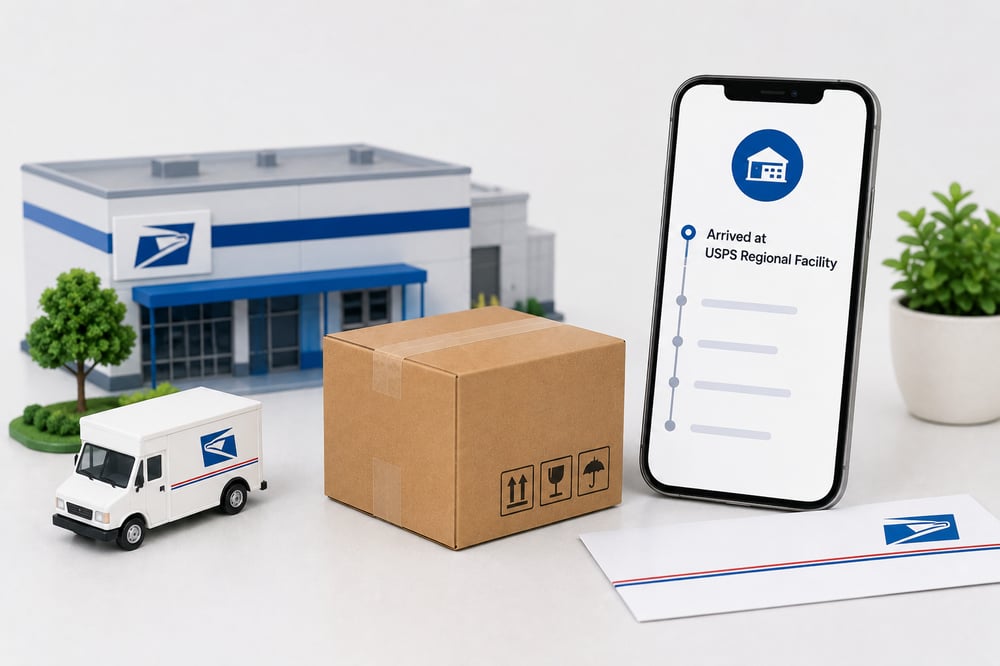
“Arrived at USPS regional facility” means your package has reached one of USPS’s large-scale sorting hubs, where it gets processed and routed toward its next destination.
This is a mid-transit checkpoint, not a delivery event.
Most shippers treat this scan as a red flag when a package sits there for more than 24 hours. That instinct is wrong. Regional facilities handle upward of 1 million pieces per day during peak periods. Therefore, a brief dwell time is normal.
What Actually Happens Inside a Regional Facility
Automated sorting equipment reads barcodes and routes each piece to the correct outbound zone. The scan your customer sees is generated the moment the package clears inbound processing.
- Packages are sorted by ZIP code destination, not carrier service type
- Priority Mail and First-Class Mail share the same physical infrastructure at most facilities
- Outbound loads are staged in waves tied to truck departures, typically every 4–6 hours
The facility doesn’t deliver anything; it moves volume between origin and destination post offices. USPS operates 22 Regional Distribution Centers and roughly 195 Sectional Center Facilities nationwide.
Why This Scan Confuses Shippers
The status label is vague by design. USPS doesn’t distinguish between a package that arrived 20 minutes ago and one sitting for 18 hours. Both show identical tracking text.
If the package reached a regional facility, it’s in the system and moving. Delays under 48 hours don’t require escalation.
What the USPS Regional Facility Status Means for Delivery Timing
When you see the scan ‘arrived at the USPS regional facility’, it means your package has entered one of USPS’s sorting hubs, a large-scale distribution center that processes mail before routing it toward the destination post office.
For eCommerce brands shipping at volume, this scan confirms the package is moving through the USPS network correctly, it hasn’t stalled, and it hasn’t been misrouted.
The common mistake is treating this update as a delay signal. It’s a transit checkpoint, and most packages clear regional facilities within 24 hours of this scan.
Why It Matters for Your eCommerce Operation
When a package sits at a regional facility longer than expected, your customers notice before you do.
WISMO (Where Is My Order) contacts spike within 48 hours of a missed estimated delivery date, and during peak periods like Black Friday or a subscription-box renewal cycle, that volume can overwhelm your support team fast.
The numbers are specific: carriers report that roughly 12% of inbound WISMO contacts trace back to customers misreading a regional facility scan as a delivery failure. That’s avoidable friction.
- Packages held at a regional facility during a returns surge can delay outbound replenishment by 2-4 days, tying up inventory capital
- Proactive tracking communication at this scan point cuts escalated support tickets by an estimated 18-22%
- A dedicated account manager can flag regional facility delays before they compound into missed SLAs
Understanding what this scan actually signals lets your 3PL fulfillment partner act on real data, not customer panic.
How the Regional Facility Process Works
- Package induction at the origin post office. When a carrier picks up, or a customer drops off a parcel, the origin post office scans it into the USPS tracking system and assigns it to an outbound transport run.
- Arrival and intake scan at the regional facility. The facility’s automated scanning equipment reads the barcode as the package enters the building. This is the exact moment the “arrived at USPS regional facility” status fires in the tracking feed.
- Machine sorting by destination ZIP. Automated sorting equipment reads the delivery address and routes the package to the correct outbound dock.
- Transfer to the destination delivery unit. Sorted packages load onto trucks or planes bound for the local post office serving the delivery ZIP.
Reduce Shipping Delays Before Customers Notice
Shipping delays cost U.S. eCommerce businesses a staggering $1.6 billion annually. That’s a lot of cash down the drain.
The only real fix is a fulfillment operation that spots exceptions, like a package stuck in a Memphis hub for three straight days, before your customers even know there’s a problem.
Curious to learn more? Reach out to Fulfyld today for consultation!