
10 Shopify Fulfillment Partners That Scale Your Business
Finding the right 3PL for Shopify starts with understanding your options. Professional Shopify fulfillment services handle warehousing, picking, packing, and shipping, freeing your team to focus on product development, marketing, and customer acquisition.
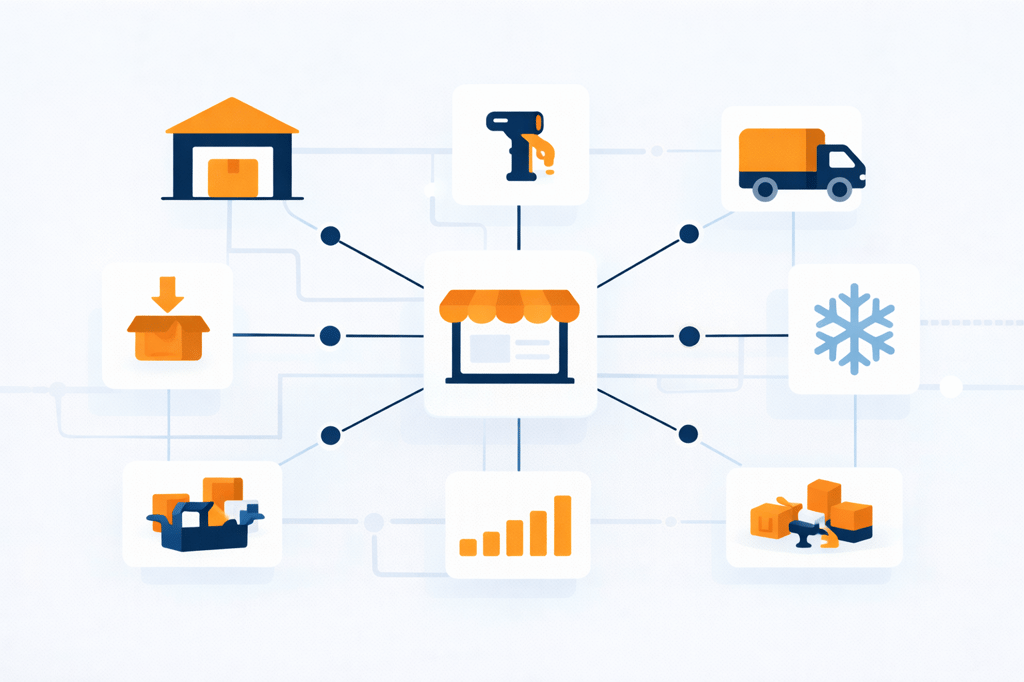
These represent the industry’s leading solutions, each excelling in specific scenarios based on product types, order volumes, and business models.
| Provider | Best For | Locations | Avg. Delivery | Key Specialization | Minimum Requirements |
| Fulfyld | Custom fulfillment | 1 (Huntsville, AL) | 2 days | Dedicated support, custom packaging | No minimums |
| Shopify FN | New merchants | 6+ (US) | 2-3 days | Built-in integration, no minimums | No minimums |
| ShipBob | Fast shipping | 60+ globally | 1-2 days | Global network, B2B capabilities | $275/month minimum |
| Amazon FBA | Global reach | 185+ globally | 2 days US | Prime access, international | Pro seller ($39.99/mo) |
| Red Stag | Heavy/bulky items | 2 (UT, TN) | 2 days | $50 guarantees, specialized handling | Selective |
| Whiplash | Customization | Multiple (US) | 2-3 days | Tailored workflows, premium handling | Custom quote required |
| Rakuten SL | Scalability | Nationwide (US) | 1-2 days | Growth infrastructure, nationwide | 250+ orders/month |
| Stord | High-volume omnichannel | 30+ (North America) | 1-2 days | Proprietary tech, UPS partnership | Custom pricing |
| ShipHero | Technology | Multiple (US/CA) | 2-3 days | Advanced WMS, 99%+ accuracy | Quote-based pricing |
| ShipMonk | Comprehensive | 12+ (US/Intl) | 1-2 days | Multi-channel, subscription boxes | No minimums |
In-Depth Look at 10 Leading Fulfillment Companies for Shopify
Choosing the best Shopify fulfillment service requires examining each provider’s capabilities, 3PL pricing models, and specializations. This comprehensive analysis helps you identify the perfect partner for your unique requirements.
1. Fulfyld – Best for Custom, Efficient Fulfillment
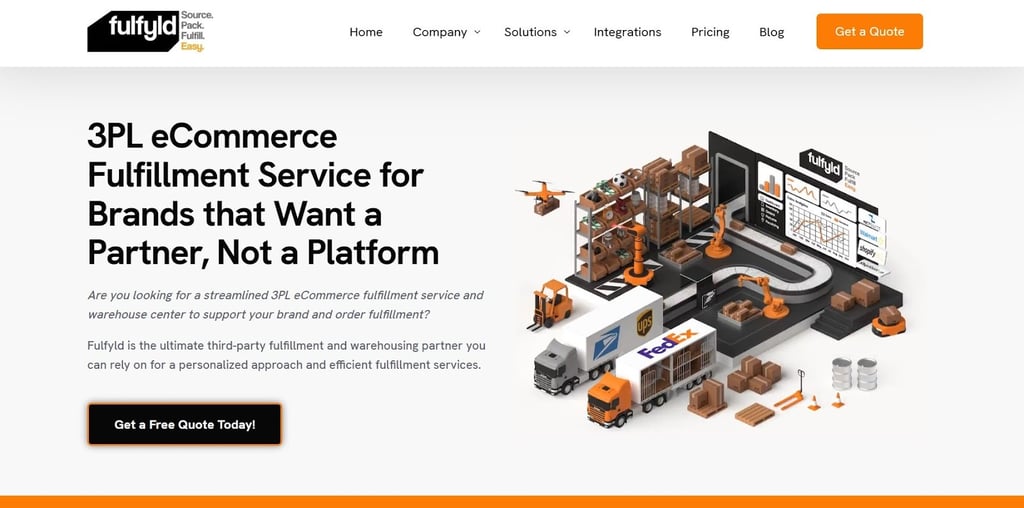
Fulfyld claims the top spot among the best fulfillment services for Shopify primarily because of the dedicated account management that sets it apart from high-volume, transactional providers.
| Feature | Details |
| Fulfillment Centers | Huntsville, Alabama (strategic central US location) |
| Average Delivery Time | 2 days to 95%+ of the continental US |
| Shopify Integration | Native app with real-time syncing |
| Specializations | Custom packaging, temperature control, dedicated support |
| Key Metrics | 2-day shipping guarantee, dedicated account managers |
| Best For | Mid-market brands ($500K-$10M) needing personalized service |
Why Fulfyld Stands Out
Operating from a strategically positioned Alabama fulfillment center, Fulfyld provides 2-day ground shipping to 95%+ of the continental US. This central location enables faster delivery at lower costs compared to single-coast warehouses.
Native Shopify 3PL integration automates order routing and provides real-time inventory tracking without complex setup. Orders sync within minutes, inventory updates instantly, and tracking numbers transmit automatically.
Core Services
- Custom Packaging & Branding: Branded boxes, tissue paper, thank-you cards, promotional inserts with custom fulfillment services
- Temperature-Controlled Storage: Climate-sensitive product protection for supplements, beauty products, foods
- Kitting & Assembly: Product bundling, subscription box preparation, promotional kit creation
- Returns Management: Complete reverse logistics processing with inspection and restocking
- Omnichannel Fulfillment: Synchronized inventory across Shopify, Amazon, eBay, and other platforms
Pricing Transparency
Fulfyld eliminates hidden fees with transparent pricing structures. Storage scales with actual usage without minimum commitments. Pick and pack fulfillment pricing includes all labor without surprise handling charges. Shipping costs pass through at carrier rates without markup.
Ideal Customer Profile
Brands prioritizing customer experience and hands-on support find Fulfyld’s approach refreshing. Dedicated account managers learn your business, anticipate needs, and proactively solve problems.
This D2C fulfillment partnership model particularly suits companies in apparel, health & wellness, beauty, and home goods requiring custom packaging and personalized service.
2. Shopify Fulfillment Network – Best for New Shopify Stores
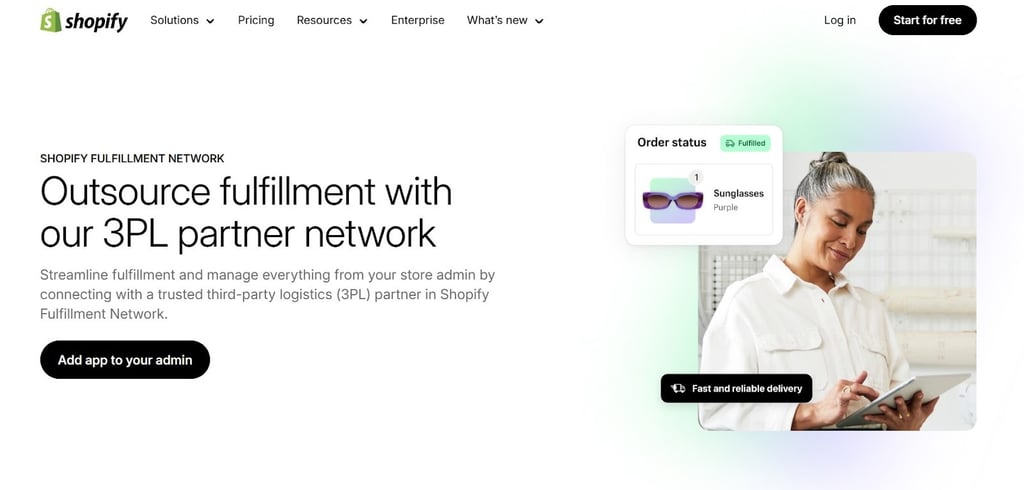
Shopify’s proprietary fulfillment service, through partnership with Flexport, provides the most seamless 3PL integration possible for Shopify merchants.
| Feature | Details |
| Fulfillment Centers | 6+ across the United States |
| Average Delivery Time | 2-3 days for most US destinations |
| Shopify Integration | Built directly into the Shopify admin |
| Specializations | Zero-code setup, machine learning distribution |
| Minimum Requirements | No minimums, no long-term contracts |
| Best For | New merchants, standardized products under $1M revenue |
Seamless Integration Benefits
SFN represents the simplest possible fulfillment solution for Shopify merchants. Enable directly through the Shopify admin with zero coding required. All fulfillment management happens within the familiar Shopify interface you already use daily.
Learn more about whether a 3PL provider can integrate directly with your Shopify store for technical details.
Machine Learning Optimization
SFN’s technology predicts demand patterns and distributes inventory accordingly across multiple fulfillment centers.
The system analyzes historical sales data, geographic trends, and seasonal patterns to position stock closest to likely buyers, optimizing both shipping costs and delivery speed.
Key Advantages
- No Barriers to Entry: No minimum order volumes or contract commitments
- Unified Dashboard: Manage fulfillment within Shopify without learning new platforms
- Automated Distribution: AI determines optimal inventory placement across warehouses
- DTC & B2B Support: Handle both direct consumer orders and wholesale shipments
- Built-In Tracking: Order tracking is integrated directly into Shopify order management
Pricing Structure
Transparent pricing displays directly in the Shopify dashboard before committing. Storage fees are charged per cubic foot monthly. Fulfillment fees cover pick, pack, and ship costs based on order complexity and destination.
When SFN Makes Sense
Shopify merchants seeking the simplest integration find SFN compelling, particularly brands under $1M annual revenue beginning their outsourcing journey with standardized products not requiring special handling.
3. ShipBob – Best for Fast Shipping & Scalability
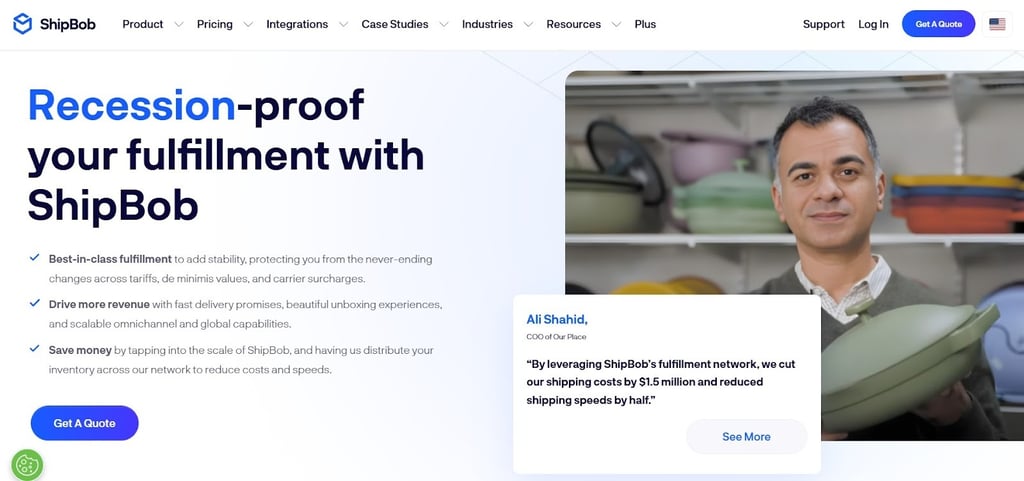
ShipBob built a technology-first 3PL for Shopify specifically designed for modern ecommerce brands requiring global capabilities and data-driven insights.
| Feature | Details |
| Fulfillment Centers | 60+ across the US, Canada, Europe, Australia |
| Average Delivery Time | 1-2 days in the US, local delivery internationally |
| Shopify Integration | App integration with advanced analytics |
| Performance Metrics | 99.95% accuracy, 99.8% on-time shipping |
| Specializations | International expansion, B2B fulfillment, analytics |
| Best For | Brands shipping 1,000+ orders monthly, international sellers |
Global Distribution Network
ShipBob’s 60+ fulfillment centers enable 2-day ground shipping to 95% of US consumers while providing local fulfillment in Canada, UK, Europe, and Australia. This distributed model reduces shipping costs by positioning inventory closer to customers.
Advanced Analytics Dashboard
ShipBob’s platform provides merchants with comprehensive visibility:
- Shipping Speed Analysis: Track delivery times by destination and carrier
- Cost Breakdowns: Understand expenses by zone, carrier, and service level
- Inventory Turnover: Monitor sales velocity and stock movement by SKU
- Customer Location Heat Maps: Visualize where orders originate geographically
- Demand Forecasting: Predict future needs using historical patterns
B2B Capabilities
Beyond DTC fulfillment, ShipBob supports wholesale orders with custom packaging meeting retailer specifications, EDI integration with major retailers, pallet and case pack shipments, and compliance with retailer-specific routing guides.
International Expansion Support
ShipBob simplifies global expansion by handling customs documentation automatically, calculating and collecting duties and taxes at checkout, providing local fulfillment from in-country locations, and maintaining relationships with regional shipping providers.
Ideal Customer Profile
Shopify brands with significant international sales or planning global expansion benefit from ShipBob’s distributed network. Companies shipping 1,000+ monthly orders that value data-driven insights find ShipBob’s analytics justify the premium pricing
4. Fulfillment by Amazon (FBA) – Best for Global Reach
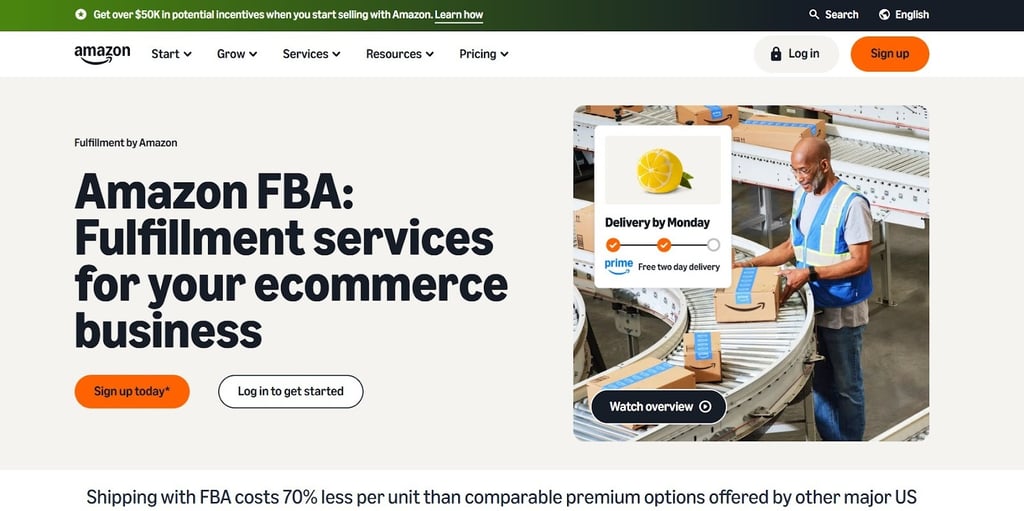
Amazon Multi-Channel Fulfillment leverages Amazon’s massive logistics infrastructure to fulfill orders from any sales channel, including Shopify stores.
| Feature | Details |
| Fulfillment Centers | 185+ globally across all continents |
| Average Delivery Time | 2 days for most US customers |
| Shopify Integration | Third-party apps connecting to Seller Central |
| Performance Metrics | 99.8% undamaged delivery, 97% on-time |
| Specializations | Global distribution, Prime-like speeds |
| Best For | International sellers, existing FBA users, and global brands |
Massive Global Infrastructure
Amazon operates the world’s largest fulfillment network with 185+ centers across North America, Europe, Asia, and other continents. This unmatched infrastructure enables international fulfillment without managing complex customs or carrier relationships.
Multi-Channel Capabilities
FBA fulfills orders from Shopify, eBay, your own website, and other platforms using shared inventory stored in Amazon warehouses. This consolidation simplifies inventory management while leveraging Amazon’s operational excellence.
Service Tiers
- Standard Shipping: 3-5 day delivery at the lowest cost
- Expedited Shipping: 2-day delivery for faster service
- Priority Shipping: Next-day delivery in select markets
Prime Badge Benefits
Products fulfilled through FBA earn the coveted Prime badge on Amazon listings, dramatically increasing conversion rates for products sold on Amazon while simultaneously serving other channels.
Returns Management
Amazon handles customer returns for all channels through standardized processes. Returned inventory automatically restocks, or disposals occur based on condition assessments performed by Amazon staff.
Pricing Complexity
FBA pricing structures can confuse merchants unfamiliar with Amazon’s fee schedules. Storage fees, fulfillment fees, removal fees, and long-term storage charges require careful calculation to understand total costs.
When FBA Makes Sense
Brands selling significant volume on Amazon alongside their Shopify store gain efficiency by consolidating fulfillment through FBA. The Prime badge value often justifies costs despite higher fees compared to traditional 3PLs.
5. Red Stag Fulfillment – Best for High-Value or Bulky Items
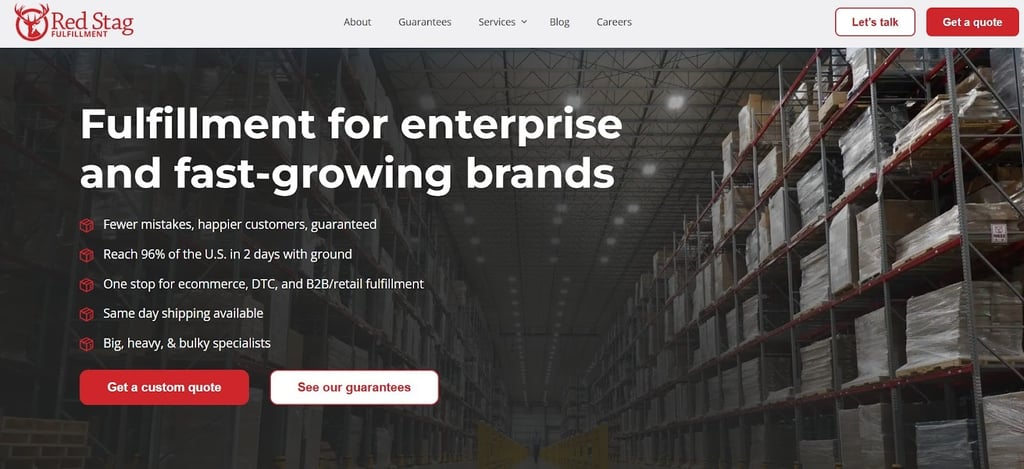
Red Stag specializes in products most 3PLs avoid: heavy, bulky, and high-value items requiring specialized handling and enhanced security.
| Feature | Details |
| Fulfillment Centers | 2 (Salt Lake City, UT & Knoxville, TN) |
| Average Delivery Time | 2 days to 96% of US homes |
| Shopify Integration | Native app integration |
| Performance Metrics | 99.98% accuracy with $50 error compensation |
| Specializations | Heavy/bulky items, high-value products, fragile goods |
| Best For | Furniture, equipment, electronics, fragile merchandise |
Industry-Leading Guarantees
Red Stag backs operations with financial guarantees rarely found in fulfillment:
- 100% Order Accuracy: $50 payment to you for any error
- Zero Inventory Shrinkage: Full reimbursement plus $50 for lost items
- On-Time Shipping: $50 compensation for late parcels
- 48-Hour Receiving: Inventory available within 2 business days
Specialized Infrastructure
Unlike standard 3PLs optimized for lightweight packages, Red Stag built facilities specifically for challenging products:
- Weight Capacity: Handle items up to 60 pounds per unit
- Climate Control: Temperature-sensitive storage protecting products
- Enhanced Security: Surveillance systems, access controls, background-checked staff
- Material Handling: Specialized equipment for oversized products
- Reinforced Shelving: Wide aisles accommodating bulky merchandise
Custom Services
- Kitting & Assembly: Bundle products, insert documentation, create gift sets
- Quality Control: Inspection upon receiving and before shipping
- Fragile Handling: Specialized padding, double-boxing, appropriate carrier selection
- High-Value Security: Limited access areas, enhanced tracking protocols
Pricing Transparency
Red Stag offers clear pricing without hidden fees: storage at $15-20 per pallet monthly, pick & pack at $2.25-3.00 per order plus $0.30-0.75 per additional item, and negotiated carrier rates passed through without markup.
Ideal Customer Profile
Shopify stores selling furniture, fitness equipment, automotive parts, or any products exceeding standard dimensions benefit from Red Stag’s specialized capabilities. Their $50 guarantees demonstrate serious accountability.
The combination of specialized infrastructure, performance guarantees, and transparent pricing makes Red Stag ideal for non-standard products.
6. Whiplash – Best for Customization
Whiplash (now Ryder E-commerce by Whiplash) delivers highly customizable fulfillment workflows tailored to each brand’s unique requirements and premium positioning.
| Feature | Details |
| Fulfillment Centers | Multiple locations across the US, UK, and Canada |
| Average Delivery Time | 2-3 days domestically |
| Shopify Integration | Real-time two-way sync via the Shopify app |
| Specializations | Tailored workflows, custom automation, premium handling |
| Best For | Lifestyle brands, fashion, crowdfunding, and complex kitting |
Complete Customization
Unlike standardized 3PL operations, Whiplash configures processes specifically for your brand. If you have signature packaging methods, complex assembly requirements, or specialized quality checks, Whiplash trains staff to execute exactly as specified.
Tailored Workflows
- Custom Quality Control: Define specific inspection checkpoints per your standards
- Multi-Step Kitting: Complex assembly procedures with multiple components
- Unique Packaging: Specialized materials, tissue wrapping with branded seals, handwritten cards
- Handling Protocols: Premium product requirements for luxury goods, including eco-friendly fulfillment options
Omnichannel Excellence
Whiplash unifies direct-to-consumer and B2B wholesale fulfillment under one roof. Manage both Shopify DTC orders and bulk retail shipments through integrated systems, maintaining consistent quality across channels.
Technology Platform
Whiplash’s warehouse management system provides real-time visibility into inventory levels, order status, and shipping information. SmartRate™ logic optimizes carrier selection to minimize costs while maintaining delivery commitments.
Crowdfunding Expertise
Whiplash handles complex backer rewards with multiple variants, staggered delivery schedules based on pledge levels, custom communications to backers, and flexible fulfillment timing as production completes.
Pricing Considerations
The trade-off for customization is higher pricing compared to commodity fulfillment. However, brands requiring tailored experiences find the investment worthwhile for maintaining their positioning and customer expectations.
Ideal Customers
Lifestyle and fashion brands demanding curated unboxing experiences, crowdfunding campaigns with complex fulfillment needs, and companies with unique processes that don’t fit standardized operations benefit most from Whiplash’s flexibility.
7. Rakuten Super Logistics – Best for Scalability
Rakuten Super Logistics operates a nationwide warehouse network designed specifically for fast-growing brands requiring scalable infrastructure.
| Feature | Details |
| Fulfillment Centers | Extensive US network, nationwide coverage |
| Average Delivery Time | 1-2 days to major markets |
| Shopify Integration | App integration with detailed reporting |
| Specializations | Growth infrastructure, scalability, and custom packaging |
| Best For | Fast-growing brands, distributed inventory strategy |
Scalable Infrastructure
RSL’s network supports growth without disruption. Start with single-location fulfillment and expand to distributed inventory as volume grows. Flexible capacity scales up for seasonal peaks without long-term commitments.
Same-Day Processing
RSL processes orders received before cutoff times same-day, enabling faster order-to-door times, same-day shipping for early orders, and next-day delivery in many regions.
Custom Packaging Options
Branding capabilities include custom boxes with logo printing, branded tissue paper and stickers, thank-you cards and promotional inserts, and gift packaging for special occasions.
Technology Platform
The RSL platform provides real-time inventory visibility across locations, detailed reporting on inventory, orders, and shipping performance, and tools to optimize stock distribution as you expand to multiple warehouses.
Returns Management
Comprehensive reverse logistics includes inspection and quality checks, restocking decisions based on condition, detailed reporting on return reasons, and customer return portals for streamlined processing.
Ideal Customer Profile
Fast-growing Shopify brands projecting rapid sales increases need fulfillment infrastructure that scales seamlessly. Companies starting single-location but planning distributed inventory within 6-12 months find RSL’s nationwide network valuable for supporting growth.
8. Stord – Best for High-Volume Omnichannel Brands
Stord combines proprietary fulfillment technology with one of North America’s largest integrated fulfillment networks, offering end-to-end commerce enablement for direct-to-consumer and omnichannel brands.
Following its May 2025 acquisition of Ware2Go from UPS, Stord operates 30+ fulfillment centers with 2.5 million square feet of warehouse capacity, reaching 99% of the U.S. within 1-2 days.
| Feature | Details |
| Fulfillment Centers | 30+ facilities across North America (11 owned + 21 Ware2Go facilities) |
| Average Delivery Time | 1-2 days to 99% of the US population |
| Shopify Integration | Native Shopify app for seamless order sync |
| Performance Metrics | 99.99% order accuracy, delivered to 11.5% of US homes in 2024 |
| Specializations | Proprietary WMS/OMS technology, UPS partnership, omnichannel fulfillment |
| Best For | High-volume brands ($5B+ commerce managed annually), businesses requiring an integrated technology platform |
Largest Fulfillment Network Through UPS Partnership
Stord’s May 2025 acquisition of Ware2Go from UPS transformed it into one of the largest fulfillment networks in North America by volume and reach. The transaction added 21 fulfillment centers and 2.5 million square feet of warehouse space to Stord’s existing 11-facility network.
This acquisition also formalized Stord’s partnership with UPS for transportation and delivery services, providing access to UPS’s nationwide parcel network while maintaining multi-carrier flexibility.
Proprietary Technology Platform
Unlike traditional 3PLs using third-party systems, Stord operates on its operator-built proprietary software, including:
- Stord One Warehouse (WMS): Cloud-based warehouse management system powering all fulfillment operations with real-time inventory tracking and 99.99% order accuracy
- Order Management System (OMS): Intelligent order routing across 30+ facilities with multi-channel inventory synchronization
- Customer Experience Platform: Pre-purchase delivery promise tools, real-time order tracking, and branded post-purchase notifications
The unified platform eliminates data silos between warehouse operations, order processing, and customer communication.
Commerce Enablement at Scale
Stord powers nearly $10 billion in commerce annually for leading DTC and B2B brands, including AG1, True Classic, Tula Skincare, American Giant, quip, Sundays for Dogs, and Legion Athletics. In 2024, Stord delivered to over 11.5% of US households and processed nearly 1% of all Black Friday and Cyber Monday orders nationwide.
Custom Pricing Model
Stord operates on custom, quote-based pricing tailored to each client’s specific fulfillment needs, order volumes, and storage requirements.
Stord emphasizes “value over price,” openly stating they’re “not the cheapest option” but focus on ROI through reduced shipping costs, improved order accuracy, and technology-driven efficiencies.
Ideal Customer Profile
Stord best serves high-volume DTC and omnichannel brands shipping significant order volumes (typically 1,000+ orders monthly), businesses requiring integrated WMS/OMS technology rather than fulfillment-only services.
Companies with complex multi-channel strategies across ecommerce, marketplaces, and wholesale can also benefit, along with the brands prioritizing logistics as a competitive advantage, willing to invest in premium technology and service.
9. ShipHero – Best for Technology-Driven Fulfillment
ShipHero differentiates through proprietary warehouse management technology, driving operational excellence and accuracy.
| Feature | Details |
| Fulfillment Centers | Multiple locations (US & Canada) |
| Average Delivery Time | 2-3 days |
| Shopify Integration | App integration with advanced WMS capabilities |
| Performance Metrics | 99%+ accuracy with barcode scanning technology |
| Specializations | Advanced WMS, lot tracking, serial numbers |
| Best For | Tech-savvy merchants, complex inventory requirements |
Warehouse Management System
ShipHero’s WMS provides capabilities beyond standard 3PLs:
- Real-Time Visibility: Track inventory locations down to specific warehouse bins
- Lot Tracking: Manage products with expiration dates and batch numbers
- Serial Number Management: Track individual items through the complete lifecycle
- Intelligent Batching: Group orders by destination for picking efficiency
- Performance Analytics: Monitor picker productivity and accuracy rates
Barcode Scanning Technology
Mobile barcode scanning cuts error rates by 99.9% according to ShipHero.
Pickers use iOS devices that guide optimal routes through the warehouse, validate every SKU scan before confirming, prevent wrong item picks through verification, and track individual performance metrics.
Software-as-a-Service Model
ShipHero offers its WMS independently, allowing you to use ShipHero technology with in-house fulfillment, manage multiple 3PL providers through a single platform, or maintain consistent systems if bringing fulfillment in-house later.
Advanced Features
- Multi-Warehouse Management: Coordinate inventory across multiple locations
- Cycle Count Tools: Maintain inventory accuracy through regular counts
- Returns Processing: Automated disposition based on product condition
- Reporting Dashboards: Labor costs, picker efficiency, carrier rate analysis
Pricing Structure
ShipHero offers tiered subscription models: Brand WMS at $1,850/month for companies managing their own inventory, 3PL WMS at $1,995/month for logistics providers, and Enterprise WMS at $70,000/year for complex operations.
Ideal Customer Profile
Tech-savvy Shopify merchants valuing detailed analytics and operational visibility appreciate ShipHero’s approach.
Brands with complex inventory, including lot tracking or serial numbers, benefit from advanced WMS capabilities unavailable with standard fulfillment providers.
10. ShipMonk – Best for Comprehensive 3PL Services
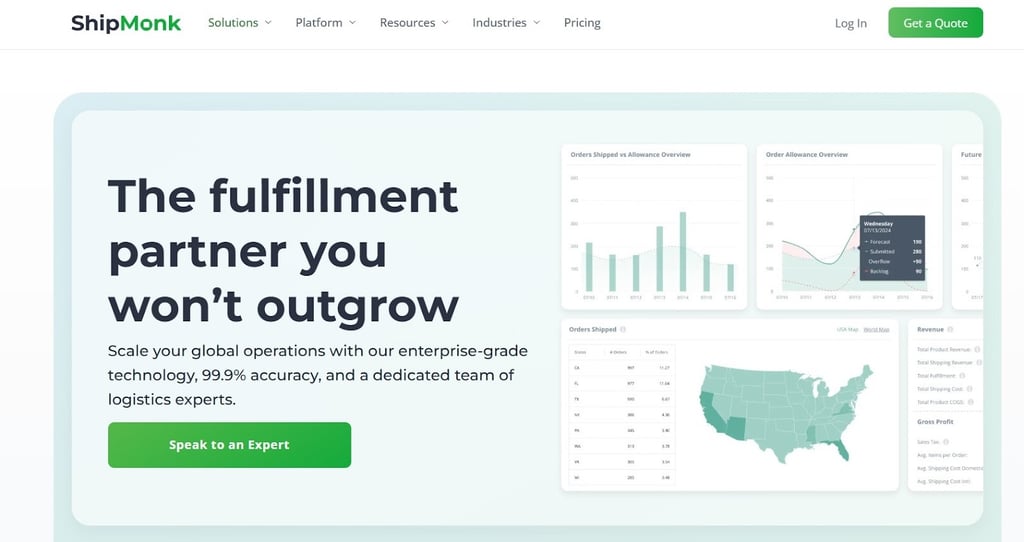
ShipMonk provides full-service 3PL Shopify capabilities designed specifically for ecommerce brands and subscription businesses.
| Feature | Details |
| Fulfillment Centers | 12+ locations (US, Canada, Mexico, Europe) |
| Average Delivery Time | 1-2 days in the US, local delivery internationally |
| Shopify Integration | App integration with proprietary dashboard |
| Performance Metrics | 99.9% picking accuracy |
| Specializations | Subscription boxes, crowdfunding, no minimums |
| Best For | Growing brands, subscription services, startups |
No Minimum Requirements
Unlike many 3PLs requiring minimum order volumes, ShipMonk accepts small businesses shipping 100+ orders monthly, startups testing product-market fit, seasonal businesses with variable volume, and crowdfunding campaigns with one-time fulfillment needs.
Subscription Box Expertise
ShipMonk specializes in subscription box fulfillment:
Recharge- and Bold-powered subscriptions are one of the most common Shopify use cases at scale, so it’s worth understanding what good looks like on the recurring side. Our complete guide to subscription box fulfillment covers the kitting, cohort-shipping, and forecasting work that separates the operational standouts.
- Kitting Services: Assemble boxes with multiple products per specifications
- Scheduled Shipping: Automate monthly or quarterly shipments
- Variant Management: Handle subscriber preferences and customizations
- Custom Packaging: Create branded unboxing experiences
Comprehensive Service Suite
ShipMonk handles beyond standard fulfillment:
- Photography: Product photography for listings and marketing
- Content Creation: Marketing materials and promotional inserts
- FBA Prep: Amazon inventory preparation services
- Consulting: 3PL consultants advising on operational optimization
Proprietary Technology
The ShipMonk Dashboard (“Stress-Less” platform) provides real-time inventory tracking across all locations, detailed order status visibility, performance metrics and reporting, transparent billing breakdowns, and multi-channel synchronization.
Happiness Engineers
ShipMonk’s support team provides dedicated account managers for personalized service, onboarding support guiding the setup process, billing transparency explaining all charges, and proactive problem-solving before issues escalate.
Global Expansion
With facilities in the US, Canada, Mexico, and Europe, ShipMonk supports international growth by providing local fulfillment, reducing shipping costs, handling customs and compliance requirements, and offering same-day shipping in multiple countries.
Ideal Customer Profile
Fast-growing Shopify brands seeking comprehensive solutions, including value-added services, find ShipMonk compelling. The best fulfillment options for Shopify subscription box businesses come from ShipMonk’s specialized kitting and recurring shipment capabilities.
The no-minimum policy makes ShipMonk accessible for startups while infrastructure scales to enterprise volumes. Compare options with our guide on 3PL vs FBA to make the right choice.
What Makes a Good 3PL for Shopify Businesses? (The Expert Checklist)
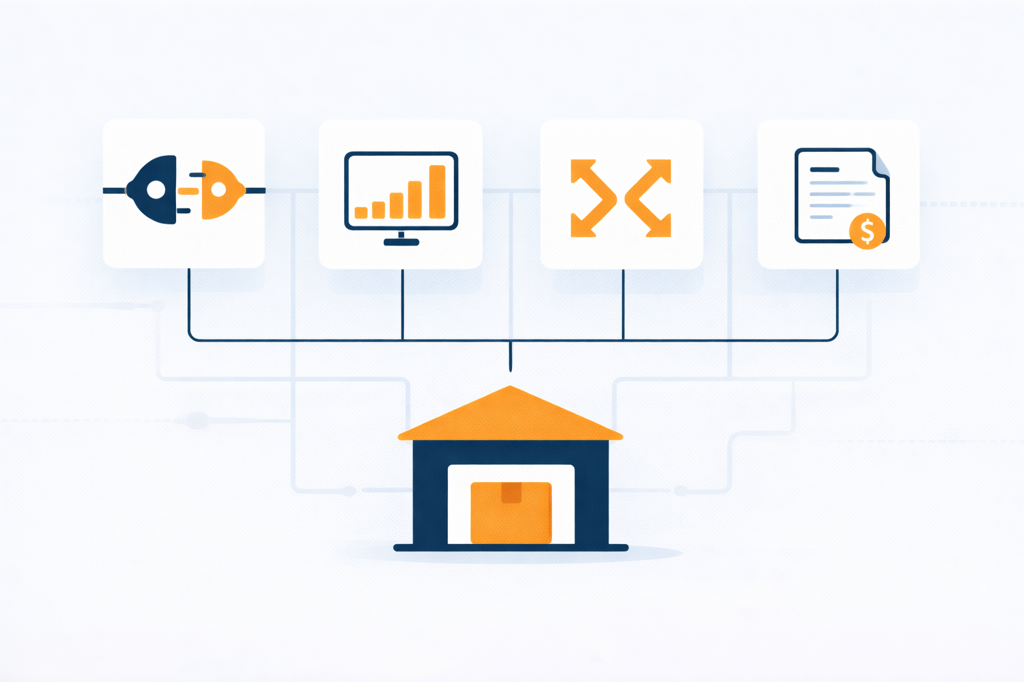
Selecting the right best fulfillment services for Shopify requires evaluating four critical capabilities.
Native Shopify Integration
Does it sync in real-time? Does it handle “Partial Fulfillments” (when one item is backordered)?
Orders should transmit within minutes of checkout. Inventory must sync bidirectionally; when the warehouse picks products, your Shopify store updates instantly. Test by placing orders at different times and checking if inventory updates appear immediately in the Shopify admin.
Strong systems handle partial fulfillments by shipping available items immediately and fulfilling backordered items automatically once inventory arrives.
Data & Analytics
Can the 3PL tell you which warehouse your Shopify customers are ordering from the most? (Crucial for inventory planning).
Quality providers offer warehouse-level insights showing where customers order from most frequently.
This drives intelligent inventory distribution, if 60% of orders ship from your East Coast facility, but you’re splitting inventory 50/50, you’re overstocking the wrong location. Modern 3PL warehouse management systems provide these critical insights.
Look for reorder point calculations, demand forecasting, turnover analysis, and safety stock recommendations.
Scalability & Breadth
Can they handle a BFCM (Black Friday Cyber Monday) spike of 10x your usual volume?
Black Friday and Cyber Monday generate 5-10x normal volume in five days. Evaluate logistics providers on maximum daily capacity, seasonal staffing plans, and historical peak performance.
For Shopify Plus brands those five days often define the year — and the operational work that holds up under that load starts months earlier. Our peak season fulfillment playbook walks through the staffing, inventory, and carrier moves required to keep promises during BFCM.
Quality 3PLs start preparation in August. As you grow, ensure your provider offers clear paths to add fulfillment centers without operational overhauls.
Transparent Billing
Watch out for “hidden” fees: receiving fees, pallet fees, packaging material markups, and account management fees.
Common hidden charges include receiving fees ($0.30-1.00/item), pallet storage ($5-40/pallet monthly), packaging markups, account management fees ($500-2,000/month), platform fees ($100-500/month), and peak surcharges (10-30% in Q4). Use our 3PL pricing template to compare providers accurately.
Request complete fee schedules in writing. Ask: “What fees beyond pick, pack, and storage will I encounter?” When comparing Shopify 3PL partners and evaluating pricing models, transparency is critical for accurate cost projections.
Shopify Fulfillment ROI Calculator
Compare your current fulfillment costs against 3PL pricing to calculate exact savings potential. Enter your monthly order volume, current cost per order, and estimated 3PL cost per order.
The calculator reveals your monthly savings, annual savings, and per-order cost difference.
Optional: Include one-time switching costs to see your payback period. Results show whether outsourcing delivers real savings or if you’re better off self-fulfilling. Even $2-3 per order savings compound to $24,000-36,000 annually at 1,000 monthly orders.
How to Prepare Your Shopify Store for Integration with a 3PL
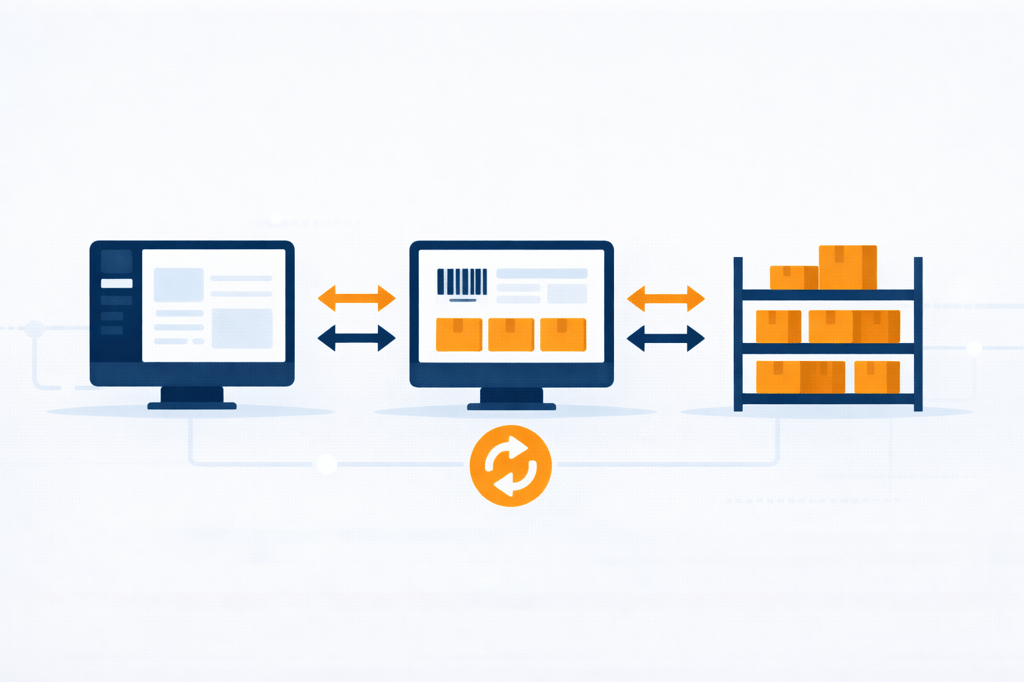
Successful partnerships begin with proper preparation. This framework ensures smooth integration from assessment through go-live.
Step 1: Assess Your Current System and Needs
Document your existing fulfillment operation comprehensively. Track monthly order volumes, product dimensions and weights, special handling requirements, and customer geographic distribution.
Conduct an inventory audit documenting every SKU’s dimensions, weight, units on hand, monthly sales velocity, and special storage requirements. This data feeds directly into the 3PL setup and determines initial storage needs.
Step 2: Choose the Right Provider
Provider selection determines partnership success. Match provider strengths to your specific needs based on the detailed reviews above.
Evaluate integration quality by requesting demos. Assess 3PL software capabilities, including inventory visibility, order tracking, and analytics tools. Understanding how much 3PL software costs helps budget appropriately. Review understanding fulfillment services to know which components you need.
Step 3: Configure Shopify Settings
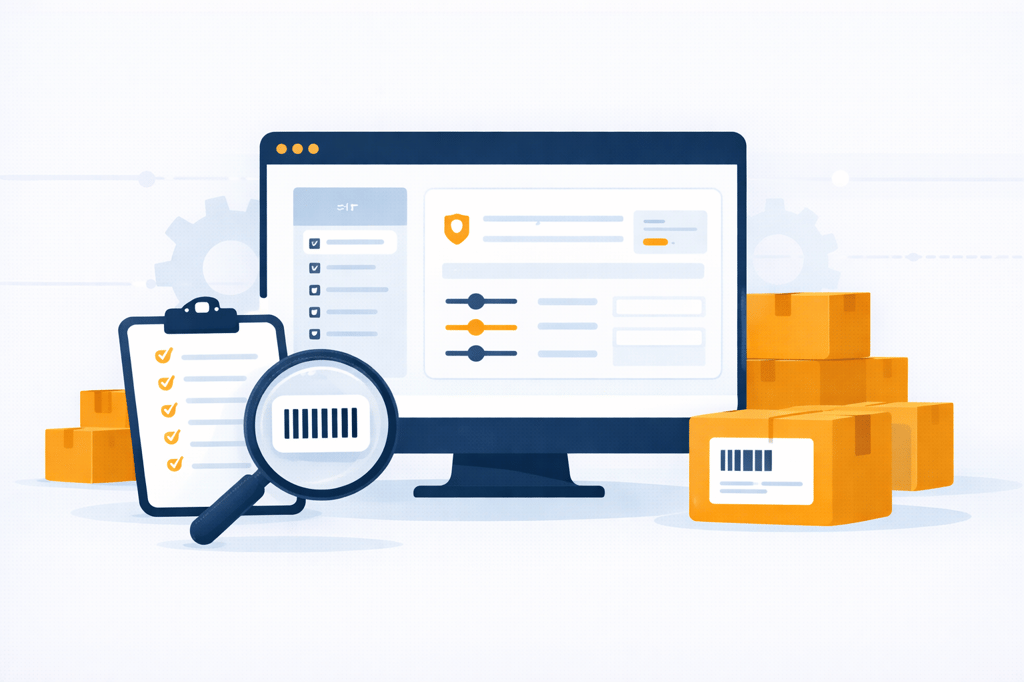
Prepare your Shopify store by configuring settings affecting fulfillment workflows. Navigate to Settings > Shipping and delivery to update shipping zones reflecting your 3PL’s capabilities.
Set up fulfillment services as a location in the Shopify admin. Organize product data systematically using consistent naming conventions. Ensure SKUs match exactly between your Shopify store and 3PL systems to prevent fulfillment errors.
Step 4: Integrate with 3PL Systems
Install your 3PL’s app from the Shopify App Store following the setup instructions carefully. Grant necessary permissions for order reading, inventory writing, and fulfillment service creation.
Map Shopify products to 3PL SKUs. Set up inventory synchronization schedules for real-time updates. Configure shipping methods and rates through your 3PL’s systems. Proper Shopify integration ensures seamless automated workflows.
Step 5: Test the Integration
Create test orders covering common scenarios: single-item orders, multi-item orders, orders with variants, and special handling requirements. Verify that each transmits correctly with accurate information.
Test inventory synchronization by simulating picks. Review the complete 3PL integration guide for detailed technical setup instructions and troubleshooting.
Step 6: Train Your Team
Train customer service on accessing order status, tracking shipments, and processing returns through the 3PL system. Educate operations teams on eccomerce inventory management, including reorder processes and receiving procedures.
Step 7: Monitor and Optimize
Establish KPIs tracking fulfillment performance: order accuracy, shipping speed, on-time delivery rates, and customer complaints. Review critical 3PL KPIs to track for comprehensive measurement.
Other Ways Shopify Businesses Handle Fulfillment
While professional 3PLs represent the ideal solution for most growing stores, several alternative models exist. Understanding the advantages of hiring a 3PL for your ecommerce business helps you make informed decisions.
Self-Fulfillment (FBM): Using Shopify Shipping Labels from Home/Office
Self-fulfillment means storing inventory in your own space and handling all packing and shipping yourself. Shopify provides integrated shipping tools that generate discounted labels from major carriers.
This approach offers maximum control but quickly becomes unsustainable. Packing orders consumes hours that could drive revenue. Most brands outgrow self-fulfillment between 100-300 monthly orders when fulfillment demands 20-40+ hours weekly.
When It Makes Sense: Starting out with under 50 monthly orders, testing new products before committing to outsourcing, or fulfilling custom items requiring personal involvement.
Dropshipping: Zero Inventory Held by the Merchant
Dropshipping eliminates inventory ownership entirely. Suppliers ship products directly to customers after you sell them. This minimizes financial risk but introduces challenges, including supplier dependency, long shipping times (often 2-4 weeks), and limited quality control.
Recommended For: Testing market demand before inventory investment or exploring niche markets without commitment. Kickstarter fulfillment may also require working with specialized 3PLs for crowdfunding campaigns.
Hybrid Model: Using a 3PL for Top-Sellers and Self-Fulfilling Niche/Custom Items
Hybrid fulfillment combines multiple approaches strategically. Send bestsellers representing 70-80% of volume to your 3PL while self-fulfilling custom or slow-moving items.
Clear order routing rules prevent confusion. Tag products in Shopify, indicating the fulfillment method. Configure workflows automatically routing standard products to your 3PL while flagging specialty items for manual fulfillment.
Making the Right Fulfillment Choice
Choosing between self-fulfillment and professional Shopify 3PL fulfillment solutions depends on order volume, product characteristics, and growth trajectory. Most brands transition to 3PLs at 300-500 monthly orders when fulfillment consumes excessive time.
Below 100 orders, self-fulfillment remains cost-effective. Above 500 orders, professional fulfillment delivers cost savings and a superior customer experience.
Request a quote from Fulfyld to explore how custom fulfillment transforms your operations, or review our 3PL fulfillment pricing to understand costs.
Contact us to discuss your specific requirements.
The best fulfillment services for Shopify enable sustainable growth while freeing your team to focus on building your brand.