
A business day in shipping is not simply Monday through Friday. It depends on carrier operating schedules, warehouse processing windows, and daily pickup cutoffs.
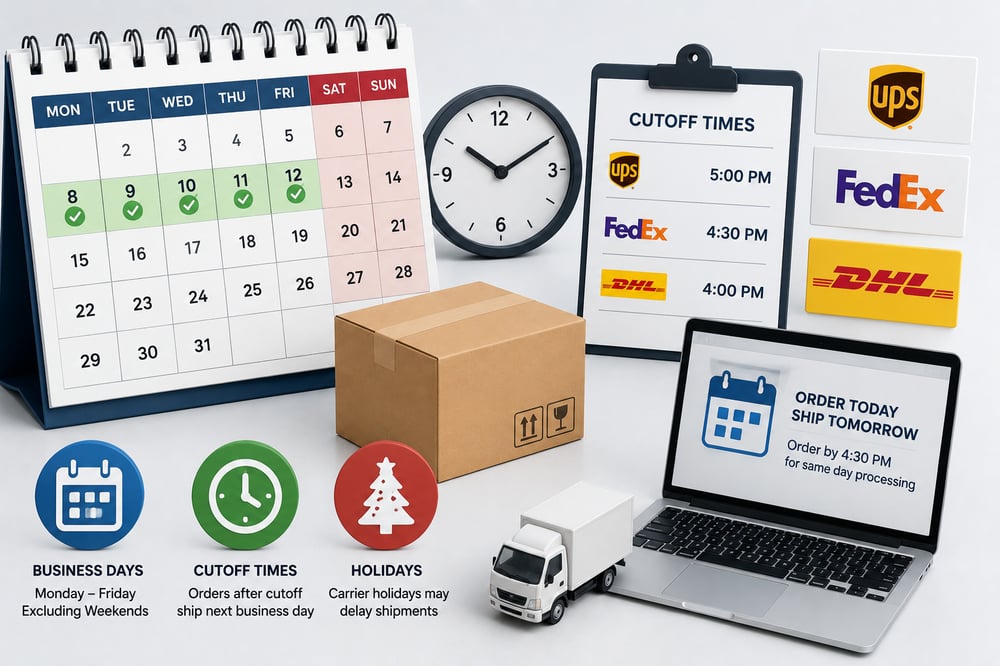
For example, if a customer places an order at 3:02 PM and your carrier cutoff is 3:00 PM, that order typically enters the next business day’s fulfillment cycle.
A quoted 5-business-day shipment can quickly become a 6-business-day delivery without any visible delay inside the order management system.
That distinction matters because customers measure delivery timelines from the moment they place an order, while carriers measure transit time from the moment a package enters their network.
How Business Days Work in eCommerce Shipping
A business day for shipping is any weekday, Monday through Friday, on which carriers and different types of fulfillment centers actively process, move, or deliver orders, excluding federal holidays.
When customers ask how long a business day is for shipping, the answer is straightforward: five days a week, holidays excluded.
This definition matters most at two moments: when setting delivery estimates at checkout and when holding a carrier accountable for a missed window.
eCommerce operators and teams managing 3PL services use business day counts to calculate transit times, schedule pick-and-pack cutoffs, and manage customer expectations before a complaint ever lands in the inbox.
Weekends are the exception that trips most brands up. Saturday and Sunday don’t count, even if a carrier physically moves a package on those days.
How Shipping Miscalculations Turn Into Lost Revenue and Support Load
Misreading what are considered business days for shipping doesn’t just create customer complaints; it creates compounding operational failures.
When your team quotes a 3-day delivery window without accounting for a federal holiday mid-week, you’ve already lost control of the customer experience before the order leaves the warehouse.
The financial exposure is real. WISMO (“Where is my order?”) calls spike 30-40% during peak periods like Black Friday when brands underestimate transit time by even one business day.
Each support ticket costs an average of $8-12 to resolve, a figure that scales fast across thousands of orders.
For brands managing subscription box fulfillment, renewal cycles are especially sensitive. A missed ship date by one business day can push delivery past a subscriber’s billing date, triggering cancellations that compound into churn.
- Inaccurate business day counts inflate carrier surcharge exposure during holiday blackout windows
- A dedicated account manager catches these calendar gaps before they reach your customers
- Logistics partners with real-time carrier integrations, flagging non-business days automatically at the order level
How Carriers Count Business Days
Most carriers and 3PLs follow the same core process, but the details at each stage determine whether your customer gets their order on time.
- Order cutoff triggers the fulfillment window. Your OMS timestamps the order against the warehouse’s daily cutoff, typically between 12:00 PM and 3:00 PM local time. Orders placed after the cutoff don’t enter the pick queue until the next business day.
- The WMS assigns pick tasks and generates a shipment label. The label creation step locks in the ship date that the carrier uses to calculate transit days.
- The transit clock doesn’t start when you print a label. It starts when the carrier physically scans the package into their system for the first time. So, if your team prints 50 labels at 11 PM on a Monday but the carrier doesn’t scan them until Tuesday morning, the clock starts on Tuesday.
- Transit days skip weekends and federal holidays completely. A 3-day ground shipment picked up on Thursday won’t show up on Sunday; it’s actually scheduled for Tuesday because the clock stops for the weekend. And if Monday happens to be Memorial Day, that package isn’t arriving until Wednesday.
- Delivery confirmation closes the business day window. Final-mile carriers log the delivery timestamp displayed on customer-facing tracking systems.
Best Practices for Shipping Around Business Days
- Set your order cutoff time at least 2 hours before your carrier pickup window to avoid same-day misses.
- Audit your carrier’s holiday schedule every January and update your store’s shipping calendar before peak season hits.
- Avoid promising next-day or 2-day delivery windows on orders placed after Friday at noon; those won’t ship until Monday at the earliest.
- Display estimated delivery dates, not just transit times, at checkout so customers aren’t calculating business days themselves.
- Flag orders placed on federal holidays in your order management system the same day they come in, not at the end-of-week review.
- Confirm your 3PL’s processing cutoffs in writing each quarter, since pickup windows shift with volume and carrier contract changes.
Improve Delivery Accuracy by Counting Business Days Correctly
Business days in shipping are not just weekdays on a calendar. They depend on carrier operating schedules, holiday closures, warehouse processing times, and daily cutoff windows.
Missing even one of those variables can delay delivery estimates, increase WISMO tickets, and create unnecessary customer frustration.
Talk to a Fulfyld specialist about your order flow, carrier cutoffs, and how to eliminate business-day confusion so your delivery promises actually match real-world fulfillment timelines.