
Ecommerce brands face strict delivery expectations, rising logistics costs, and constant competition.
As order volumes grow, many online sellers rely on outsourced logistics partners to keep operations efficient. The core benefits of using a 3PL provider for online business extend well beyond storage; they provide the labor, technology, and infrastructure needed to scale sustainably.
By partnering with a third-party logistics provider, ecommerce businesses strengthen fulfillment speed, improve inventory visibility, and operate with far greater flexibility. These benefits support stronger growth without the cost and complexity of running logistics in-house.
Main 3PL Benefits Powering Ecommerce Success
Ecommerce logistics shifts fast, with demand spikes and inventory swings adding pressure. A 3PL fulfillment partner helps brands stay efficient by managing these challenges with speed and accuracy, offering far more value than basic warehousing.
1. Cost Efficiency and Financial Stability
Managing ecommerce logistics internally requires large upfront investments in warehousing, staffing, technology, and shipping contracts. Outsourcing removes these costs and replaces them with predictable, usage-based pricing.
It helps ecommerce brands save money through:
- Lower overhead, since you avoid facility leases, equipment, and labor costs
- Volume-based carrier discounts, providing more competitive shipping rates
- Reduced packing and labor expenses, thanks to optimized workflows
These savings allow brands to redirect resources toward growth areas such as marketing, product development, or customer experience, rather than tying up capital in infrastructure.
2. Scalability and Operational Flexibility
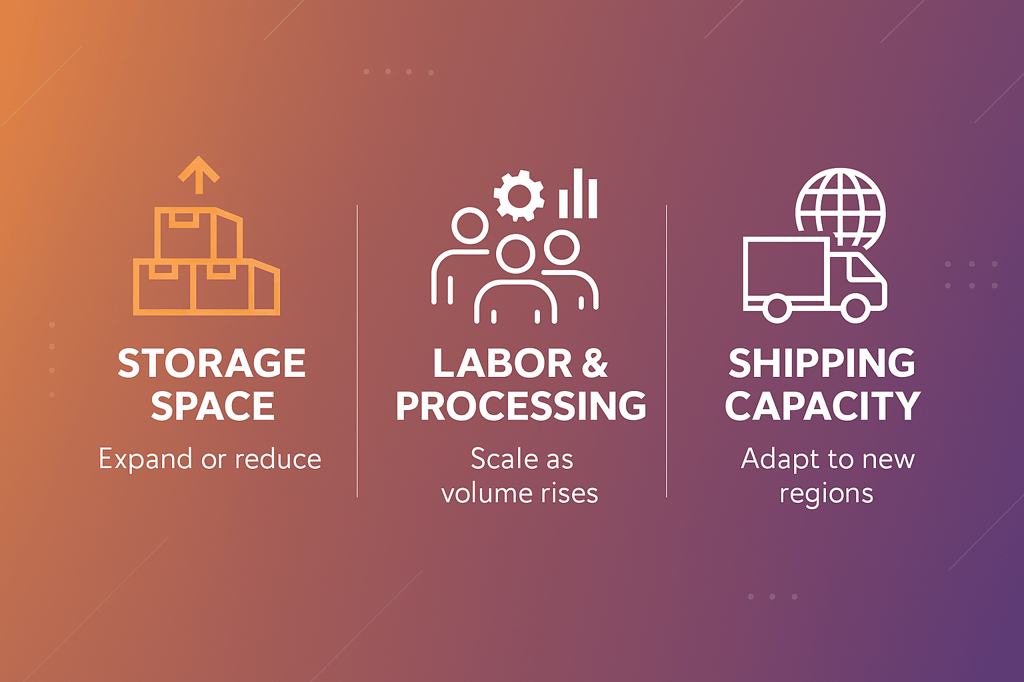
Ecommerce order volume is rarely consistent. Seasonal spikes, product launches, promotions, and viral demand all place pressure on fulfillment systems. An outsourced logistics model offers built-in flexibility that internal teams struggle to match.
With outsourced operations, brands can seamlessly:
- Expand or reduce storage space without long-term contracts
- Scale labor and processing capacity as order volume rises
- Adapt shipping capabilities when new regions or product lines are added
This agility is especially important during Q4, flash sales, or restock cycles, where sudden volume increases require fast response.
3. Expertise, Technology, and Operational Knowledge
Ecommerce logistics requires technical knowledge across warehousing, compliance, packaging, carrier routing, and fulfillment technology. Logistics operations teams bring deep industry expertise supported by advanced systems that many brands cannot build alone.
Strong logistics infrastructure supports ecommerce brands with:
- Technology integration, syncing your store with WMS systems
- Compliance knowledge, reducing mistakes in packaging, labeling, and shipping
- Optimized workflows, such as faster picking processes and slotting accuracy
- Risk reduction, thanks to experienced logistics oversight and problem-solving
This expertise results in fewer errors, faster fulfillment, and more predictable operations.
4. Enhanced Customer Experience and Order Accuracy
Customer expectations in ecommerce revolve around speed, transparency, and reliability. Poor fulfillment performance quickly leads to negative reviews and abandoned carts.
A strong logistics operations setup customer satisfaction through processes designed specifically for accuracy and speed.
A strong ecommerce delivers:
- Faster shipping with optimized carrier selection
- Higher order accuracy, reducing returns and complaints
- Improved tracking visibility, strengthening the post-purchase experience
Happy customers convert more, return more often, and share positive experiences, directly supporting brand growth.
When Should an E-commerce Brand Hire a 3PL?
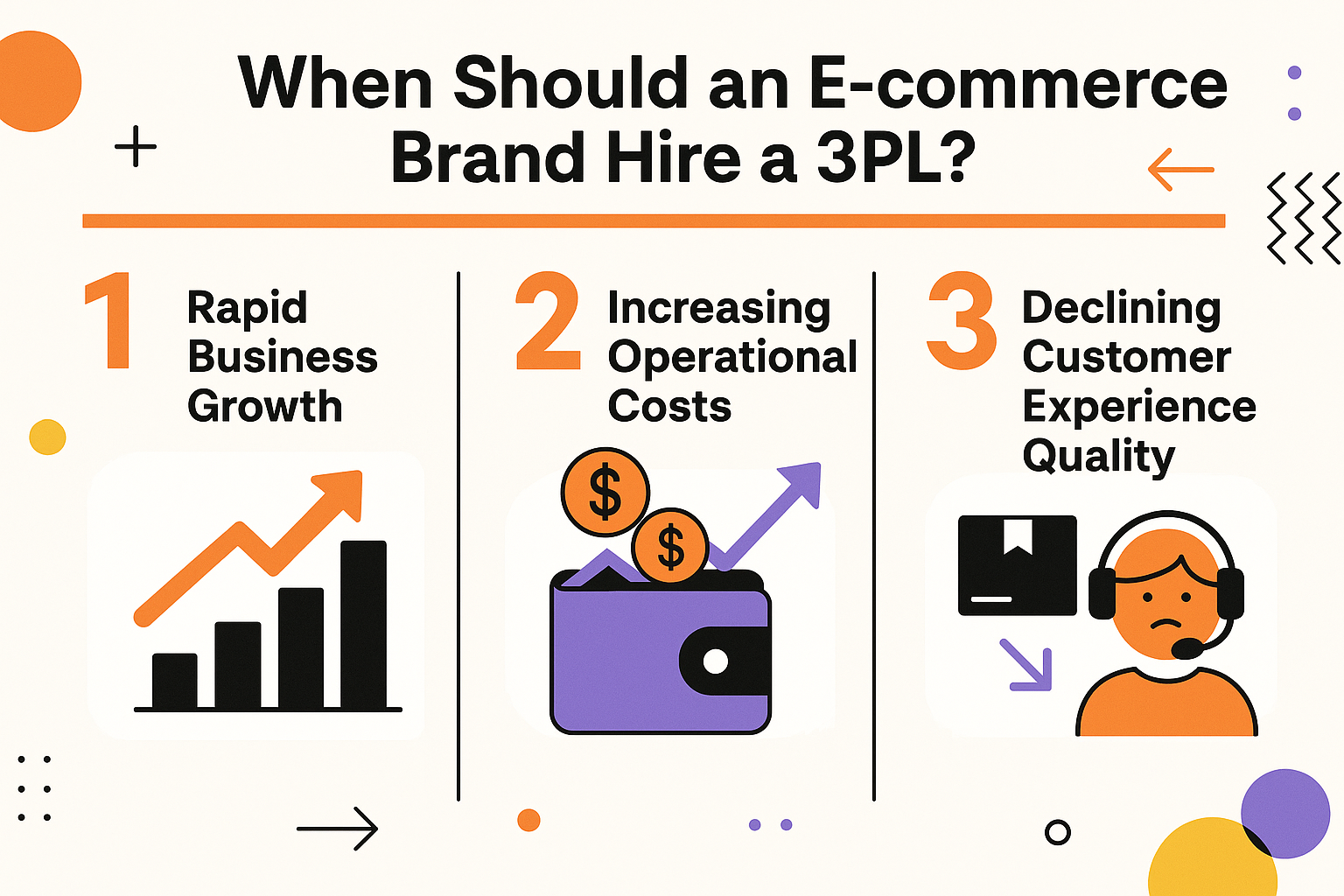
Hiring one becomes valuable when an ecommerce brand reaches a stage where internal operations can no longer keep pace with demand, customer expectations, or operational complexity.
Recognizing these moments early helps prevent delays in fulfillment, occupational burnout, and inconsistent customer experiences.
1. Rapid Business Growth
When order volumes rise quickly, internal teams often struggle to keep up with the sudden increase in fulfillment demands. This can lead to slower processing times, operational bottlenecks, and a decline in overall efficiency.
Partnering with an external logistics team provides scalable support, additional warehouse capacity, and expert fulfillment systems that help maintain smooth operations during periods of accelerated growth without overwhelming your internal resources.
2. Increasing Operational Costs
As an ecommerce brand expands, costs related to storage, staffing, packaging, and shipping can begin to climb beyond manageable levels.
When these expenses start cutting into profit margins or requiring frequent reinvestments, outsourcing to logistics professionals becomes a practical solution.
With established infrastructure and optimized processes, it can stabilize operational costs and help brands avoid the financial strain of building or expanding their own logistics facilities.
3. Declining Customer Experience Quality
Slow deliveries, inaccurate orders, or limited shipping options signal that your fulfillment workflow is under strain. It can enhance service quality by improving speed, accuracy, and overall delivery reliability.
When your internal team begins spending more time troubleshooting fulfillment issues than focusing on core growth activities, it’s a strong indication that hiring a 3PL may be beneficial.
This shift often signals that your operational load has exceeded internal capacity, making it difficult to maintain efficiency, consistency, and customer satisfaction without external support.
How to Compare 3PL Advantages Before Hiring One?
Evaluating different providers requires a clear understanding of which strengths matter most to your business.
By examining capabilities, technology, service levels, and cost structures, ecommerce brands can make informed decisions that align with their long-term goals.
1. Technology and System Integration
It should offer seamless integration with your ecommerce platform, real-time inventory visibility, and automation tools that simplify order management.
Integration depth varies most across providers when your storefront is Shopify, which serves the largest single share of growth-stage DTC brands. Our complete guide to Shopify order fulfillment covers the integration architecture and provider trade-offs specific to that platform.
Advanced reporting, reliable syncing, and stable system performance help maintain efficient workflows and informed decision-making.
This level of technological alignment ensures smoother workflows, reduces manual work, and gives your team the visibility needed to make informed, fast-moving decisions.
2. Service Capabilities and Scalability
Different providers offer varying levels of support, from basic picking and packing to advanced omnichannel fulfillment. Assess whether their services can grow alongside your brand.
Compare providers by checking whether they:
- Offer warehousing and fulfillment solutions that scale with seasonal or long-term demand
- Provide value-added services such as kitting, custom packaging, or returns processing
- Support multiple sales channels across ecommerce, retail, and wholesale
3. Pricing Structure and Cost Transparency
Pricing models differ widely, so it’s important to understand storage fees, pick-and-pack costs, shipping rates, and any unexpected charges. A transparent provider helps you forecast expenses more accurately.
Evaluate pricing differences by looking at:
- The clarity and consistency of their rate breakdowns
- How costs change as your monthly order volume fluctuates
- Whether extra fees apply to storage, returns, or special handling
4. Geographic Reach and Delivery Speeds
A provider with multiple warehouse locations can reduce shipping times and costs while increasing delivery reliability. Distribution network strength plays a major role in customer satisfaction.
Assess geographic benefits by reviewing:
- How many fulfillment centers does the provider operate
- Whether their locations align with your key customer regions
- Their ability to support international fulfillment if needed
5. Reputation, Reliability, and Client Support
Look for a provider with strong reviews, dependable service levels, and responsive customer support. Reliability is essential for maintaining smooth operations during peak seasons or unexpected surges.
How Logistics Providers Adapt to Ecommerce Growth and Fulfillment Pressure
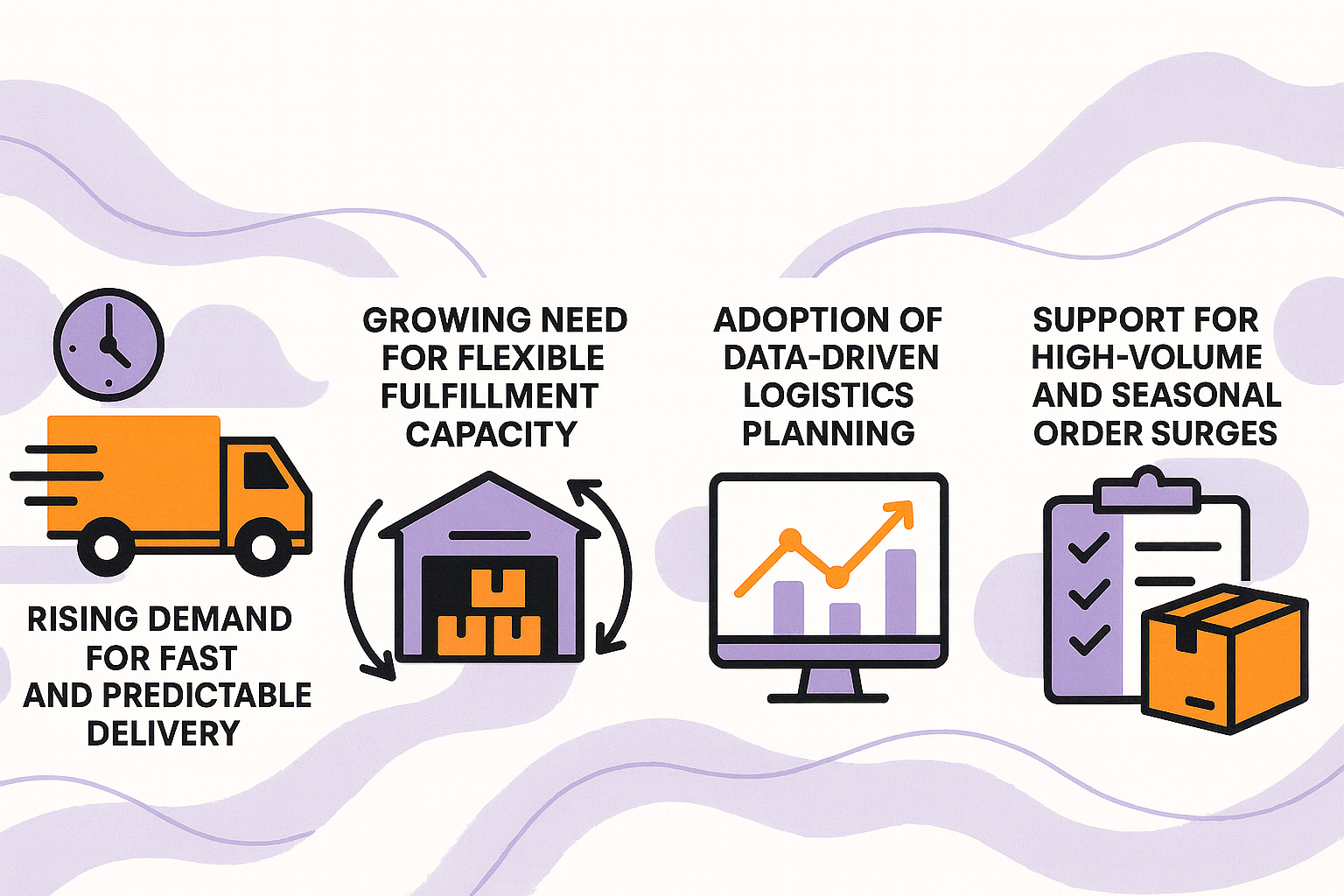
As e-commerce expands, logistics demands intensify, requiring systems that can keep up with high expectations and volume spikes. These providers now play a central role in supporting modern commerce.
Rising Demand for Fast and Predictable Delivery
Shoppers expect reliable shipping windows and real-time updates, and partners strengthen delivery consistency through integrated transport systems across regions.
- Delivery speed improves using optimized carrier networks.
- Predictability increases with real-time shipment monitoring.
- Customer trust grows through accurate delivery promises.
Growing Need for Flexible Fulfillment Capacity
To support rapid changes in order volume, businesses rely on companies that offer adaptive fulfillment capacity across multiple locations and workflows.
Peak seasons become easier to manage when businesses rely on expansion-ready resources that absorb sudden demand, while inventory adjusts quickly through flexible warehouse layouts designed for rapid movement.
Fulfillment also remains stable thanks to scalable operational support that keeps processes consistent even during volume spikes.
Adoption of Data-driven Logistics Planning
E-commerce success requires informed decision-making, and logistics partners provide access to analytics-driven insights that optimize forecasting and supply strategies.
- Algorithms predict demand with data-backed accuracy.
- Route planning improves via transport performance metrics.
- Inventory allocation benefits from predictive modeling tools.
Support for High-volume and Seasonal Order Surges
They are equipped to absorb spikes in activity, helping brands maintain smooth operations during heavy sales periods using high-capacity systems built for scale.
- Order surges stabilize with expanded fulfillment staffing.
- Stock levels stay controlled via volume-responsive inventory.
- Delivery delays shrink due to burst-capable processing lanes.
Strengthening Your E-commerce Advantage With the Right Partner
Choosing a well-matched partner helps brands improve service quality, reduce inefficiencies, and expand into new markets with stronger logistics alignment designed for long-term growth.
The benefits of 3PLs include tools and expertise needed to streamline fulfillment, enhance delivery confidence, and support strategic expansion, ultimately helping businesses stay competitive in a fast-evolving e-commerce ecosystem.