
A bubble mailer is a self-sealing shipping envelope lined with bubble cushioning, designed to protect lightweight products during transit without the cost of a corrugated box. The outer shell is kraft paper or poly film; the inner lining is bonded bubble wrap, typically 3/16″ or 5/16″ deep.
Is a Bubble Mailer Considered an Envelope or a Package?
USPS classifies bubble mailers as large envelopes (flats) if they’re uniform in thickness, flexible, and under 3/4″ thick. Once a product creates a lump or rigid point, it’s reclassified as a package, and package rates run 30–60% higher than flat rates.
- A folded t-shirt in a bubble mailer typically qualifies as a flat
- A phone case with raised edges usually gets bumped to package pricing
- A poly bubble mailer under 1 oz empty adds roughly 0.3–0.5 oz to shipment weight
Where Bubble Mailers Fit in a Fulfillment Operation
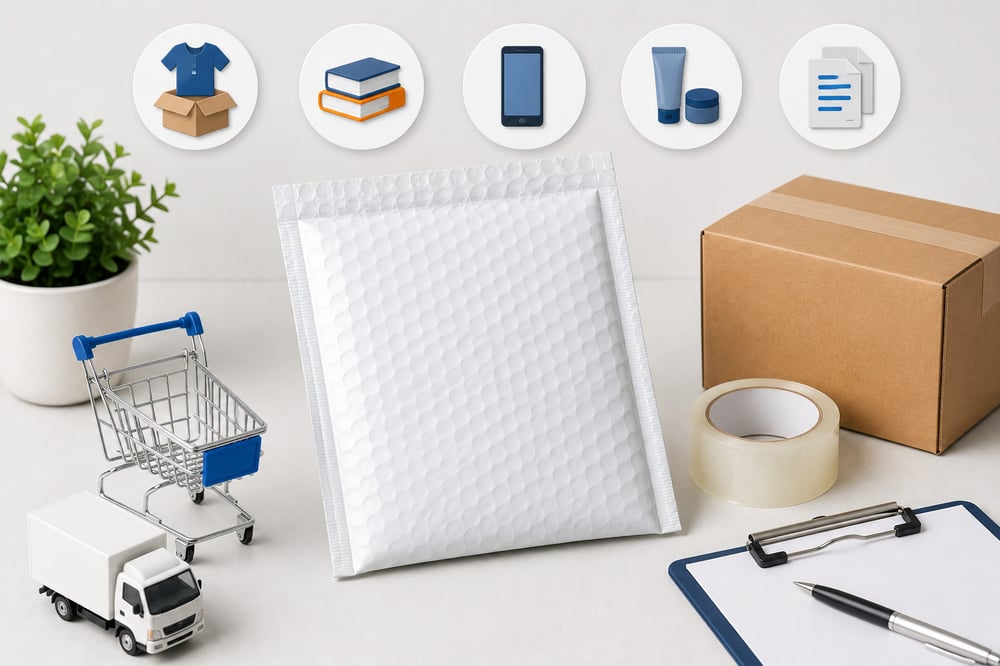
Bubble mailers suit products needing light protection but not box costs, such as jewelry, cosmetics, folded apparel, and media. A standard 6″x10″ kraft bubble mailer costs $0.18–$0.35 per unit at volume, versus $0.80–$1.50 for a comparable corrugated box.
They won’t protect anything that can crack or compress under moderate pressure. That’s a scope boundary to build into your packaging matrix from day one.
What Bubble Mailers Are Used for
A bubble mailer is a shipping bag lined with bubble wrap cushioning bonded to the inner surface, giving you protective padding without the bulk of a rigid box. You get the flexibility of an envelope with enough impact resistance to protect lightweight, non-fragile products.
eCommerce brands use them for jewelry, phone cases, cosmetics, and small electronics, anything needing more protection than a poly mailer but not justifying the dimensional weight cost of a corrugated box.
3PLs stock them in volume because they’re faster to pack than boxes and cheaper to ship at comparable weights.
One thing most guides miss: USPS classifies a bubble mailer as an envelope only when it stays under 3/4 inch thick when sealed. Exceed that, and it’s reclassified as a package, changing your postage rate entirely.
Why Bubble Mailers Matter for Your Fulfillment Operation
Choosing the wrong mailer isn’t a minor inconvenience.
Damage rates for improperly packaged soft goods and small electronics run between 3% and 11%, and every damaged shipment generates a WISMO call, a replacement order, and a return label.
During peak periods like Black Friday or a subscription-box renewal cycle, that exposure multiplies fast. A 3PL fulfillment service processing 10,000 units in a single week can’t absorb a 5% damage rate without it showing up directly in customer acquisition costs and churn.
Bubble mailers also affect dimensional weight billing. Because they stay relatively flat under 1 inch in thickness, many carriers classify them as envelopes rather than packages, which drops the rate tier.
That distinction alone can reduce per-unit shipping costs by $0.40 to $1.20, depending on zone and carrier contract.
Your dedicated account manager should be auditing this regularly; shipping packaging misclassification is one of the most recoverable cost leaks in a growing eCommerce brand’s fulfillment spend.
How a Bubble Mailer Actually Works
A bubble mailer is a packaging system with a specific sequence of decisions that determines whether your product arrives intact or in pieces.
- Size selection against product dimensions: Measure the item at its longest, widest, and thickest points, then match those to an interior cavity with at least 1 inch of clearance on each side.
- Product placement and void fill: Place the item centered, face down if fragile. If it doesn’t fill the cavity, wrap it in tissue or kraft paper to prevent shifting without adding meaningful weight.
- Sealing the peel-and-stick strip: Press firmly for 5–10 seconds to create a permanent bond. Paper bubble mailers require moisture-activated sealing or a secondary strip; skipping this step is the leading cause of in-transit openings.
- Weight capture and carrier classification: Carriers classify a sealed bubble mailer as either a large envelope or a package based on rigidity and thickness. Mailers exceeding 3/4″ thickness are rated as a package, changing the postage tier entirely.
The most common failure point isn’t the bubble liner; it’s incorrect size selection. Overstuffed mailers breach the seal; undersized mailers compress the cushioning and defeat its purpose.
Reduce Shipping Costs Without Damaging More Orders
Choosing the right mailer is one decision. Executing it consistently across thousands of orders per month is another problem entirely, and where most growing brands hit a wall.
Don’t underestimate your packaging weight.
A seemingly harmless bubble mailer that’s just 0.5 oz heavier than necessary can push a 4.5 oz shipment into a higher USPS weight tier, instantly adding an extra $0.24 to every single package. At 500 orders a month, that’s $120 straight out of your pocket. Ouch.
Talk to a Fulfyld specialist about packaging, carrier selection, and fulfillment that scales with your volume.