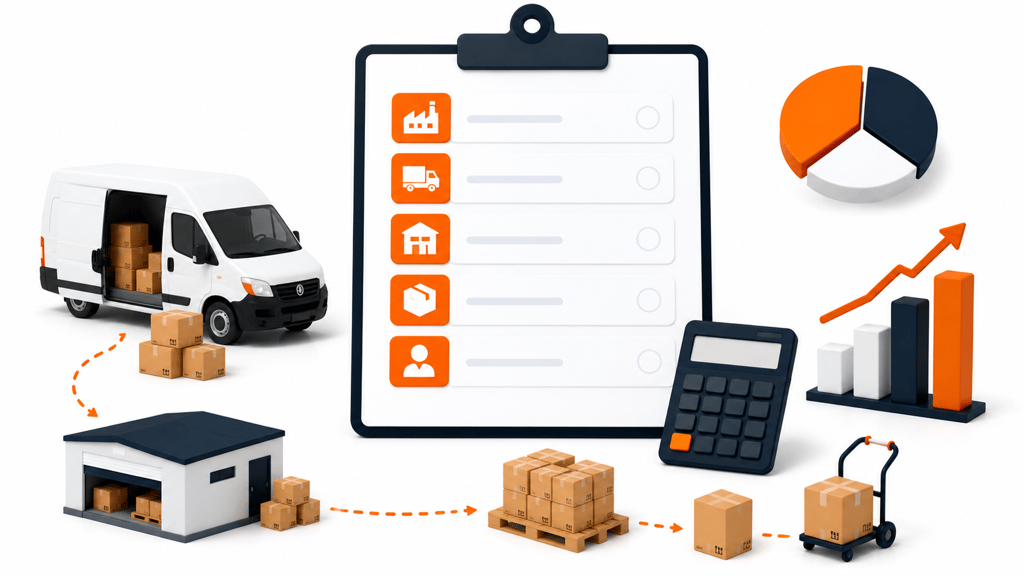
Cost Per Unit Calculator: Instantly Uncover the True Cost Behind Every Product You Sell

Trying to figure out exactly how much each product really costs you to produce or acquire? Our Cost Per Unit Calculator gives you instant clarity by breaking down your total expenses into an accurate cost-per-item figure.

Whether you’re pricing for profit, managing production, or analyzing supplier quotes, this tool helps you avoid underpricing, catch hidden costs, and make sharper business decisions.

Use it now to uncover your true unit economics and confidently price your products for sustainable growth.

Cost Per Unit Calculator | Fulfyld
Cost Per Unit Calculator
Optimize Your eCommerce Fulfillment Costs
1 Essential Information
2 Additional Costs (Optional)
📊 Your Cost Analysis Results
Cost Per Unit: $0.00
💰 Cost Breakdown
Base Cost Per Unit: $0.00
Shipping Cost Per Unit: $0.00
Storage Cost Per Unit: $0.00
Handling Fee Per Unit: $0.00
Total Additional Costs: $0.00

Maximize Your Profit Margins: Complete Cost Per Unit Calculator Breakdown + Real-World Examples

Here’s an in-depth exploration of each component in the Cost Per Unit Calculator, featuring practical scenarios and strategic insights to help you optimize your e-commerce fulfillment costs and boost profitability across your product lines.

1. Total Cost Input (Essential)

This field captures your complete production investment before any additional fulfillment expenses, representing the foundational cost structure that determines your baseline unit economics.

Examples:

Fashion E-commerce Brand:

  • Total Cost: $15,000 for 500 units
  • Includes: Manufacturing, materials, quality control
  • Product: Premium denim jackets

Supplement Company:

  • Total Cost: $8,500 for 1,000 bottles
  • Includes: Ingredients, bottling, labeling, compliance testing
  • Product: Protein powder supplements

Tech Accessories Business:

  • Total Cost: $22,000 for 2,000 units
  • Includes: Components, assembly, and packaging design
  • Product: Wireless earbuds

Why It Matters: Total cost establishes your profit foundation and reveals manufacturing efficiency, directly impacting your competitive pricing strategy and market positioning.

2. Number of Units Input (Essential)

This component defines your production volume, which dramatically influences economies of scale and determines the distribution of fixed costs across your inventory.

Examples:

Small Batch Artisan Business:

  • Units: 200 handcrafted items
  • Strategy: Premium pricing for limited quantities
  • Market: Luxury gift segment

Mid-Scale E-commerce Operation:

  • Units: 2,500 products per batch
  • Strategy: Balanced volume for market testing
  • Market: Mainstream consumer products

Large Volume Retailer:

  • Units: 25,000 items per production run
  • Strategy: Maximum cost efficiency through scale
  • Market: Mass market distribution

Why It Matters: Unit volume directly affects your per-unit cost structure and determines your ability to compete on price while maintaining healthy margins.

3. Shipping Cost Input (Optional Enhancement)

This captures all transportation expenses from your supplier to the fulfillment center, including international freight, customs, and domestic delivery to your warehouse.

Examples:

International Sourcing:

  • Shipping: $3,200 for container shipment
  • Origin: Manufacturing facility in Asia
  • Destination: US fulfillment center

Domestic Manufacturing:

  • Shipping: $850 for truck delivery
  • Origin: Local production facility
  • Destination: Regional warehouse

Drop-shipping Model:

  • Shipping: $1,200 for direct-to-consumer logistics
  • Strategy: Supplier ships directly to customers
  • Benefit: Reduced inventory holding costs

Why It Matters: Shipping costs significantly impact landed cost per unit and affect your ability to offer competitive pricing and fast delivery options.

4. Storage/Warehouse Cost Input (Optional Enhancement)

This component accounts for ongoing inventory holding expenses, including warehouse rent, utilities, insurance, and inventory management systems.

Examples:

3PL Partnership:

  • Storage Cost: $2,400 monthly
  • Service: Professional warehouse management
  • Benefits: Scalability and expertise

Self-Managed Warehouse:

  • Storage Cost: $4,800 monthly
  • Facility: Owned/leased warehouse space
  • Control: Direct inventory oversight

Hybrid Storage Strategy:

  • Storage Cost: $1,800 monthly
  • Approach: Combination of 3PL and owned space
  • Flexibility: Seasonal capacity adjustment

Why It Matters: Storage costs accumulate over time and directly impact your carrying costs, affecting cash flow and inventory turnover strategies.

5. Handling Fee Per Unit Input (Optional Enhancement)

This field captures the pick, pack, and processing costs associated with each individual order, representing the labor and operational expenses of order fulfillment.

Examples:

Complex Product Fulfillment:

  • Handling Fee: $2.50 per unit
  • Requirements: Special packaging, assembly, and quality checks
  • Product Type: Electronics or fragile items

Standard Product Processing:

  • Handling Fee: $0.75 per unit
  • Requirements: Basic picking and standard packaging
  • Product Type: Books, clothing, simple items

Premium White-Glove Service:

Why It Matters: Handling fees accumulate with every sale and directly impact your fulfillment scalability and customer experience delivery costs.

6. Selling Price Per Unit Input (Profit Analysis Feature)

This optional field enables comprehensive profit analysis by comparing your total cost structure against anticipated revenue per unit.

Examples:

Premium Positioning Strategy:

  • Selling Price: $89.99 per unit
  • Cost Structure: $31.50 total cost per unit
  • Margin: 65% gross profit margin

Competitive Market Pricing:

  • Selling Price: $24.99 per unit
  • Cost Structure: $11.75 total cost per unit
  • Margin: 53% gross profit margin

Value-Based Pricing:

  • Selling Price: $149.99 per unit
  • Cost Structure: $45.25 total cost per unit
  • Margin: 70% gross profit margin

Why It Matters: Selling price analysis reveals your profit potential and validates your pricing strategy against market positioning and competitive landscape.

7. Calculate Cost Per Unit Button

This triggers instant computation of your complete unit economics using industry-standard cost allocation methods for comprehensive financial analysis.

Calculation Process:

  • Computes the base cost per unit from the total cost and volume
  • Allocates shipping and storage costs across unit quantity
  • Adds handling fees for a complete cost picture
  • Provides profit analysis when the selling price is included

Why It Matters: Immediate calculation enables real-time pricing decisions, profit optimization, and strategic planning for business growth.

8. Cost Breakdown Display

The calculator provides detailed cost component analysis, revealing exactly how each expense category contributes to your final unit cost.

Example Results and Strategic Insights:

Optimized Cost Structure:

  • Base Cost: $8.50, Shipping: $1.25, Storage: $0.75, Handling: $0.50
  • Total Unit Cost: $11.00
  • Interpretation: Well-balanced cost distribution with efficiency opportunities

Shipping-Heavy Structure:

  • Base Cost: $12.00, Shipping: $4.50, Storage: $0.80, Handling: $0.70
  • Total Unit Cost: $18.00
  • Interpretation: High shipping costs require volume optimization or supplier negotiations

Complete Business Analysis Example

Scenario: Direct-to-Consumer Fitness Equipment Brand

Input Values:

  • Total Cost: $75,000 (for 1,500 resistance band sets)
  • Shipping Cost: $4,200 (container from overseas manufacturer)
  • Storage Cost: $1,800 (monthly 3PL warehouse fees)
  • Handling Fee: $1.25 per unit (pick, pack, branded packaging)
  • Selling Price: $79.99 (premium positioning strategy)

Calculation Results:

  • Base Cost Per Unit: $50.00
  • Shipping Per Unit: $2.80
  • Storage Per Unit: $1.20
  • Handling Per Unit: $1.25
  • Total Cost Per Unit: $55.25
  • Profit Per Unit: $24.74
  • Profit Margin: 30.9%

Strategic Insights:

  • Healthy profit margins supporting sustainable growth
  • Shipping costs represent an optimization opportunity for future orders
  • Storage efficiency enables cash flow management
  • Handling fees justify a premium customer experience

Optimization Recommendations:

  • Negotiate volume discounts for shipping on larger orders
  • Explore regional fulfillment centers to reduce storage costs
  • Test higher-volume production runs to reduce base costs
  • Evaluate premium pricing elasticity for margin expansion

This comprehensive cost analysis empowers e-commerce businesses to make data-driven decisions about pricing, sourcing, fulfillment strategies, and profit optimization while maintaining competitive market positioning.

Slash Your Costs Like a Pro: Game-Changing Strategies Every Business Owner Must Know

Transform your bottom line with these battle-tested cost reduction techniques that successful businesses use to maximize profitability. Each strategy can dramatically impact your unit economics when implemented correctly.

Negotiating Better Supplier Terms

Smart negotiation goes beyond asking for lower prices – it’s about creating win-win partnerships that reduce your costs while strengthening supplier relationships.

  • Payment terms leverage: Offer faster payment cycles in exchange for 2-5% discounts
  • Volume commitments: Guarantee annual purchase quantities for tiered pricing benefits
  • Exclusive partnerships: Become a preferred customer for priority pricing and terms
  • Multi-year contracts: Lock in favorable rates while protecting against price increases
  • Flexible delivery schedules: Reduce supplier logistics costs through consolidated shipments

Pro Tip: Always negotiate with multiple suppliers simultaneously – competition drives better deals, and backup options protect your supply chain.

Optimizing Order Quantities for Economies of Scale

Finding your sweet spot between cash flow and cost savings requires strategic thinking about inventory levels and purchasing power.

  • Break-even analysis: Calculate optimal order sizes using economic order quantity (EOQ) formulas
  • Tier-based pricing: Identify volume thresholds where unit costs drop significantly
  • Group purchasing: Combine orders with other businesses for bulk pricing advantages
  • Seasonal timing: Place larger orders during supplier slow periods for better rates
  • Storage cost balance: Ensure bulk savings exceed additional warehousing expenses

Pro Tip: Use the 80/20 rule – focus bulk ordering on your top 20% of products that generate 80% of revenue for maximum impact.

Alternative Packaging Solutions

Packaging often represents 10-30% of product costs, making it a prime target for optimization without compromising product protection or brand appeal.

  • Material substitution: Switch to cost-effective alternatives like biodegradable or recycled materials
  • Size optimization: Reduce dimensional weight charges through custom-fit packaging designs
  • Multi-product packaging: Create combo packs to reduce per-unit packaging costs
  • Supplier packaging: Negotiate direct-to-consumer packaging from manufacturers
  • Minimalist design: Eliminate unnecessary packaging elements while maintaining brand standards

Pro Tip: Test packaging changes with small batches first – customer perception of quality can be more valuable than cost savings.

Regional Fulfillment Strategies

Strategic warehouse placement can cut shipping costs by 20-40% while improving delivery speeds and customer satisfaction.

  • Geographic distribution: Position inventory closer to major customer concentrations
  • 3PL partnerships: Leverage regional fulfillment centers without capital investment
  • Zone skipping: Use consolidated shipping to reduce multi-zone delivery charges
  • Local supplier networks: Source products regionally to minimize transportation costs
  • Hybrid fulfillment: Combine self-fulfillment with third-party services for optimal coverage

Pro Tip: Analyze your shipping data quarterly – customer location patterns change, and your fulfillment strategy should evolve accordingly.

Inventory Management Best Practices

Efficient inventory control prevents both stockouts and overstock situations that inflate your true cost per unit.

  • ABC classification: Focus on high-value items with sophisticated forecasting methods
  • Just-in-time ordering: Reduce carrying costs through precise demand prediction
  • Dead stock elimination: Implement clearance strategies before inventory becomes worthless
  • Automated reordering: Use technology to maintain optimal stock levels consistently
  • Supplier-managed inventory: Let vendors handle stock management for key products

Pro Tip: Track inventory turnover rates monthly; slow-moving products tie up cash and increase storage costs per unit.

Costly Mistakes That Are Secretly Destroying Your Profits (Fix Them Today)

These hidden profit killers lurk in most businesses, silently inflating costs and eroding margins. Identifying and eliminating them can instantly improve your unit economics.

Forgetting Hidden Fees and Charges

The devil is in the details –  small, overlooked charges accumulate into significant cost increases that distort your true unit economics.

  • Payment processing fees: Credit card charges, international transaction fees, chargeback costs
  • Platform commissions: Marketplace fees, affiliate commissions, advertising costs
  • Compliance expenses: Certifications, inspections, regulatory filing fees
  • Insurance premiums: Product liability, shipping insurance, warehouse coverage
  • Professional services: Legal fees, accounting costs, consultant charges

The Fix: Create a comprehensive cost-tracking spreadsheet that captures every expense category, no matter how small. Visibility is the first step to control.

Incorrectly Allocating Fixed Costs

Spreading fixed expenses incorrectly across products leads to flawed pricing decisions and missed profit opportunities.

  • Facility costs: Rent, utilities, maintenance are distributed unevenly across product lines
  • Labor expenses: Salaries, benefits not properly attributed to production activities
  • Equipment depreciation: Machinery costs are allocated without considering actual usage
  • Administrative overhead: Management, HR, and finance costs spread arbitrarily
  • Technology expenses: Software licenses, IT infrastructure not matched to usage

The Fix: Implement activity-based costing (ABC) methods that assign costs based on actual resource consumption rather than simple percentage allocations.

Seasonal Demand Miscalculations

Seasonal swings create inventory imbalances that spike costs through emergency orders, storage fees, and clearance markdowns.

  • Peak season shortages: Rush orders at premium prices during high-demand periods
  • Off-season overstock: Excessive inventory requiring deep discounts or disposal
  • Warehouse capacity: Inadequate space during peaks, leading to expensive external storage
  • Staffing mismatches: Overtime costs or an insufficient workforce during busy periods
  • Cash flow timing: Poor planning creates financing costs for seasonal inventory

The Fix: Develop rolling 18-month demand forecasts using historical data, market trends, and early indicator metrics to smooth seasonal variations.

Currency Fluctuation Impacts

Exchange rate volatility can turn profitable products into loss leaders overnight, especially for international sourcing arrangements.

  • Supplier payment timing: Delayed payments during unfavorable exchange periods
  • Contract duration: Long-term agreements without currency protection clauses
  • Multi-currency exposure: Revenue and costs in different currencies create mismatches
  • Hedging costs: Expensive financial instruments to protect against rate changes
  • Pricing lag: Slow adjustment of selling prices to reflect currency movements

The Fix: Implement currency hedging strategies for large purchases and build 3-5% currency buffers into international sourcing contracts.

Not Accounting for Returns and Defects

Quality issues and returns create hidden costs that many businesses fail to properly attribute to unit economics.

  • Return processing: Labor, inspection, restocking costs for returned merchandise
  • Defect replacement: Free replacements that double the actual unit cost
  • Customer service: Support time and resources for handling quality complaints
  • Brand damage: Long-term revenue impact from negative reviews and reputation issues
  • Disposal costs: Expenses for damaged goods that cannot be resold

The Fix: Track total cost of quality (TCOQ) metrics, including prevention, detection, internal failure, and external failure costs, to get accurate unit economics.

Know Your True Unit Economics Before You Price Again

Pricing without clarity leads to missed margins, hidden losses, and slow growth. With this Cost Per Unit Calculator, you can break down every expense – production, shipping, storage, handling, and more to reveal exactly what each unit costs you. 

No more relying on rough estimates or generic pricing rules. Whether you’re preparing for a new product launch, renegotiating supplier terms, or scaling your operations, this tool gives you the visibility needed to price with precision. Make smarter decisions, protect your profit, and stay competitive, because knowing your true unit economics isn’t just smart, it’s your edge in today’s market.