
Calculator Inputs
Results & Analysis
0
Days on Hand
0
Annual Inventory Turnover
Enter your inventory data to see detailed analysis and recommendations.

Master Your Stock Levels
Optimize your fulfillment operations with precise inventory planning
Enter your inventory data to see detailed analysis and recommendations.
Your inventory is either working for you or sitting still, quietly draining cash.
Inventory days on hand (DOH) tells you which one it is, the exact number of days your current stock will last at today’s sales pace.
Too high, and capital is trapped on shelves you’re paying to rent. Too low, and you’re one busy week away from a stockout.
Enter your inventory value, COGS, and time period above, then choose your fulfillment model and category. In seconds, you’ll see your days on hand, turnover, reorder point, safety stock, storage cost, and fulfillment readiness, the full picture, not just one number to stare at.
Inventory days on hand measure the average number of days your business takes to sell through its stock. A DOH of 40 means that, at your current sales rate, today’s inventory would last about 40 days before you’d run dry. It’s one of the clearest signals of how efficiently your capital is working, and a cornerstone of any e-commerce inventory management strategy.
The metric is the mirror image of your inventory turnover ratio and a close cousin of days’ sales of inventory. When days on hand go down, turnover goes up; you’re cycling stock faster, converting it to revenue sooner, and reinvesting that cash more quickly. When days on hand climb, the opposite happens: capital sits idle, storage bills grow, and you carry more risk that products go obsolete or become dead stock before they sell.
That’s why lower is usually better, up to a point. Push DOH too low, and you flirt with stockouts, backorders, and rushed reorders that eat into margin.
The goal isn’t the smallest possible number; it’s the tightest number that still keeps popular SKUs available when customers want them. Tracking DOH over time also flags trouble early: a rising trend often points to weakening demand, over-ordering, or a seasonal product that outstayed its welcome, while a healthy, stable figure signals disciplined purchasing and reliable forecasting.
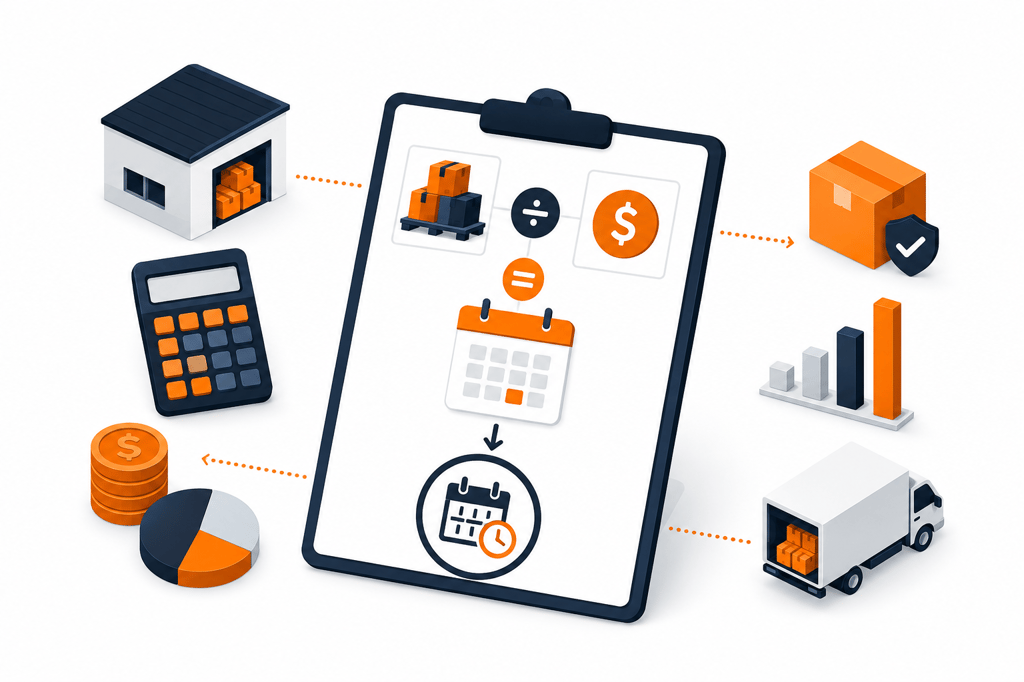
There are two standard formulas, and both land at the same place.
Formula 1, from average inventory and COGS: Days on Hand = (Average Inventory ÷ COGS) × Number of Days in the Period
Formula 2, from your turnover ratio: Days on Hand = Number of Days in the Period ÷ Inventory Turnover Ratio
Two supporting numbers make these work. Average inventory is (Beginning Inventory + Ending Inventory) ÷ 2; it smooths out the swings between a full shelf and an empty one. Daily COGS is Total COGS ÷ Number of Days in the Period, which is what you divide your stock value by to get days.
Here’s a quick worked example. Say your average inventory is worth $43,780, and your COGS for the year is $373,400.
Divide $43,780 by $373,400, multiply by 365, and you get roughly 43 days on hand. That business replenishes its entire stock a little over eight times a year.
Our Inventory DOH calculator uses the first method and reports your turnover automatically, so you only enter what you already know:
The tool then returns your days on hand and annualized inventory turnover instantly and flags whether you’re sitting in the optimal band, running lean, or carrying overstock.
A “good” DOH depends entirely on what you sell. Perishable food needs to move in days; automotive parts and seasonal goods are expected to sit for months.
As a broad rule, many operators aim for 45 days or fewer, but the number that actually matters is the one for your category. The calculator scores you against these ranges:
| Product Category | Healthy Days on Hand |
| Food & Beverages | 7-30 days |
| Electronics | 20-45 days |
| General Products | 30-60 days |
| Apparel | 45-90 days |
| Automotive | 60-120 days |
| Seasonal Items | 90-180 days |
Land inside your band and the tool marks you Optimal; you’re balancing cash flow against availability. Fall below it, and you’ll see a Low Stock Risk flag, a warning that fast movers could sell out before your next shipment lands, especially if you’re relying on 3PL receiving windows.
Climb above it, and you’ll get an Overstock Risk flag, signaling capital tied up in slow stock that’s better off discounted, bundled, or liquidated to recover cash. Read these bands as context, not verdicts: a deliberate pre-season build for a seasonal SKU can look like “overstock” on paper while being exactly the right call.

A raw DOH number tells you where you stand; it doesn’t tell you what to do next. That’s where the calculator goes further than a plain formula, translating your inputs into the operational levers a fulfillment team actually pulls.
Your fulfillment model shapes the strategy, too. With 3PL fulfillment, keep a 15% to 20% buffer for receiving lead times and minimum storage requirements. With in-house fulfillment, you keep direct control over inventory timing and costs.
With dropshipping, supplier reliability matters more than any stock you hold. And in a hybrid model, the smart play is routing fast movers to direct fulfillment and parking slower SKUs with a 3PL. These are the details a generic days-on-hand formula ignores, and the ones that decide whether your inventory strategy actually holds up in the warehouse.
If your number is running high, here are the highest-leverage ways to bring it down without creating stockouts:
Small, consistent adjustments compound. Shaving even a week off your DOH across your top SKUs can release meaningful working capital back into the business.
Inventory days on hand is one of the most important metrics for balancing inventory and cash flow. Use this calculator to measure your DOH, compare it with healthy benchmarks, and decide whether it’s time to reorder, reduce inventory, or stay the course.
Those insights only create value if your fulfillment operation can act on them. When high storage costs or slow inventory movement are driving your DOH higher, better execution matters more than another spreadsheet. With accurate SKU tracking, flexible storage, and smarter replenishment, you can keep inventory lean without risking stockouts.
Ready to optimize your inventory strategy? Get a quote from Fulfyld and build a fulfillment operation that scales with your business.