

Guessing at box dimensions costs you money on every order. Our calculator gives an instant price estimate based on your exact box size, material, color, and print, so you know the cost before you commit.
Enter your specs, hit calculate, and get a per-box price in seconds. No quote requests, no waiting on a sales call, just numbers you can plan around.
How to Use the Calculator
Start with your dimensions, since everything else in the calculator builds off them.
- Dimensions. Length, width, and height in inches, measured to fit your product plus any padding you plan to use.
- Material. Single Wall for light items, Double Wall for everyday cushioning, Heavy Duty for fragile or bulky goods.
- Color. Brown Kraft for a standard, cost-effective look, or White for a cleaner finish.
- Printing. No print keeps costs lowest, while 1-color or 2-color options add your logo or design.
- Quantity. How many boxes are you ordering?
Once your dimensions and options are set, hit Calculate, and the results appear instantly. No account, no minimum order, so it’s easy to test a few combinations of material and print before committing to a bulk order.
Run two or three versions of the same box, say Double Wall with no print versus Heavy Duty with a logo, and comparing the numbers replaces a multi-day back-and-forth with a custom packaging vendor.
Standard Box Sizes and How They Compare
If you’re unsure where to start, these standard sizes are a useful baseline before customizing:
| Size Category | Length (in) | Width (in) | Height (in) | Best For |
| Small Box | 12 | 9 | 4 | Electronics, cosmetics, small gadgets |
| Medium Box | 16 | 12 | 6 | Clothing, accessories, and most consumer goods |
| Large Box | 20 | 16 | 8 | Bulky items, multi-product shipments |
There’s no single industry-wide standard, the way there is for envelopes. What matters is the smallest box that fits your product plus room for protective material, since anything bigger adds cost without adding protection.
Material should match what’s inside, not just what’s cheapest. Single Wall suits short-distance, low-risk shipments.
Double Wall is the middle ground most e-commerce brands settle on, handling normal freight without adding much cost. Heavy Duty earns its price on anything breakable, heavy, or traveling long distances through multiple carrier hubs.
Internal vs. External Dimensions: Why the Difference Matters
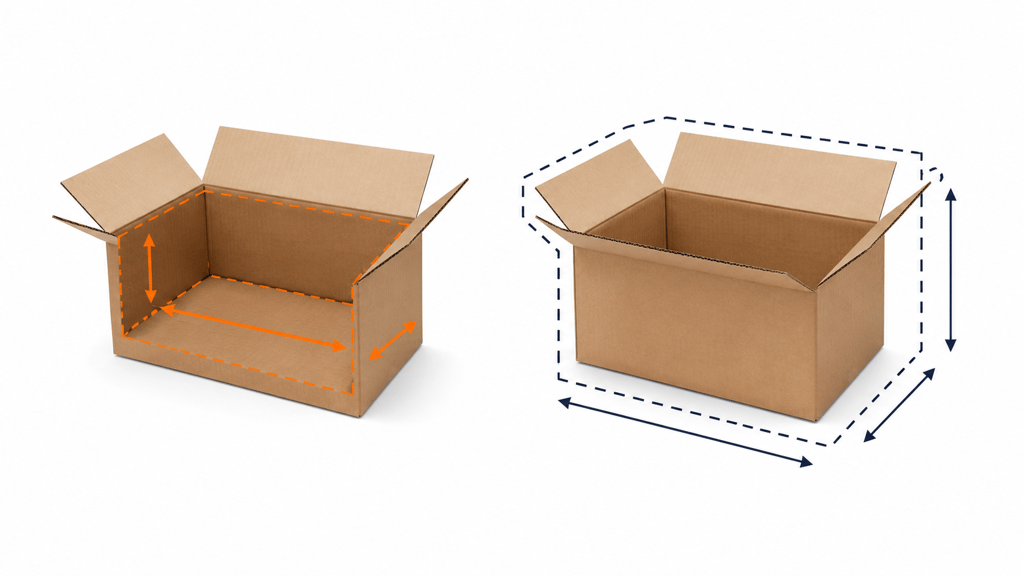
Dimensions are the specific length, width, and height numbers; size is how much the box can actually hold. Internal dimensions are the usable space where your product sits once the box is assembled. External dimensions add the thickness of the cardboard walls, which is why a box labeled “12x9x4” doesn’t always hold a 12x9x4 product.
For fitting your product, internal dimensions are what matter. Enter the internal measurement you need, since that’s what determines whether your product and its padding fit once the box is built.
How to Measure Your Product Accurately
Accurate inputs produce accurate estimates, so measure properly before you calculate.
- Measure to the nearest 0.1 inch. Rounding up “to be safe” throws off your price and can leave you with more empty space than you need.
- Include your padding in the measurement. If you’re using bubble wrap, foam, or inserts, measure your product with that material already in place, not just the bare item.
- Measure the longest, widest, and deepest points. For irregularly shaped products, use the maximum dimension in each direction rather than an average.
- Record each side separately. Length, width, and height each get their own number in the calculator, so don’t combine or estimate any of them.
This is the same process packaging suppliers recommend, whether you’re sizing a standard box or a fully custom one. Getting the numbers right the first time means you won’t re-run the calculator after an order arrives the wrong size.
Common Box Sizing Mistakes to Avoid
A few habits separate an accurate estimate from a wasted order, and most are common packaging mistakes you can head off early.
- Sizing too tight. A box snug against your product with no room for padding protects less than one sized a half-inch larger with cushioning inside.
- Guessing on material. Picking Single Wall on a product that needs Double Wall usually costs more in damage claims than it saves in materials.
- Ordering the wrong quantity. The calculator multiplies your per-box price by quantity to get your total, so a typo here throws off your total cost even though the per-box price itself stays the same.
- Leaving color and print for last. Both affect the per-box price, so factoring them into your estimate upfront avoids a higher number than expected.
Why Accurate Box Sizing Saves Money
Packaging decisions reach well past the box’s sticker price. Here’s how getting it wrong plays out versus getting it right:
| Sizing Issue | What It Costs You |
| Oversized box | More cardboard per unit, extra void fill, more labor per pack |
| Undersized or under-protected | Product movement, damage claims, and higher return rates |
| Right-sized with the correct material | Predictable per-unit packaging costs, fewer damage claims |
The impact compounds with volume. A half-inch of wasted space per box barely registers across a few hundred orders a month, but repeat it across thousands and it becomes a real line item, in cardboard, void fill, and labor alike. Less wasted space also means a smaller packaging footprint, the same payoff behind eco-friendly packaging, that scales with you.
Packaging shapes how your brand shows up on the doorstep, too. A snug, well-branded box signals a professional operation, while skipping print leaves a cheap marketing touchpoint on the table. Running your specs through the calculator before a bulk order protects margin as you scale.
How Box Size Affects Your Shipping Costs
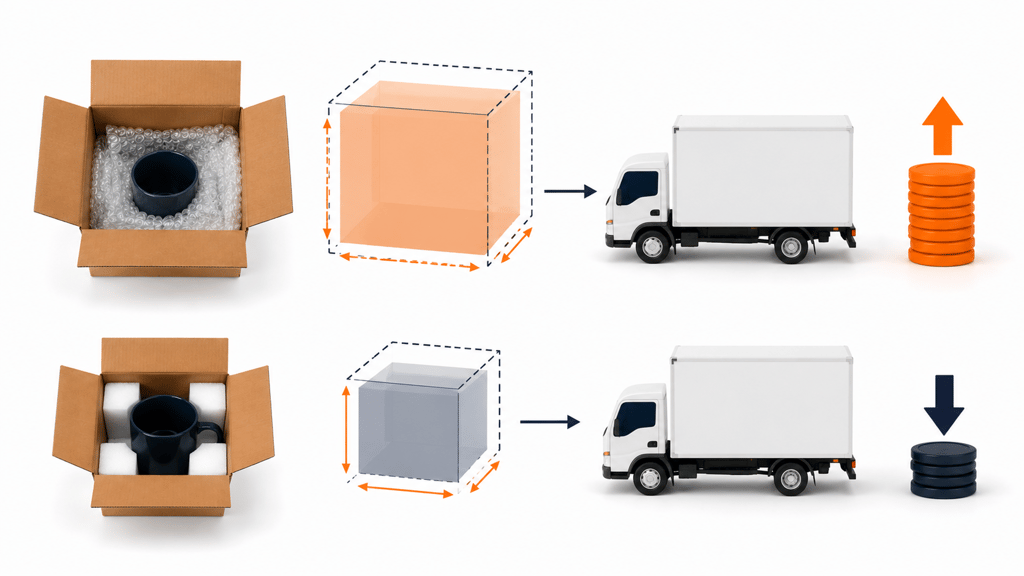
The calculator prices the box itself. Your carrier bill is separate, and box size drives that one too, through dimensional weight.
UPS and FedEx bill the greater of your package’s actual weight or its dimensional weight, a figure based on how much space the box takes up rather than what it weighs. USPS applies the same rule to larger parcels, those over one cubic foot. Either way, an oversized box pushes that number up, so you end up paying to ship air.
The calculator doesn’t estimate carrier fees, but the rule of thumb is simple: the smallest box that safely fits your product and its padding keeps both the box cost and the shipping cost down.
Matching Box Size to Your Product
Padding needs vary by product. Electronics need room on every side for foam or air pillows. Apparel and soft goods compress, so you can often size down.
Fragile items and glassware should be sized up, since a small item still needs protective wrap on all sides. Heavy or bulky goods need heavy-duty material but not extra empty space, which just invites shifting.
In each case, measure the product with its padding in place, then enter those internal dimensions so the price reflects the box you’ll actually order.
Size & Price Your Box in Seconds
Stop guessing on packaging costs. Enter your dimensions, pick your material and print options, and get a clear, upfront price per box before you place a single order.
Looking for fulfillment that goes beyond packaging? Fulfyld’s 3PL solutions handle storage, pick and pack, and shipping so you can focus on growing your brand instead of managing a warehouse.