
Over 90% of Fortune 500 companies use at least one third-party logistics provider, not because it is fashionable, but because the moment a growing brand tries to operate its own warehouse, hire staff, and negotiate carrier contracts, it discovers how fast logistics complexity consumes the capital that should be driving growth.
The global 3PL market was valued at approximately $1.1 to $1.3 trillion in 2024 and is projected to reach $1.9 trillion by 2030. Understanding 3PL fulfillment comes down to one strategic trade: hand off the operational complexity, keep the margin.
This guide covers the definition, four service model types, the complete 6-stage fulfillment process, 10 operational benefits, industry verticals, contract red flags, onboarding timelines, and pricing breakdowns.
What Is 3PL Fulfillment? Definition and Origin
Third-party logistics is the outsourcing of a brand’s physical supply chain operations to an external provider whose entire business is built around executing those functions efficiently at scale.
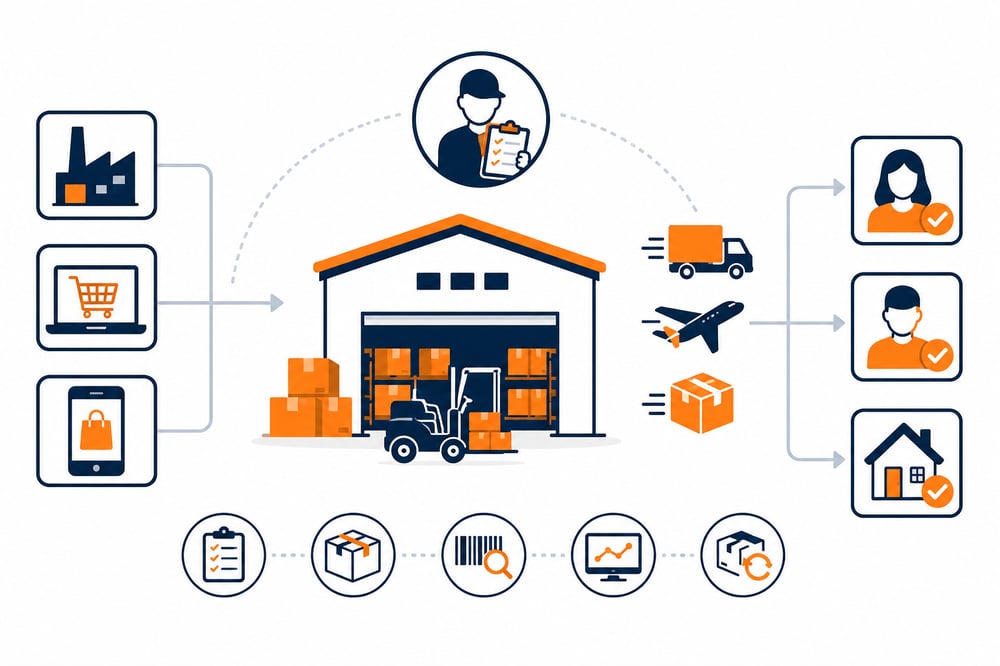
In practice, it is a complete operational handoff: your inventory lives in the 3PL’s warehouse, their systems track every unit in real time, and their carrier relationships get packages to customers faster and cheaper than you could manage independently.
The term “logistics” has its roots in military operations, but what is third party logistics in a commercial sense came into focus in the 1980s as supply chains globalized and companies began systematically outsourcing distribution.
Today, understanding what a 3PL does versus what a 3PL warehouse physically looks like is the starting point for any brand evaluating outsourced fulfillment.
Core activities a 3PL handles on your behalf:
- Receiving and logging inbound inventory against purchase orders
- Real-time inventory tracking via a Warehouse Management System (WMS)
- Order management and processing across all connected sales channels
- Pick, pack, and ship coordination with pre-negotiated carrier rates
- Returns receiving, inspection, and inventory recovery
- Value-added services, including kitting, custom packaging, inserts, and FBA prep
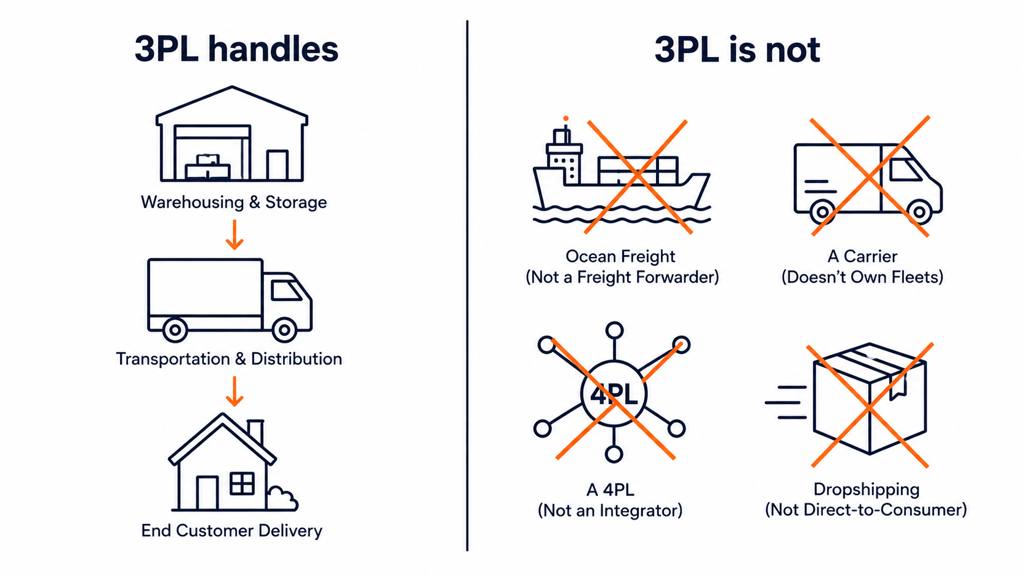
What 3PL is not:
- Not a freight forwarder: freight forwarders handle international transit and customs, not domestic fulfillment
- Not a dropship supplier: In dropshipping, the supplier owns the inventory, not you
- Not a 4PL: a 4PL manages other 3PLs strategically rather than executing operations directly
- Not a carrier: carriers deliver; 3PLs store, pick, pack, and hand off to carriers
For brands evaluating whether e-commerce fulfillment services are the right fit, the sections below give you the complete operational picture.
3PL vs. 4PL vs. Freight Forwarder vs. Dropshipping
These four models are frequently confused, and choosing the wrong one costs brands operational control, margin, and months of correction time. The table below maps the key differences side by side.
| Dimension | 3PL | 4PL | Freight Forwarder | Dropshipping |
| Who owns the inventory | You | You | You | Supplier |
| What they handle | Warehousing, pick/pack, shipping, returns | Manages multiple 3PLs and full supply chain strategy | International transit, customs, import/export | Product sourcing, storage, and direct fulfillment |
| Brand control | High | High | Medium | Low |
| Technology provided | WMS, OMS integration, carrier network | Multi-3PL management, supply chain analytics | Freight booking, customs documentation | Supplier’s own systems |
| Best for | DTC, B2B, omnichannel brands | Enterprise with complex multi-provider networks | Brands importing goods internationally | New businesses, product testing, no-inventory models |
| Cost basis | Per order plus storage | Management fee plus 3PL costs | Per shipment and weight | Margin difference per sale |
| Scalability | High within the 3PL network | Very high | Limited to the transit leg | High with no inventory risk |
3PL vs. 4PL
A 3PL handles physical execution: receiving inventory, picking orders, packing shipments, and coordinating delivery. A 4PL takes strategic oversight, managing multiple 3PLs and optimizing the entire supply chain network. Most growing brands need a 3PL; enterprise companies with global multi-provider networks may benefit from a 4PL layer on top.
3PL vs. Freight Forwarder
A freight forwarder moves goods across international borders, managing ocean freight, customs clearance, and import documentation. Their job ends when the shipment arrives in-country. A 3PL picks up from there, receiving the inventory, storing it, and fulfilling individual customer orders. Most import-heavy brands use both.
3PL vs. Dropshipping
In dropshipping, the supplier owns and ships inventory directly to your customer; you never hold the product. Margins are typically 30 to 50% lower than wholesale models, and quality control is limited. With a 3PL, you own the inventory and the 3PL manages operations, giving you brand control, better margins, and faster shipping.
Before evaluating any provider, it pays to understand 3PL automation capabilities and how they affect throughput speed and error rates. A purpose-built 3PL warehouse management system tells you more about a provider’s operational maturity than any sales deck they hand you.
The 4 Types of 3PL Service Models
Not all 3PLs offer the same scope. Here are examples of third-party service models that define the industry, and knowing which tier aligns with your business model determines whether a partnership works or breaks down at scale.
| Model | Scope of Services | Best For | Technology Level | Typical Price Point |
| Standard 3PL | Basic warehousing, pick/pack, ship | Early-stage, simple catalogs, single channel | Basic WMS | Lowest |
| Service Developer 3PL | Standard plus kitting, VAS, custom packaging, returns | Subscription brands, DTC with complex packaging | Intermediate | Mid-range |
| Customer Adapter 3PL | Deep client integration, dedicated workflows, and account management | Multi-channel, B2B plus DTC split, regulated products | Advanced | Mid-to-high |
| Customer Developer 3PL | Strategic partner, supply chain optimization, co-developed processes | Enterprise, high-volume, distributed networks | Enterprise | Highest |
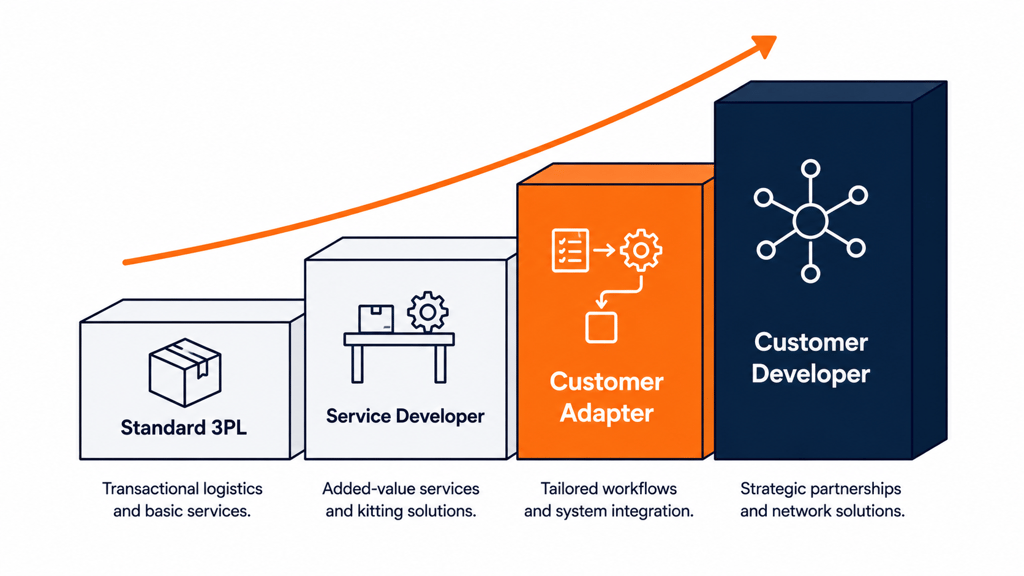
Type 1: Standard 3PL Provider
What It Is: Basic warehousing, pick/pack, and shipping with standardized processes and no dedicated account management. Handles straightforward, single-channel, low-complexity order types without customization.
Best For: Brands shipping fewer than 300 to 400 monthly orders on a single channel with a limited and stable SKU catalog.
Real-World Example: A candle brand with 8 SKUs shipping via Shopify. Standard warehousing and daily pick/pack cover the full scope.
Limitation: These providers may lack native platform integrations, dedicated support, or the capacity to handle rapid growth. Boutique 3PL services often represent the high end of this tier, more attentive than commodity warehouses and more agile for early-stage brands.
Type 2: Service Developer 3PL
What It Is: All standard services plus value-added capabilities, including kitting, custom packaging, branded inserts, subscription box assembly, FBA prep, and co-packing designed to brand specifications.
Best For: Brands requiring custom unboxing experiences, subscription commerce, crowdfunding campaigns, or bundled product offerings.
Real-World Example: A beauty subscription brand assembling 6 to 8 items per box with branded tissue and a custom insert card. This is exactly the kind of work covered under kitting and fulfillment services, where assembly complexity and brand specifications are built into the workflow from the start.
What sets this tier apart: Service Developer providers bring genuine value-added services capability in-house, so brands are not managing a separate vendor for every custom element of their packaging.
Type 3: Customer Adapter 3PL
What It Is: A 3PL that builds deeply around a specific client’s requirements, including custom workflows, multi-channel order routing, and dedicated account management. Operates as a virtual extension of the brand’s logistics team.
Best For: Mid-to-large brands with simultaneous B2B and DTC operations, regulated product categories, or multiple sales channels feeding a single inventory pool. Brands at this stage are better served by a provider offering premium fulfillment services as a standard, not an upgrade.
Real-World Example: A supplement brand requiring FIFO lot rotation, FDA-compliant documentation, and simultaneous B2B and DTC processing from a shared inventory pool, all through a single account with dedicated account management as the primary operational contact.
Type 4: Customer Developer 3PL
What It Is: The most strategic tier. The provider takes co-ownership of supply chain performance, invests in shared technology, and functions as a logistics consultant rather than a vendor. This is a true infrastructure-level partnership.
Best For: Enterprise fulfillment operations processing 10,000 or more monthly orders, multi-warehouse networks, and brands expanding into new geographies or channels.
Real-World Example: An electronics brand running omnichannel e-commerce fulfillment across Amazon FBA, DTC Shopify, wholesale retail, and international markets from two warehouse locations, requiring unified WMS and real-time inventory allocation across every channel.
The 3PL Fulfillment Process: 6 Stages Explained
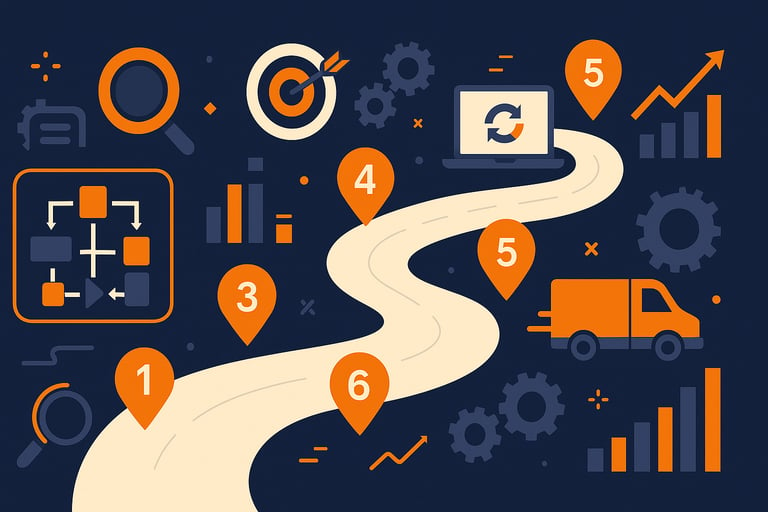
The 3PL fulfillment process is a six-stage operational cycle, beginning when inventory arrives at the warehouse and completing when the order reaches the customer, then looping back through returns.
| Stage | Name | Primary Activity | Key SLA Benchmark | Core Technology |
| 1 | Inventory Receiving and Intake | Count, verify, and log inbound inventory | Under 48 hours dock-to-stock | WMS, barcode scanners |
| 2 | Storage and Warehouse Management | Organize, slot, and maintain inventory | Ongoing 99%+ accuracy | WMS, cycle counting |
| 3 | Order Processing and Routing | Receive orders and generate pick lists | Real-time under 60-second sync | OMS, WMS, API |
| 4 | Pick, Pack, and Ship | Pick items, pack, label, and hand them to the carrier | Same-day by cutoff | WMS, pick-to-label |
| 5 | Carrier Management and Delivery | Rate shop, dispatch, and track delivery | 2-day ground typical | TMS, carrier API |
| 6 | Returns Handling | Receive, inspect, and disposition returns | 2 to 5 business days | RMS, WMS |
Stage 1: Inventory Receiving and Intake
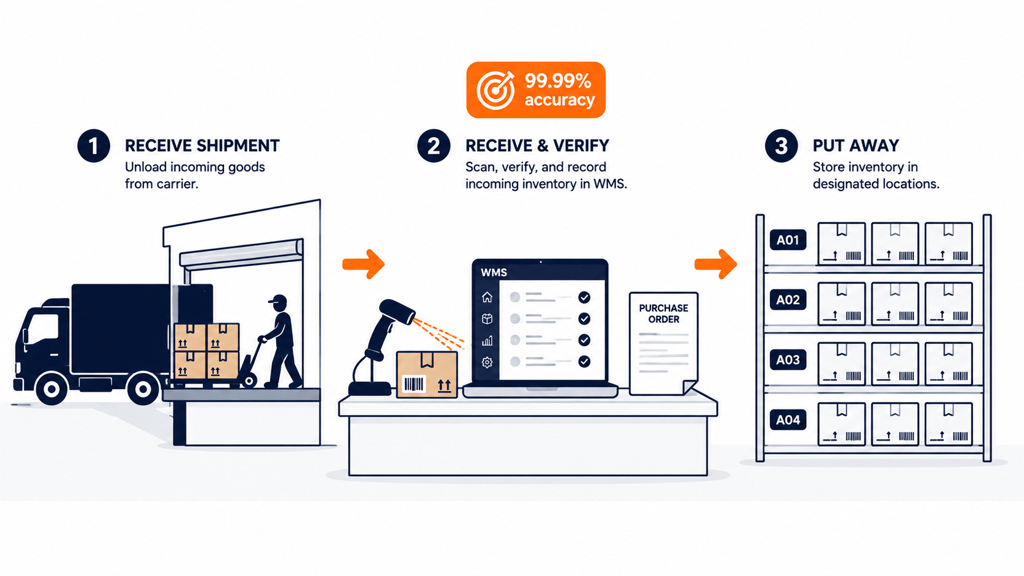
Receiving is where the fulfillment process begins, and where most downstream accuracy problems either start or are prevented. When your manufacturer ships inventory to the warehouse, the 3PL must receive, count, verify, and log every unit before any of it becomes available to fill orders.
Step-by-step receiving workflow:
- An Advanced Shipment Notice (ASN) is sent by the supplier or freight forwarder before delivery
- Physical unloading, condition inspection, and unit count verified against the purchase order
- Barcode or RFID scanning of each unit and pallet is recorded into the WMS
- Discrepancies are documented, and the supplier is notified within 24 to 48 hours
- WMS entry completed and inventory availability flag activated
- Putaway to the assigned bin location per the slotting strategy
What to demand from your 3PL at this stage:
- Dock scheduling that prevents receiving bottlenecks and keeps dock-to-stock under 48 hours
- Receiving accuracy at 99% or higher, with a discrepancy rate below 2%
- Mandatory ASN requirement from all suppliers before delivery
- Photo documentation of any damaged shipments for carrier claims
Fulfyld completes dock-to-stock within 2 business days and publishes a 99.99% receiving accuracy rate, feeding directly into the accuracy of your inventory fulfillment from day one.
Red flags at this stage:
- No ASN requirement, creating log-jams at the dock on delivery day
- Dock-to-stock exceeding 5 or more days, leaving inventory unavailable
- No photo documentation policy for damaged inbound shipments
Stage 2: Storage and Warehouse Management
Once received, inventory is stored using a strategy designed to minimize pick time and maximize cubic space utilization. Storage organization directly determines pick speed and accuracy in Stage 4; a poorly slotted warehouse costs time on every single order.
ABC slotting, the industry standard storage strategy:
- A-items (top 20% of SKUs, generating roughly 80% of volume): Stored closest to packing stations for the fastest pick
- B-items (middle 30% of SKUs): Standard rack positions at moderate travel distance
- C-items (bottom 50% of SKUs): Deepest storage, counted less frequently
Storage type options by product requirement:
- Shelf and bin storage for small items and high-SKU catalogs
- Pallet racking for high-volume, case-quantity, or bulky products
- Climate-controlled bays for supplements, cosmetics, and probiotics
- Secure caged areas for high-value electronics and licensed merchandise
3PL storage billing models:
| Billing Method | What It Measures | Typical Rate |
| Per pallet per month | Pallet positions occupied | $5 to $15 per pallet/month |
| Per cubic foot per month | Cubic feet of space occupied | $0.50 to $1.50 per cu ft/month |
| Per bin per month | Individual shelf bin positions | $1 to $5 per bin/month |
Understanding warehouse shrinkage, inventory loss through theft, damage, and miscounts, is essential for holding any 3PL accountable. The ways to improve warehouse efficiency that elite providers implement separate a well-organized operation from one that creates downstream errors.
Stage 3: Order Processing and Routing
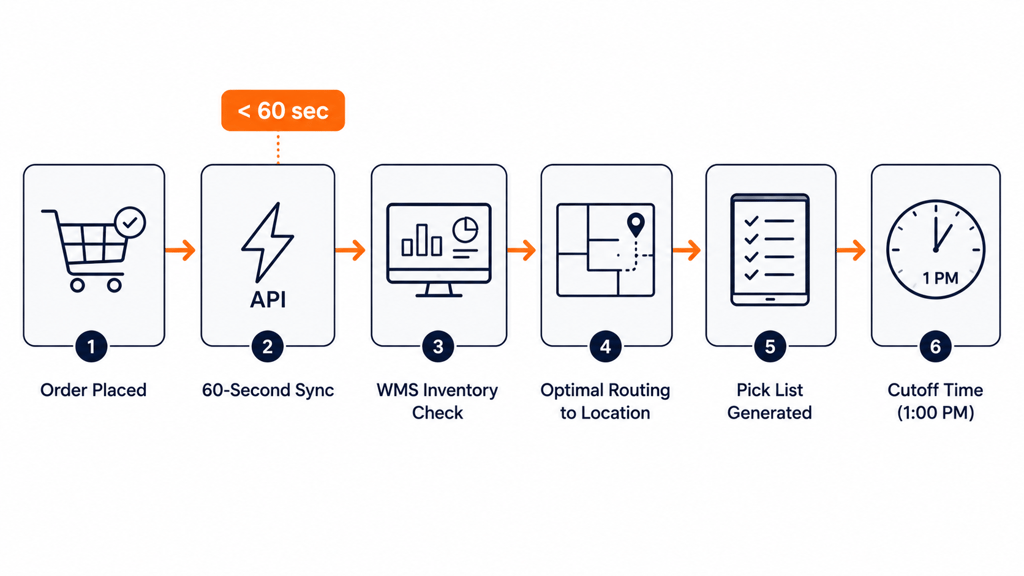
When a customer places an order on your Shopify store, Amazon marketplace, or WooCommerce site, that order data flows automatically into the 3PL’s WMS via API. From that moment, the system validates inventory, generates a pick list, and assigns the order to the warehouse floor without manual intervention.
The quality of the integration between your sales platform and the 3PL’s WMS determines whether this handoff takes seconds or introduces delays that compound through every subsequent stage.
Automated order flow, step by step:
- Customer places an order on any connected sales channel
- API integration pushes orders to 3PL OMS and WMS within 60 seconds
- WMS checks inventory availability and flags exceptions, including out-of-stock, and addresses issues
- Order routed to the correct warehouse zone based on SKU bin location
- Pick list generated and assigned to floor associate or automated picking system
- Order prioritized by shipping method, carrier cutoff time, and SLA tier
The daily cutoff time, the single most important fulfillment concept:
The cutoff time, 1 PM local warehouse time at Fulfyld, is the dividing line between same-day ship and next-day ship. Orders placed before it are picked, packed, and handed to the carrier that same business day; orders placed after it ship the following business day.
For brands asking whether a 3PL can integrate directly with Shopify, that integration is precisely what makes automatic cutoff-time enforcement possible. Brands looking to tighten this stage further will find the guide on improving the order fulfillment process directly applicable.
Stage 4: Pick, Pack, and Ship
Pick and pack is where the process becomes physical. A warehouse associate locates each item, verifies it via barcode scan, packs it, prints the carrier label, and moves it to the shipping dock. The accuracy and speed of this stage determine your published order accuracy rate and your average fulfillment speed.
Step-by-step pick, pack, and ship workflow:
- The associate receives a digital pick list on a handheld scanner
- Travels to the bin location and scans the bin barcode to confirm the correct position
- Scans the item barcode to confirm the correct SKU, providing double verification
- Visual condition check performed before packing
- Item packed into dimensional weight-optimized packaging: box, poly mailer, or padded envelope
- Custom brand elements added per specifications, including inserts, tissue, and branded tape
- Final weight scan performed, and carrier label printed and applied
- Order moved to carrier-specific staging lane for pickup
Picking methods and when each applies:
| Method | How It Works | Best For | Speed | Accuracy |
| Single-order picking | One picker follows one order A to Z | Low volume, complex multi-SKU orders | Slowest | Highest |
| Batch picking | One picker handles multiple orders simultaneously | Medium volume, similar SKU profiles | Fast | High |
| Zone picking | Each picker covers one warehouse zone; orders are merged at packing | High-volume warehouses | Fastest | Requires sorting |
| Wave picking | Scheduled picking sessions aligned to carrier cutoffs | Large operations with multiple daily cutoffs | Optimized | High |
Fulfyld publishes a 99.99% order accuracy rate across all pick and pack operations. Brands with complex unboxing requirements should evaluate pick and pack fulfillment services alongside contract manufacturing and custom packaging capabilities before selecting a provider.
Stage 5: Carrier Management and Last-Mile Delivery
Once packed and labeled, every order enters the carrier network. This is where a 3PL’s pre-negotiated carrier relationships become one of the most financially significant parts of the partnership.
Instead of paying retail shipping rates, brands access volume-discounted contracts across FedEx, UPS, USPS, and regional carriers. Industry data consistently shows brands saving 20 to 40% per shipment compared to self-negotiated retail rates.
How carrier management works inside a 3PL:
- The WMS automatically selects the carrier and service level based on destination zone, weight, delivery promise, and cost
- Primary carrier volume commitments unlock negotiated rates and priority pickup scheduling
- Backup carriers activate for overflow, zone gaps, or service failures
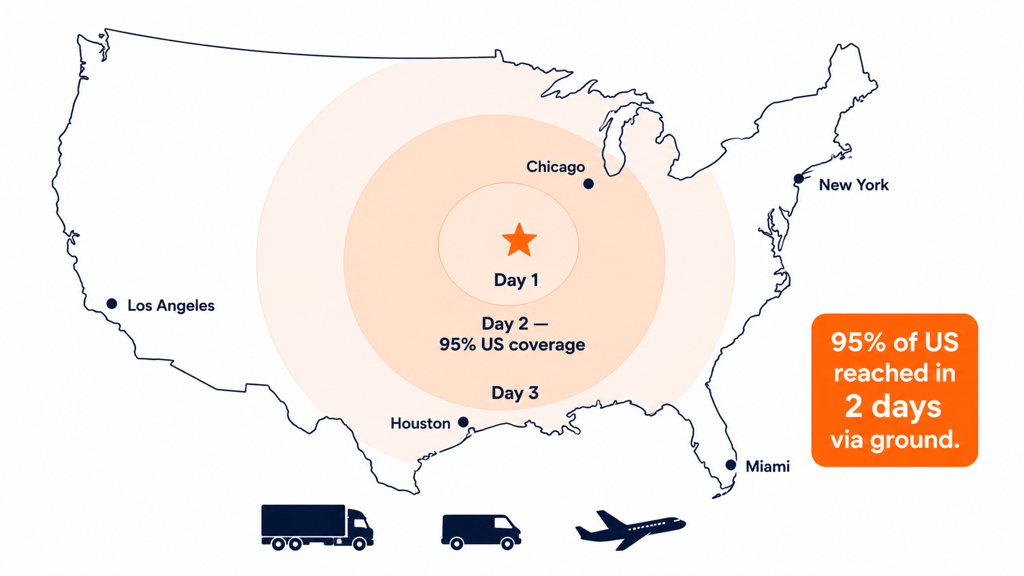
- Brands targeting 2-day fulfillment can do so via ground shipping from a well-positioned center, eliminating air freight entirely
Geographic positioning and delivery speed:
Centrally located fulfillment centers reach approximately 95% of the US population via 2-day ground shipping without air freight surcharges. Distributing inventory across two or more locations reduces the average shipping zone, cutting per-order carrier costs by 15 to 30%.
Fulfyld publishes a 99.99% on-time delivery rate, with same-day shipping on all orders placed before the 1 PM cutoff. Improving shipping efficiency through better carrier selection and zone-based routing is one of the fastest ways to reduce per-order cost.
Stage 6: Returns Handling
The fulfillment cycle loops back through returns, which represent an average of 20 to 30% of all online orders. A capable 3PL receives inbound returns, inspects each item against a documented grading rubric, makes a disposition decision, and restocks eligible inventory within 24 to 48 hours.
What returns handling covers at this stage:
- Return authorization coordination and inbound label management
- Receiving, logging, and condition inspection upon warehouse arrival
- Disposition grading: Grade A restock, Grade B refurbishment, Grade C liquidation, Grade D disposal
- WMS inventory update and refund trigger pushed back to the OMS
- Full reverse logistics services, including refurbishment, secondary market routing, and carrier claim coordination
Key returns performance benchmarks:
- Processing time: 2 to 5 business days from receipt to completed disposition
- Restocking time for Grade A items: 24 to 48 hours from arrival
- Return-to-resale rate target: 60 to 80% of all returns back into sellable inventory
Returns management handled by a capable 3PL directly impacts inventory availability, refund cycle time, and customer retention.
The Core Benefits of Using a 3PL That Actually Move the Needle for Your Business
The case for outsourcing logistics goes well beyond “saves time.” These ten benefits show up directly in P&L statements, customer retention rates, and a brand’s ability to grow past the operational ceilings that stop most scaling businesses in their tracks.
Benefit 1: Fixed Infrastructure Costs Become Variable
Warehouse leases, racking systems, WMS licenses, utilities, and insurance are fixed costs whether you ship 100 orders or 10,000. A 3PL converts all of it to variable: you pay per order processed and per unit stored, with no lease, no payroll, and no equipment overhead sitting on your books.
What you stop paying for when you outsource to a 3PL:
- Monthly warehouse lease or commercial storage rental
- WMS software licensing and IT maintenance costs
- Full-time fulfillment staff salaries, benefits, and onboarding
- Material handling equipment, including forklifts, pallet jacks, and shelving
- Utilities, security systems, and facility insurance
Pro tip: Review 3PL fulfillment pricing structures before your first provider call. Knowing the industry-standard fee categories makes it much harder for a 3PL to pad invoices with charges you did not expect.
Benefit 2: Pre-Negotiated Carrier Rates You Cannot Access Independently
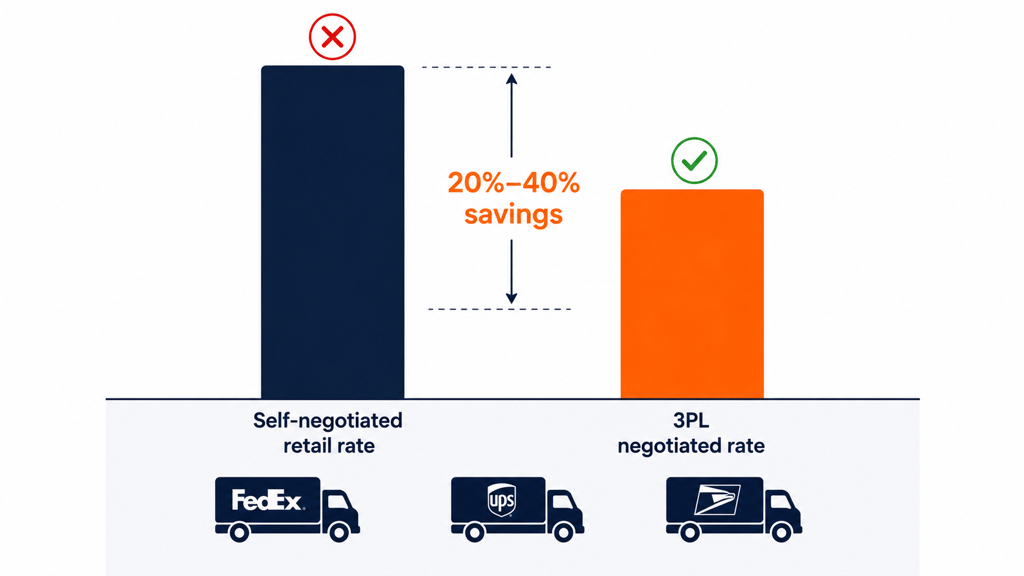
Carrier discount tiers are based on total annual shipping volume, and most growing brands simply do not ship enough to unlock meaningful rates on their own.
A 3PL aggregating volume across dozens of client brands negotiates contracts with FedEx, UPS, and USPS that no individual brand can access at any price point.
What those savings look like in practice:
- Standard ground shipping discounts of 20 to 40% versus retail rates
- Dimensional weight calculations negotiated more favorably than published rates
- Surcharge waivers or reductions on residential delivery and peak season fees
- Priority carrier pickup scheduling is unavailable to low-volume shippers
That per-shipment saving often fully offsets the 3PL’s per-order fee, making the cost of outsourcing closer to zero than most brands realize before running the numbers.
Benefit 3: Scalability Without the Hiring and Space Problem
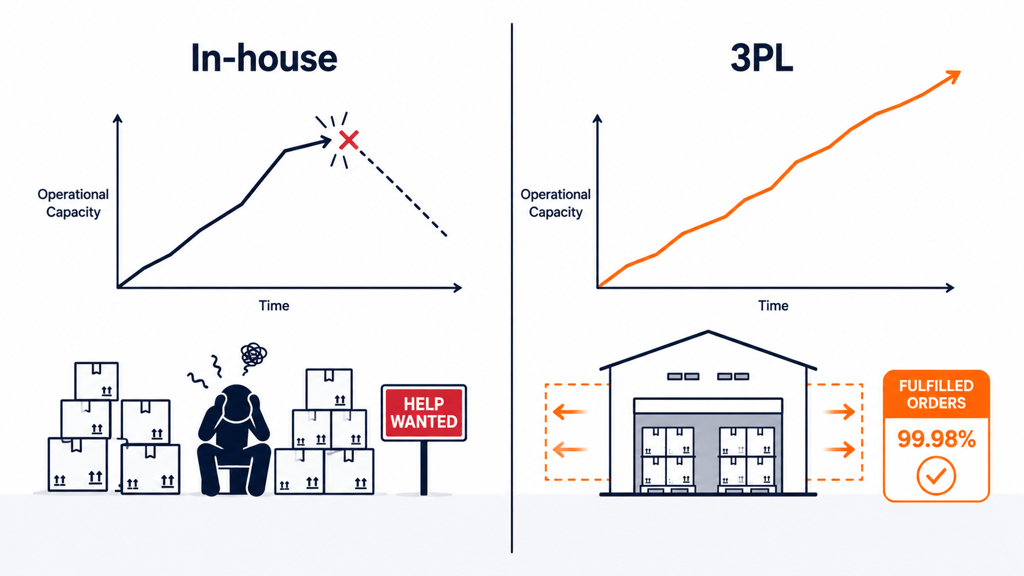
Order volume can spike 5 to 10x during Q4, major promotions, or a product going viral. In-house operations respond by emergency hiring and running overtime, and still frequently fail to keep pace; a 3PL absorbs those surges using shared infrastructure and pre-arranged carrier capacity.
What peak-season scalability looks like inside a 3PL:
- Pre-positioned staff surge capacity planned months before Q4
- Carrier pickup slots secured in advance for projected peak volume
- No hiring, training, or scheduling burden is placed on your team
- Real-time throughput monitoring to flag bottlenecks before they affect SLAs
Holiday fulfillment capability is the single best acid test for any 3PL you are evaluating. Ask for their Q4 performance data from the previous year before signing anything.
Benefit 4: Same-Day and 2-Day Delivery Without Air Freight
Customers expect Amazon-level delivery speed, and meeting that without paying air freight premiums requires a fulfillment center in the right geographic location.
A centrally located 3PL reaches approximately 95% of the US population via 2-day ground shipping, something most brands shipping in-house cannot replicate without significant capital investment.
What fast delivery requires from a 3PL:
- Central or multi-node warehouse positioning to minimize shipping zones
- Pre-negotiated 2-day ground rates across all major carriers
- Daily carrier cutoff times are honored without exception at any volume level
- Real-time order sync, so no time is lost between purchase and fulfillment start
- E-commerce fulfillment services built around a published cutoff time and a guaranteed on-time ship rate, not a “best efforts” commitment
Delivery speed directly influences conversion rates, cart abandonment, and repeat purchase behavior. A 3PL solves the infrastructure problem the moment you onboard.
Benefit 5: Enterprise WMS Technology Included
Enterprise WMS platforms cost $50,000 to $500,000 to implement independently, requiring dedicated IT resources to maintain and upgrade.
A trusted 3PL fulfillment partner provides real-time dashboard access to inventory, orders, and performance data, all included in the service fee with no capital outlay from your side.
What WMS access gives you on day one:
- Real-time inventory visibility across every SKU in the warehouse
- Order status tracking from pick through delivery confirmation
- Inbound shipment tracking from supplier ASN through dock-to-stock completion
- Performance reporting for order accuracy, fulfillment speed, and returns processing
The full advantages of hiring a 3PL for your e-commerce business extend well beyond the WMS alone, but technology access is consistently one of the highest-value line items when brands run a true cost comparison.
Benefit 6: Faster Launch of New Products and SKUs
Launching a new SKU in-house means reorganizing warehouse space, updating the inventory system, briefing staff, and sourcing packaging before the first order ships. A 3PL compresses that entire process to 24 to 48 hours from the moment inventory arrives at the dock.
What a fast SKU launch looks like with a 3PL:
- New SKU entered into WMS and available for orders within 24 hours of receiving completion
- Bin location assigned and slotted for optimal pick speed based on forecasted velocity
- Packaging specifications are uploaded once and applied consistently from the first order
- No internal workflow disruption while the new product goes live alongside existing SKUs
For brands running seasonal collections or frequent product drops, that speed advantage compounds directly into revenue. It is also one of the clearest illustrations of why pick and pack fulfillment at a capable 3PL outperforms in-house operations the moment catalog complexity starts growing.
Benefit 7: Multi-Channel Fulfillment From a Single Inventory Pool
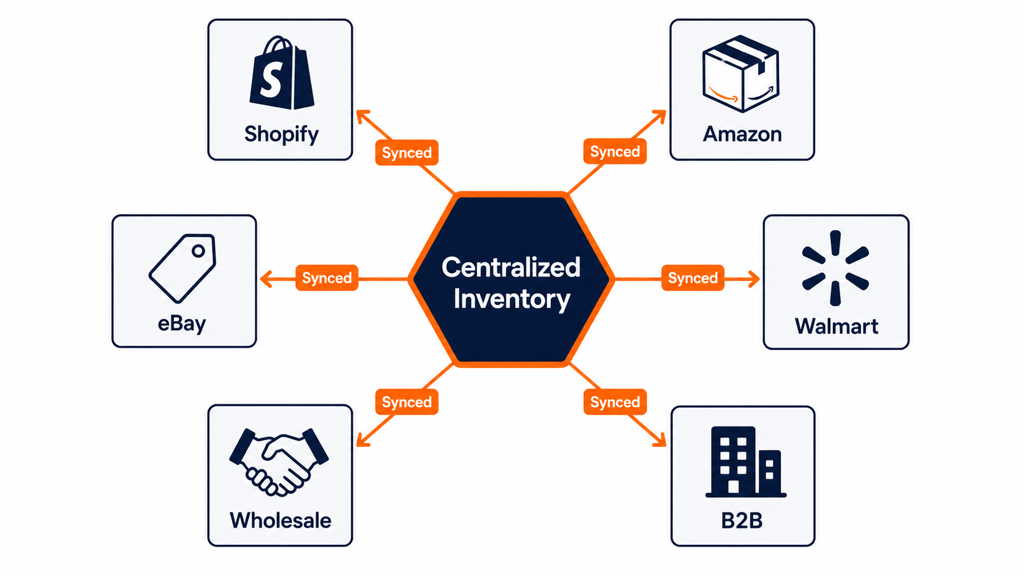
Shopify, Amazon, eBay, Walmart Marketplace, wholesale, and B2B orders all arrive simultaneously and require different fulfillment workflows, labeling standards, and carrier requirements.
A capable 3PL centralizes inventory and routes every order through the correct workflow automatically, preventing overselling and maintaining real-time sync across every channel.
What centralized multi-channel fulfillment prevents:
- Overselling caused by inventory counts being out of sync between platforms
- Manual reconciliation consumes 5 to 10 staff hours per week
- Retailer chargebacks from non-compliant B2B routing and labeling
- Customer-facing stockout messages on one channel while inventory sits available in another
Understanding how supply chains with 3PL logistics create long-term profits starts with exactly this kind of channel consolidation at the inventory level.
Benefit 8: Value-Added Services That Build Brand Loyalty
The unboxing moment is the first physical touchpoint a customer has with your brand after buying. Custom kitting, branded packaging, personalized inserts, and FBA prep transform that moment from a commodity transaction into a brand experience.
Value-added services available through a qualified 3PL:
- Custom kitting and multi-item assembly with documented bill of materials management
- Branded box inserts, tissue paper, thank-you cards, and promotional materials
- Amazon FBA prep, including FNSKU labeling, poly-bagging, and case-packing
- Co-packing and bundle creation for promotional or subscription configurations
- Purpose-built subscription box fulfillment workflows for brands running monthly cycles, including billing platform integrations and cycle-based batch processing
Benefit 9: Built-In Logistics Expertise From Day One
Carrier claim resolution, receiving discrepancy management, and SKU complexity management are problems a 3PL has already solved across hundreds of client brands.
That institutional knowledge is available from your first order, eliminating the trial-and-error period every in-house operation goes through when scaling logistics.
Areas where 3PL expertise delivers immediate value:
- Carrier claim filing and follow-up for lost or damaged shipments
- Receiving discrepancy resolution with supplier documentation already in place
- Dimensional weight and zone-based shipping cost optimization
- SKU slotting strategy updated from real order velocity data, not guesswork
- Supply chain efficiency improvements that compound over time, since each process the 3PL refines benefits every client on the same infrastructure
Benefit 10: Dedicated Account Management That Prevents Problems Before They Escalate
The best 3PLs assign a named account manager to every client, someone who knows your products, SLAs, and seasonal patterns. When a carrier misses a pickup or a new product launch needs expedited onboarding, you have a direct line to resolution rather than a generic support ticket queue.
What a dedicated account manager actively handles for your brand:
- Proactive monitoring of daily SLA performance and flagging of any anomalies
- Carrier issue escalation and claim coordination on your behalf
- New product onboarding and WMS setup before inventory arrives at the dock
- Regular performance reviews with data-backed improvement recommendations
The importance of customer service as a retention lever applies to 3PL relationships exactly as it does to the customer relationships your brand manages. A 3PL without a dedicated contact is a vendor; one with a proactive account manager is a partner.
3PL Industry Verticals: What 3PL Looks Like by Business Type
3PL fulfillment adapts to what you sell and how you sell it. Here is how the model looks across six major business types, along with the specific operational requirements that define each.
| Business Type | Primary 3PL Need | Critical Capability | Fulfyld Service |
| DTC / E-commerce | Same-day ship, branded packaging, returns | Platform integration, pick accuracy | D2C Fulfillment |
| B2B / Wholesale | Pallet shipping, EDI compliance, retailer routing | B2B workflow rules, compliance expertise | B2B Distribution |
| Supplements and Health | FIFO, lot tracking, and regulated documentation | Temperature control, FDA-compliant storage | Supplement Fulfillment |
| Apparel and Fashion | Size and variant accuracy, fast returns, restocking | High pick accuracy, quick returns processing | Apparel Fulfillment |
| Subscription Boxes | Kitting, batch processing, cycle-based shipping | Assembly capacity, WMS kitting workflow | Subscription Box Fulfillment |
| Crowdfunding / Kickstarter | One-time large-batch ship, reward-tier segmentation | Kitting at scale, backer-list management | Crowdfunding Fulfillment |
DTC / E-commerce Fulfillment
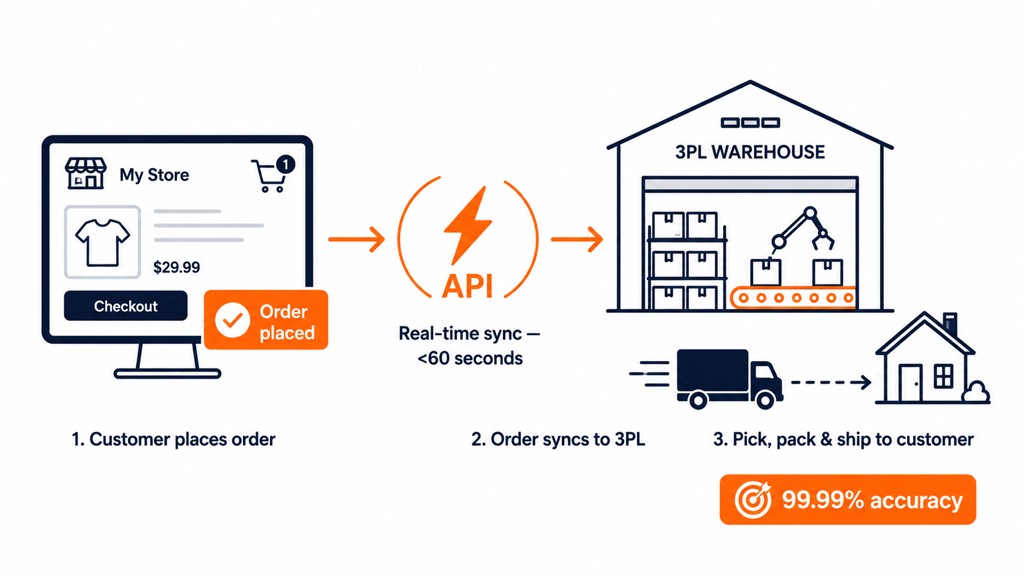
D2C fulfillment is the most common 3PL use case. DTC brands need same-day fulfillment, real-time inventory sync to prevent overselling, branded packaging options, and a returns workflow that restocks eligible inventory within 48 hours.
Key operational requirements:
- Native integration with Shopify, WooCommerce, BigCommerce, or Amazon Seller Central
- Daily cutoff time is honored without exception at every order volume level
- Dedicated account manager who responds within hours rather than days
- Returns restocking within 48 hours of receipt and grading decision
B2B / Wholesale Fulfillment
B2B orders involve larger shipments, pallet quantities, and retailer-specific routing guides with strict EDI compliance requirements. Non-compliance with routing guides from major retailers triggers chargebacks that can reach 2 to 5% of the order value.
Key operational requirements:
- Simultaneous processing of B2B pallet shipments and individual DTC orders from the same inventory pool
- Separate labeling, documentation, and carrier workflows per order type
- EDI connectivity for automated purchase order receipt and shipment confirmation
- A provider with genuine B2B distribution capability, not one that treats wholesale orders as oversized DTC shipments
Supplement and Health Product Fulfillment
Supplement fulfillment requires capabilities most standard 3PLs do not offer as baseline: FIFO lot rotation to prevent expiration, lot and batch tracking for FDA recall readiness, and temperature-controlled storage for probiotics and certain vitamins.
Key operational requirements:
- FIFO rotation is enforced at every pick without exception
- Lot and batch numbers are tracked from receiving through fulfillment and into shipping records
- Temperature-controlled storage bays available and monitored
- FBA prep capability, including re-labeling and case-packing per Amazon requirements
Apparel and Fashion Fulfillment
Apparel complexity scales with variant count. One style in 5 sizes and 4 colorways equals 20 distinct SKUs, each requiring correct pick identification. E-commerce apparel returns run 20 to 30% on average, making returns processing speed and restocking accuracy the two most critical KPIs to monitor.
Key operational requirements:
- Barcode scan verification at pick for every SKU variant, size, and color combination
- Returns inspection and restocking completed within 48 hours of receipt
- Rapid new product onboarding for seasonal collection launches
- Proven apparel fulfillment capability, since variant pick accuracy requires a different slotting and verification standard than general merchandise
Subscription Box Fulfillment
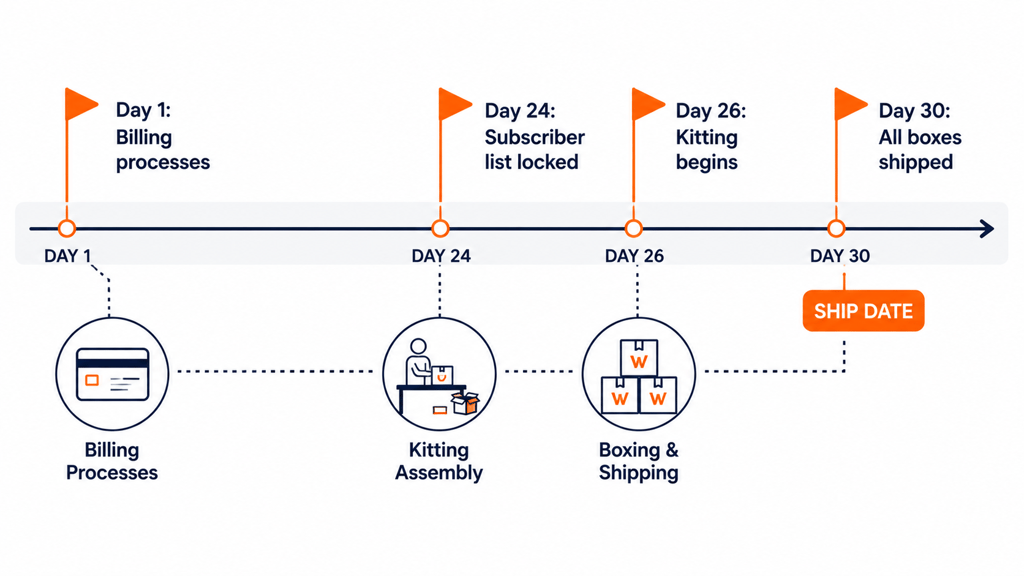
Subscription box fulfillment is a fundamentally different operational model: cycle-based batch processing, multi-item kitting, subscriber-list-driven volume, and zero tolerance for missed ship windows.
Key operational requirements:
- Dedicated assembly capacity with kit bill-of-materials management in the WMS
- Integration with billing platforms, including Recharge, Bold, and Cratejoy
- Batch processing aligned to monthly billing cycles with confirmed subscriber counts before assembly begins
- Damage-free kit packing with branded tissue, inserts, and custom void fill per brand specification
Crowdfunding and Campaign Fulfillment
Crowdfunding fulfillment is a one-time large-batch event: 500 to 50,000 or more backer rewards shipping within a compressed window, often with reward-tier-level item differentiation. A delayed shipment is a public relations event, not just a logistics incident.
Key operational requirements:
- Backer-list segmentation by reward tier managed inside the 3PL’s WMS
- Kit assembly differentiated by reward tier, with documented bill of materials per tier
- International shipping coordination for backers outside the US
- A 3PL with dedicated crowdfunding campaign fulfillment experience, since the one-time, time-compressed nature of campaign shipping is operationally unlike any recurring fulfillment model
Is Your Brand Ready for a 3PL? The Decision Framework
Outsourcing fulfillment before you are operationally or financially ready creates as many problems as it solves. Use this framework to assess readiness objectively and avoid a costly, disruptive mismatch.
You are ready for a 3PL when:
- Shipping 200 to 300 or more orders per month consistently
- Order fulfillment consumes more than 15 to 20% of your team’s working hours
- Running out of storage space, whether at home, in a garage, or in rented self-storage
- Shipping error rates are increasing as order volume grows
- Missing carrier pickup windows or processing orders 48 or more hours after placement
- Expanding to new sales channels, including Amazon, wholesale, or international markets
- Planning for a seasonal surge that will spike orders beyond current capacity
When to wait:
- Monthly order volume under 100 to 150 units with an unclear growth trajectory
- Products requiring handling so specialized that no 3PL has operational experience with them
- Margin structure does not yet support per-order 3PL fees at the current revenue level
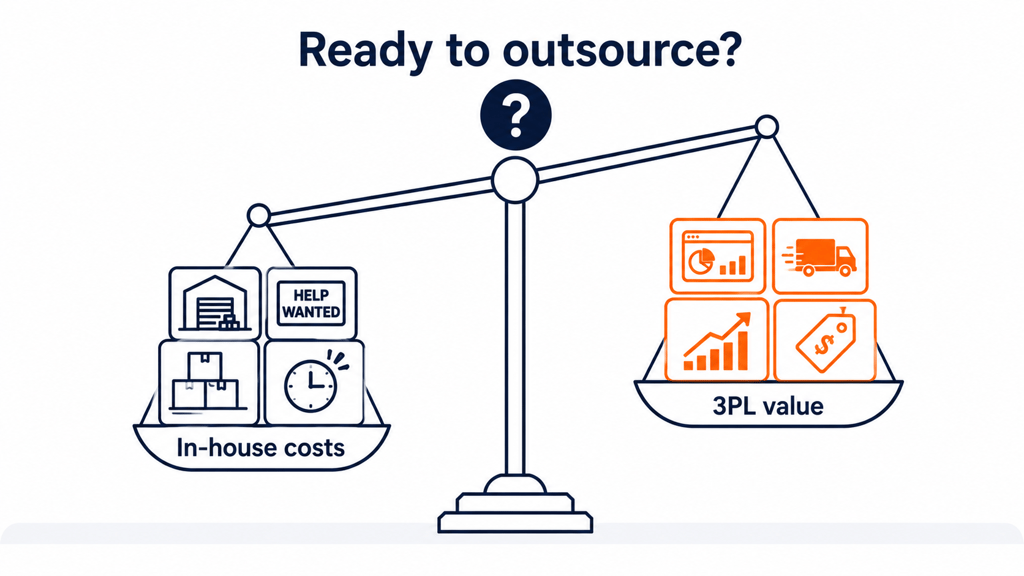
Readiness decision table:
| Metric | In-House Is Fine | 3PL Makes Sense When |
| Monthly orders | Under 200 and manageable | 200 to 300 or more consistently |
| Fulfillment hours per week | Under 15% of total team hours | Over 20% and rising |
| Shipping cost vs. 3PL rate | Within 15% of the 3PL rate | The 3PL rate is equal to or lower than |
| Warehouse lease on the table? | No lease yet | Actively considering signing |
| Returns volume per month | Under 30, manageable in-house | Over 50, consuming staff hours |
The outsourcing vs. in-house cost breakdown makes the variable-versus-fixed cost comparison explicit with real examples. The 3PL comparison guide gives you the evaluation criteria to assess any provider’s fit for your specific operation. When ready, getting started with Fulfyld takes you directly through the onboarding intake process.
What Happens After You Sign: The 3PL Onboarding Timeline
Most brands know they need a 3PL. Very few know what actually happens between signing the contract and the first live order shipping.
| Phase | Timeframe | What Happens | Who Owns It |
| Contract and Account Setup | Week 1 | Contract signed, account created, intake form completed, account manager assigned | 3PL and Brand |
| Integration and Tech Setup | Weeks 1 to 2 | E-commerce platform connected, WMS API configured, order sync tested end-to-end | 3PL IT and Brand |
| Inventory Transfer | Weeks 2 to 3 | Brand ships inventory to the warehouse; 3PL receives, counts, and enters all units into WMS | Both |
| System Testing | Weeks 2 to 3 | Test orders placed and processed end-to-end; tracking verified; exceptions tested | Both |
| Go Live | Weeks 3 to 4 | First live orders processed; account manager monitors closely in real time | 3PL |
| Optimization | Months 2 to 3 | SKU slotting optimized from real data; reorder alerts configured; monthly reporting established | Both |
What to prepare before onboarding starts:
- Complete SKU list with product dimensions, weights, and barcodes (UPCs or EANs)
- Inbound shipment scheduled from the supplier or existing warehouse to the 3PL facility
- Admin access to all connected sales platforms is granted to the 3PL integration team
- Packaging specifications confirmed, including any custom inserts, boxes, or branded materials
- Return policy documented in writing, including eligibility windows and condition requirements
- SLA requirements defined in advance; understanding what 3PL responsibilities include at each onboarding phase helps brands set contractual expectations before anything is signed with a 3PL fulfillment partner
Common onboarding mistakes to avoid:
- Shipping inventory before platform integration is fully tested means orders will not flow automatically
- Missing barcodes on product blocks received from logging units in the WMS entirely
- Treating the transition as a 2-week project creates a rushed, error-prone go-live window
The full integrations library covers which platforms connect natively. For Shopify-first brands, Shopify fulfillment services include native return routing built directly into the fulfillment workflow, so returns data flows back into your store automatically alongside outbound order tracking.
3PL Contract and SLA Red Flags to Watch Before You Sign
The 3PL contract you sign is more operationally consequential than the sales pitch that preceded it. These are the specific clauses and SLA terms that consistently cost brands’ inventory, margin, and operational control.
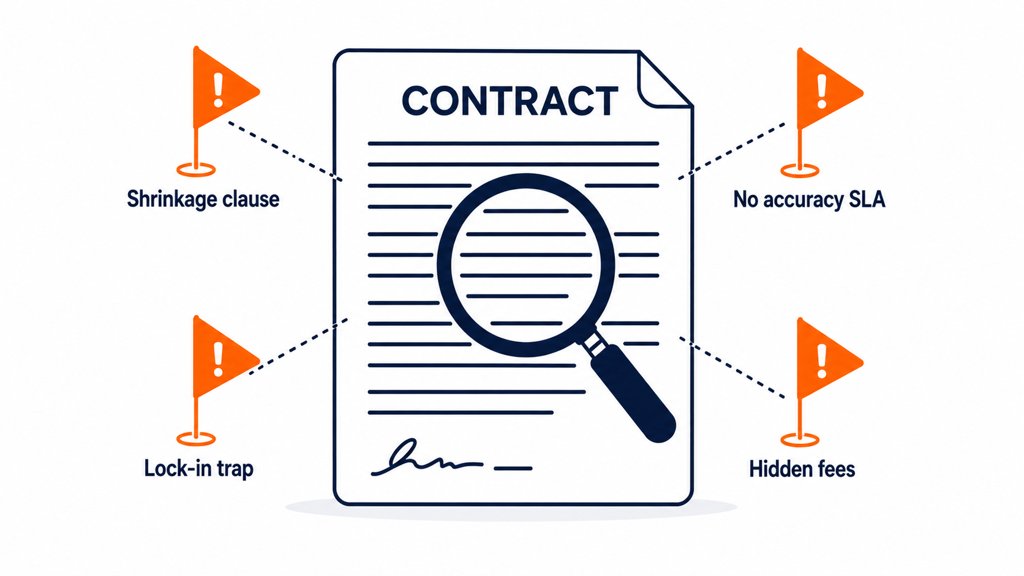
| Contract Term | What a Good Contract Looks Like | Red Flag |
| Order accuracy SLA | Specific percentage target stated (99%+) and enforceable with remedies | No accuracy SLA or “we strive for accuracy” language |
| On-time ship SLA | Defined percentage by cutoff time with the measurement methodology stated | “Best efforts” commitment or no defined threshold |
| Receiving / dock-to-stock SLA | Committed window stated in hours or business days | No receiving time commitment anywhere in the contract |
| Shrinkage allowance | Zero; 3PL is fully liable for inventory loss | 0.5 to 2% built-in allowance, transferring your inventory loss risk to you |
| Exit clause | 30 to 60 days’ written notice with a clear inventory retrieval process | 6 to 12 months lock-in with no performance-based exit right |
| Monthly minimum spend | None, or a transparent and reasonable stated floor | $1,500 to $5,000 or more minimum, regardless of order volume |
| Billing transparency | Line-item breakdown of every fee category provided upfront | Bundled fees with no itemization or itemization available “upon request.” |
| Carrier cost pass-through | Actual carrier rate charged with no markup | Undisclosed markup applied on top of negotiated carrier rates |
Red Flag 1: Shrinkage Allowances Built Into the Contract
Many 3PL contracts include a shrinkage allowance clause, typically 0.5 to 2% of inventory value, that makes inventory loss the brand’s financial problem rather than the 3PL’s. This clause lets the 3PL lose or damage a portion of your stock without financial accountability.
How to protect yourself before signing:
- Request written confirmation that the shrinkage allowance is zero, not 0.5% or 1%
- Confirm that the 3PL carries cargo liability insurance covering your full inventory value
- Ask how inventory discrepancies are documented, investigated, and resolved
- Require monthly inventory reconciliation reports with discrepancy explanations at the SKU level
Fulfyld operates on a zero-shrinkage policy: if inventory is lost or damaged inside the warehouse, Fulfyld bears the financial liability. Confirm this commitment in writing in any contract you evaluate.
Red Flag 2: No Defined Order Accuracy SLA
“We pride ourselves on accuracy” is a marketing statement, not a service level agreement. Without a defined accuracy target in writing, you have no contractual basis to act when error rates rise and no remediation process when customers start receiving wrong orders at scale.
What a real order accuracy SLA must include:
- A specific percentage target, 99% or higher, is stated explicitly in the contract
- A clear definition of what constitutes an “error,” including wrong item, wrong quantity, and missing item
- The measurement methodology used, whether WMS audit, customer complaint rate, or both
- A stated consequence if the target is missed, whether a credit, a fee waiver, or a remediation plan
Red Flag 3: Long Lock-In Without a Performance Exit Clause
A 12-month or longer commitment without a performance exit clause traps your brand even when the 3PL consistently misses the SLAs written into that same contract. Brands routinely lose 6 to 12 months of operational momentum simply because they have no contractual right to leave.
What to negotiate before signing any long-term agreement:
- A 30 to 60-day written notice period for standard termination
- A performance-based exit right is triggered if stated SLAs are missed by a defined margin for two consecutive months
- Clear inventory retrieval procedures, including timelines and any associated retrieval fees
- A transition assistance clause obligating the 3PL to cooperate with your next provider during the handoff period
Red Flag 4: Hidden Fees Not Disclosed Before Contract
The fee schedule shown during the sales process and the invoice arriving in month two are frequently very different documents. Setup charges, minimum storage fees, dimensional weight adjustments, and peak season Q4 uplifts accumulate into 15 to 30% above the quoted per-order rate for many brands.
How to eliminate surprise fees before you sign:
- Request a complete, itemized fee schedule covering every applicable charge category in writing
- Ask specifically about peak season surcharges, Q4 rate adjustments, and any volume-based minimum fees
- Confirm whether packaging materials are included in the pack fee or billed separately
- Verify whether carrier rate markups are applied on top of negotiated rates, and by how much
The case studies from the Sonia Roselli Beauty fulfillment partnership and the Daily Grind Planner fulfillment case study show what a genuinely transparent, accountable 3PL relationship looks like in practice. Review 3PL pricing models before entering any contract negotiation to understand which fee structures are industry-standard and which are designed to obscure true cost.
How Much Does 3PL Fulfillment Cost?
Understanding what 3PL fulfillment pricing is before you request quotes is how you compare proposals accurately and budget without surprises. The fee structure is consistent across the industry, even as the actual rates vary by provider, product type, and order volume.
Comprehensive 3PL fee structure:
| Fee Category | What It Covers | Typical Industry Range |
| Receiving/inbound | Unloading, count verification, putaway | $0.10 to $0.50 per unit or $25 to $50 per hour |
| Storage | Pallet or shelf space per month | $5 to $15 per pallet per month |
| Pick fee | Picking each item in an order | $0.15 to $0.75 per item |
| Pack fee | Packing, void fill, tape, label application | $0.50 to $2.00 per order |
| Packaging materials | Boxes, poly mailers, tissue, inserts | $0.20 to $2.00 per order |
| Shipping | Carrier cost at negotiated 3PL rate | Varies by weight, zone, and carrier |
| Returns processing | Receiving, inspecting, and dispositioning | $2 to $8 per return |
| Kitting / VAS | Assembly, inserts, custom packaging | $0.50 to $5.00 or more per unit |
Note: These ranges reflect publicly available 3PL industry pricing data. Actual rates vary by geography, product complexity, and order volume.
All-in per-order cost estimate for a standard DTC order (1 item, poly mailer, standard ground shipping):
- Pick plus pack plus materials: approximately $3 to $5
- Carrier cost at 3PL negotiated rate for average US zone: approximately $5 to $9
- Storage cost allocated per order: approximately $0.50 to $1.50
- Total estimated all-in cost per order: $8 to $15
Brands consistently shipping 1,000 or more monthly orders can negotiate below these benchmarks through volume-based pricing tiers.
What drives per-order cost up or down:
| Factor | Pushes Cost Higher | Pushes Cost Lower |
| Order volume | Low or inconsistent | High and consistent |
| SKU count | Many, frequently changing | Few, stable SKUs |
| Product size and weight | Large or heavy items | Small and lightweight items |
| Returns rate | High returns volume | Low returns volume |
| Value-added services | Kitting, inserts, custom packaging | Standard poly mailer only |
Use the fulfillment cost calculator to model your specific scenario against industry benchmarks. The guide on how to calculate fulfillment cost per order walks through the full methodology. For per-unit cost modeling that includes bulk discounts and landed cost components, the cost per unit calculator handles that calculation directly.
Third-Party Logistics Is the Infrastructure Behind Every Scalable Brand
Third-party logistics fulfillment is not a vendor decision; it is a foundational infrastructure choice that determines how fast you can scale, how well you serve customers, and how efficiently you deploy working capital. The 3PL fulfillment process, when executed well, removes the operational ceiling that most brands hit between 300 and 1,000 monthly orders.
Whether you are shipping 300 orders a month from your garage or 30,000 a month and evaluating distributed network optimization, the right 3PL converts logistics from a daily operational drain into a measurable competitive advantage.
Fulfyld offers transparent pricing, dedicated account management, and 99.99% operational accuracy across all fulfillment stages. Ready to see how the process works for your brand?
Get Started with Fulfyld | Request a Quote | Contact Our Team
View Our Full Service Line | Compare Fulfyld vs. Competitors
Frequently Asked Questions
How to use a 3PL for ecommerce fulfillment?
Ship your inventory to the 3PL’s warehouse, connect your sales channels via API, and the 3PL picks, packs, and ships every order automatically. Most brands are fully live within 3 to 4 weeks of contract signing. The 3PL handles storage, fulfillment, carrier coordination, and returns on your behalf from that point forward.
What is better: 3PL or in-house logistics?
3PL is better for most brands consistently shipping 200 or more orders monthly. In-house makes sense below that threshold, or when products require handling that no 3PL can replicate. The deciding variable is cost per order: when the 3PL’s all-in per-order cost matches or beats your true in-house cost, including your time, the transition makes financial sense.
How does 3PL improve e-commerce fulfillment?
A 3PL provides faster shipping, higher order accuracy (99%+), pre-negotiated carrier discounts, enterprise WMS technology, and scalable capacity for volume spikes without the capital investment of building in-house. Brands consistently report improved delivery times and significant freed-up staff capacity after transitioning.
How do 3PL services handle order fulfillment?
When a customer places an order, it syncs automatically from your sales platform to the 3PL’s WMS via API. The WMS generates a pick list, a warehouse associate picks and scans each item, packs the order, and prints the carrier label. Orders placed before the daily cutoff ship that same business day, with tracking pushed back to your platform automatically.
What is a 3PL fulfillment center?
A 3PL fulfillment center is a purpose-built warehouse operated by a third-party logistics provider, designed for high-velocity order processing rather than long-term bulk storage. It houses multiple clients’ inventory simultaneously, uses a WMS to track every unit in real time, and has carrier dock access for multiple daily pickups.
How much does 3PL cost?
Industry-typical 3PL costs include receiving ($0.10 to $0.50 per unit), storage ($5 to $15 per pallet per month), pick and pack ($1 to $3 per order), carrier shipping at negotiated rates, and returns processing ($2 to $8 per return). For a standard DTC order, the all-in per-order cost typically falls between $8 and $15.