
Choosing a fulfillment partner directly affects customer experience, operational efficiency, and how well a brand can grow.
This ShipBob review breaks down where the platform performs well, where it falls short, and how it holds up on the things that matter most once you’re evaluating a 3PL seriously: scalability, onboarding, integrations, and support.
Overview of ShipBob as a Fulfillment Provider
ShipBob is a technology-enabled 3PL that handles warehousing, order fulfillment, and shipping through a centralized software platform. It’s one of the most widely used fulfillment companies in ecommerce, particularly among brands selling across multiple channels.
Key aspects of ShipBob’s offering include:
- Warehousing across a large network of fulfillment centers in the US and internationally
- Software-based inventory and order management
- Broad integrations with ecommerce platforms and marketplaces
- Reporting tools for tracking fulfillment performance and cost
- A dedicated implementation specialist for onboarding, plus tiered support afterward
ShipBob Pros and Cons for Ecommerce Fulfillment
Like any 3PL, ShipBob’s strengths and limitations affect merchants differently depending on size, order volume, and product type. Here’s a breakdown based on common patterns in ShipBob reviews and customer feedback.
| Pros | Cons |
|---|---|
| Distributed fulfillment network | Cost sensitivity for smaller brands |
| Strong ecommerce integrations | Support variability during peak periods |
| Real-time inventory visibility | Limited customization for specialized handling |
| Scalable operations | No Amazon Seller-Fulfilled Prime support |
| Structured fulfillment processes | Occasional fulfillment or carrier delays |
| Customization options | Itemized fee structure |
Main Pros
- Distributed Fulfillment Network: A large footprint of warehouse locations allows brands to ship from closer to customers, reducing shipping delays.
- Strong Ecommerce Integrations: Native connections with major platforms make order and inventory syncing largely hands-off.
- Real-Time Inventory Visibility: Centralized tracking across every fulfillment center from one dashboard.
- Scalable Operations: ShipBob is built to support brands as order volume grows, not just steady-state shipping.
- Structured Fulfillment Processes: Standardized workflows help keep order handling consistent across locations.
- Customization Options: Branded packaging, inserts, and gift notes are available for brands that want a more premium unboxing experience.
Biggest Cons
- Cost Sensitivity for Smaller Brands – Monthly order minimums and storage fees can be a stretch for low-volume or newer sellers.
- Support Variability During Peak Periods – Some merchants report slower response times when support tickets spike around peak season.
- Limited Customization for Specialized Handling: Highly specific packaging or handling needs don’t always fit ShipBob’s standardized model.
- No Amazon Seller-Fulfilled Prime Support: Brands relying on the Prime badge outside of FBA will need a workaround.
- Occasional Fulfillment or Carrier Delays: A smaller share of reviews point to delays tied to carrier performance or high-volume surges.
ShipBob Onboarding, Integrations & Omnichannel Setup
Getting started with ShipBob follows a fairly standard 3PL onboarding path: a dedicated implementation specialist helps configure shipping settings, migrate inventory, and connect your sales channels.
| Category | Examples |
|---|---|
| Ecommerce & marketplaces | Shopify, BigCommerce, WooCommerce, Amazon, Walmart, eBay |
| Omnichannel & B2B/retail | EDI-compliant workflows, retail dropshipping programs |
| Order & inventory management | Multi-channel inventory and reporting tools |
| Returns management | Dedicated returns platforms |
| Marketing, CRM & support tools | Fulfillment data synced into broader operations |
| Accounting & tax | Cost reconciliation tools |
ShipBob’s Distributed Inventory Network: Features, Pros & Cons
ShipBob’s fulfillment centers span a large number of US locations plus additional international warehouses, and this distributed network is central to how the platform positions itself.
| Network Feature | Pro | Con |
|---|---|---|
| Multi-region warehousing | Shortens the distance (and time) between warehouse and customer | Splitting low-volume SKUs across many warehouses can raise per-unit storage costs |
| Facility redundancy | Reduces reliance on any single facility if one location has a delay | More locations mean more moving parts to monitor and reconcile |
| International reach | Supports cross-border expansion by storing inventory closer to non-US customers | Requires active forecasting — brands that don’t manage allocation can end up with imbalanced inventory |
What ShipBob Customers Are Saying
Across Trustpilot, G2, and the Shopify App Store, ShipBob generally sits in the 4-star range across thousands of reviews.
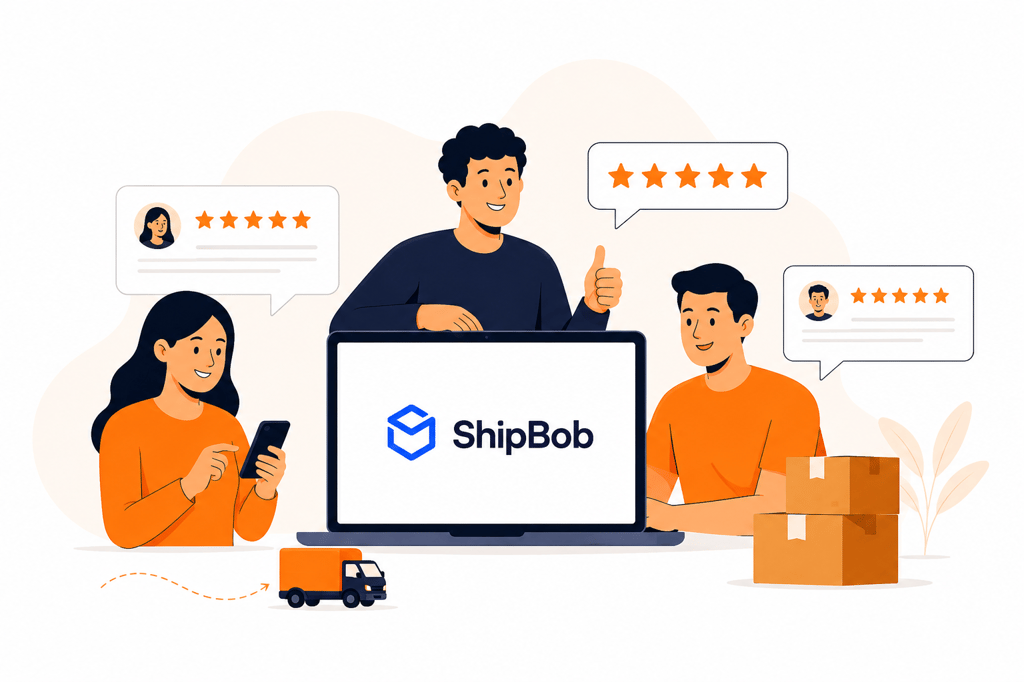
⭐⭐⭐⭐⭐ What customers appreciate:
- An intuitive dashboard with real-time inventory visibility across warehouses
- Responsive, hands-on account reps once a relationship is established
- Reliable handling of sudden sales spikes without needing a new setup
- Smooth Shopify and multi-channel integrations
⭐ What customers complain about:
- Actual invoices coming in higher than initial quotes, mostly through shipping costs
- Slow response times on support tickets, especially for smaller or newer accounts
- Lost, delayed, or mishandled inventory during transfers between warehouses
- Inconsistent service quality depending on account size and tenure with ShipBob
ShipBob vs. Fulfyld: Side-by-Side Comparison
Legend: ✅ = Included/Strong offering · ⚠️ = Available but varies by use case or plan · ❌ = Not included/limited
| Capability | ShipBob | Fulfyld |
|---|---|---|
| Distributed fulfillment network | ✅ Multi-location network | ✅ Strategically located warehouses |
| On-time delivery performance | ⚠️ Volume & season dependent | ✅ Consistency-focused |
| Order accuracy | 99.95% | 99.99% |
| Inventory accuracy | 97%–98% | 99.7% |
| Turnaround time | ⚠️ Volume-dependent | ✅ Optimized workflows |
| Order reliability | High overall, varies by volume | Exceptional reliability |
| Ecommerce platform integrations | ✅ Broad integrations | ✅ Core ecommerce integrations |
| Custom packaging & kitting | ⚠️ Limited flexibility | ✅ Supported |
| Scalability for growth | ✅ Designed to scale | ✅ Built for growing brands |
| Dedicated account manager | ❌ Tiered support, not guaranteed | ✅ Included |
| 24/7 human support | ❌ Not offered | ✅ Direct, human support |
| Guaranteed SLAs | ❌ Not offered | ✅ Included |
| Onboarding & transition support | ⚠️ Platform-led setup | ✅ Guided onboarding |
As your business scales, fulfillment expectations evolve. If ShipBob no longer aligns with your operational goals, Fulfyld offers greater consistency, visibility, and hands-on support without disrupting day-to-day operations.
Switching From ShipBob Doesn’t Have to Slow You Down
ShipBob is a capable, technology-driven 3PL with real strengths in network reach, integrations, and scalable infrastructure; it holds up well for brands with consistent volume and multi-channel operations.
Where it’s more likely to fall short is support consistency during peak periods and cost predictability for smaller or slower-moving catalogs.
If you’re evaluating ShipBob against other options, Fulfyld offers a flat, all-inclusive per-order rate, a dedicated account manager, and hands-on support built for growing brands. Get a free quote today.
FAQs
What are the pros and cons of ShipBob for a brand my size?
It depends heavily on order volume. ShipBob’s strengths tend to benefit mid-size to larger brands with consistent, predictable order volume.
Smaller or newer brands are more likely to feel the cons: order minimums, itemized fees that add up, and tiered support that doesn’t guarantee a dedicated point of contact.
Is ShipBob worth it, and who is it best (and worst) for?
ShipBob is generally worth it for established ecommerce brands with steady-to-high order volume, multi-channel selling, or B2B/retail distribution needs.
It’s a weaker fit for very early-stage stores, low-volume or slow-moving inventory, and brands needing highly specialized handling (hazmat, oversized, or heavily customized packaging) that falls outside standardized 3PL workflows.
How does ShipBob compare to Fulfyld on human 24/7 support?
ShipBob’s support is tiered and largely ticket-based, without a guaranteed dedicated account manager for every account, but response times can vary, particularly during peak periods.
Fulfyld includes direct, human support and a dedicated account manager as standard, which is one of the clearer differentiators between the two for brands that want a consistent point of contact rather than a support queue.
What are the best ShipBob alternatives?
The right alternative depends on what’s driving the switch. Brands that want a flat, predictable per-order rate and hands-on account management often look at Fulfyld.
Brands with highly specialized handling needs, low order minimums, or different niche requirements may fit better with other 3PLs suited to those specific constraints.
Is ShipBob good for high-volume or enterprise brands?
Yes, ShipBob’s network, software, and B2B/EDI programs are built to support higher-volume and enterprise-level operations, and scalability is one of its clearer strengths.
The main considerations at that scale are cost as volume and storage needs grow, and whether the tiered support model keeps pace with the level of account attention an enterprise brand typically expects.
Is ShipBob a good fit for apparel, fashion, or beauty brands?
For apparel and fashion, ShipBob’s SKU-level tracking handles size and color variants reasonably well, and its customization suite supports branded unboxing, though heavy seasonal spikes (holiday, back-to-school) are exactly where its peak-period support variability tends to show up.
For beauty and cosmetics, ShipBob covers standard pick-and-pack and kitting for bundles or gift sets, but brands with strict regulatory or hazmat-adjacent needs (aerosols, alcohol-based products) should confirm handling capabilities directly.