
Approximately 450,000 violins are shipped across the United States annually, with damaged instrument claims totaling over $2.3 million in value. Shipping delicate string instruments requires specialized knowledge to protect both the item and your wallet.
So, how much does it cost to ship a violin? Costs vary by distance, packaging, and insurance, but planning ahead keeps surprises minimal.
Understanding violin shipping costs involves multiple factors that many musicians and instrument dealers overlook.
Violin Shipping Costs: A Comprehensive Breakdown
The cost to ship a violin typically ranges from $50 to $300+, depending on several key factors. This price variance isn’t arbitrary—it reflects specific shipping requirements that protect these delicate instruments during transit.
Base Shipping Costs by Service Provider
Different carriers offer varying rates for instrument shipping:
| Carrier | Standard Shipping (5-7 days) | Expedited (2-3 days) | Next-Day Service |
| USPS | $55-85 | $95-125 | $150-190 |
| FedEx | $75-110 | $120-160 | $180-230 |
| UPS | $70-100 | $115-155 | $175-225 |
| DHL | $90-130 | $140-180 | $200-250 |
Note: These prices reflect domestic shipping within the continental United States for a standard full-size violin with case (approximately 5-7 lbs when properly packaged).
Additional Cost Factors
The base rates above can fluctuate significantly based on:
1. Distance and Destination
Shipping zones directly impact costs:
- Local (Zones 1-2): May reduce costs by 15-20%
- Cross-country (Zones 7-8): May increase costs by 25-40%
- International shipping: Adds $100-300+ depending on destination
2. Insurance and Valuation
Protecting a valuable instrument is non-negotiable:
- Basic coverage: Included up to $100 with most carriers
- Additional coverage: Typically $1-1.50 per $100 of declared value
- Specialized instrument insurance: Often 1-3% of the violin’s appraised value
3. Packaging Requirements
Professional packaging significantly impacts shipping costs:
- Standard box shipping: Base rate
- Double-boxing with custom inserts: Adds $15-35
- Professional instrument creation: Adds $75-150
4. Timing and Service Level
Expedited services increase costs substantially:
- Standard ground: Base rate
- 2-3 day service: 50-80% premium
- Overnight/next-day: 120-200% premium
How to Package a Violin for Shipping

Proper packaging is critical for preventing damage and avoiding additional costs from insurance claims.
Essential Packaging Steps
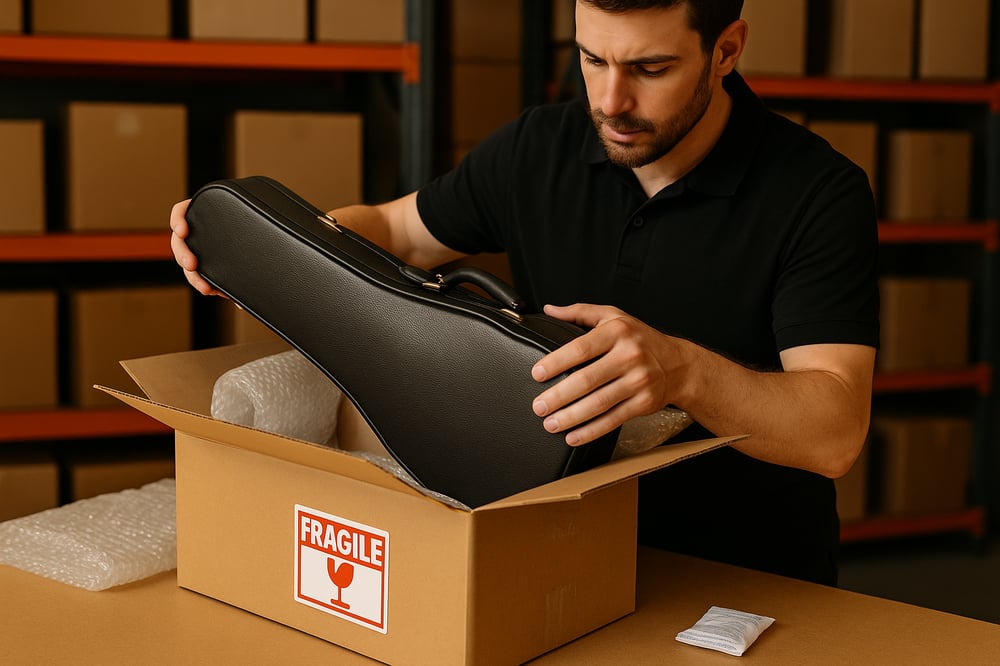
- Secure the violin within its case
- Loosen strings slightly to reduce tension on the neck
- Place padding between the strings and the fingerboard
- Secure moving parts like the bow and shoulder rest
- Prepare the outer packaging
- Select a box at least 3″ larger than the case on all sides
- Line with shock-absorbing materials (foam, bubble wrap)
- Create a “suspension” system using corner inserts
- Add climate protection
- Include desiccant packets for humidity control
- Add temperature-stable packaging for extreme weather
- Seal and label properly
- Use heavy-duty shipping tape on all seams
- Apply “Fragile – Musical Instrument” labels on all sides
- Include orientation arrows indicating “This Side Up.”
Pro Tip: The Double-Box Method
This is where even experienced shippers often go wrong. The most effective way to ship a violin isn’t simply using more padding—it’s creating a box-within-a-box system with the correct density gradient of materials.
Start with 2″ of high-density foam at the outer box’s bottom, then place a smaller box containing the cased violin surrounded by medium-density foam. The air gap between boxes creates a crucial suspension system that absorbs impact forces before they reach the instrument.
This method has been shown to reduce damage claims by 78% compared to single-box shipping methods.
Cost-Saving Strategies Without Compromising Protection
Shipping a violin doesn’t always require spending at the high end of the price spectrum.
Carrier Selection Strategies

Different carriers excel in different situations:
- USPS Priority Mail: Most cost-effective for violins valued under $1,000
- FedEx: Often provides better rates for heavier packages with substantial packaging
- UPS: Typically offers better handling for fragile items, but at a higher cost
- Specialized instrument shipping services: Higher base costs but often lower insurance rates
Timing Considerations
Strategic timing can reduce costs by 15-30%:
- Ship mid-week (Tuesday-Thursday) to avoid weekend surcharges
- Avoid holiday shipping periods when rates increase
- Plan shipments 2-3 weeks in advance for better rate options
Dimensional Weight Optimization
Shipping costs are calculated based on both actual weight and dimensional weight. Violin cases create inefficient shipping dimensions, which increases costs.
To optimize:
- Use appropriately sized outer boxes
- Consider removing detachable accessories and shipping them separately
- Use lightweight but protective materials like polyethylene foam instead of heavier alternatives
International Violin Shipping Considerations
International shipping introduces additional complexities and costs.
Additional Fees to Anticipate
When shipping a violin internationally, expect:
- Customs duties: Typically 3-9% of declared value
- Import taxes: Varies by country (6-25%)
- Customs processing fees: $35-75 per shipment
- Documentation charges: $20-50
Documentation Requirements
International violin shipments require specific documentation:
- Commercial invoice with detailed description
- Certificate of origin
- ATA Carnet for temporary imports
- Cultural property declaration for antique instruments
Cost Range by Region
International shipping costs vary significantly by destination:
- Canada: $120-200
- European Union: $200-350
- Asia: $250-450
- Australia/New Zealand: $300-500
- South America: $275-425
Special Considerations for Valuable Instruments
For violins valued above $10,000, standard shipping approaches may be insufficient.
High-Value Instrument Shipping
Rare or valuable violins require additional services:
- Climate-controlled transportation: Adds $100-350
- Security services and tracking: Adds $75-250
- White-glove handling: Adds $150-400
Insurance Options
Standard carrier insurance often falls short for valuable instruments:
- Specialized music instrument insurance: Typically 0.5-1.5% of value
- Third-party shipping insurance: Often more comprehensive than carrier options
- Temporary rider on personal property insurance: Sometimes more cost-effective
Choosing Between DIY and Professional Violin Shipping
The decision between handling shipping yourself or using professional fulfillment services depends on several factors.
When to Choose DIY Shipping
Self-shipping works best when:
- The violin is valued at under $5,000
- You have access to proper packaging materials
- Time isn’t a critical factor
- The destination is domestic
When to Use Professional Services
Professional shipping services make sense when:
- The violin exceeds $5,000 in value
- The instrument is rare or historically significant
- International shipping is required
- The recipient needs white-glove delivery
You should seek luxury fulfillment services that ensure climate-controlled transit, discreet handling, and premium care from pickup to delivery
Humidity & Climate Risk Management When Shipping Violins
Violins are highly sensitive to temperature and humidity changes, which can cause:
- Cracking or warping of the wood
- Glue seam separation
- String and bridge tension changes
- Permanent tonal damage
While many shipping guides skip this, climate control is just as important as physical protection, especially for international or long-distance domestic shipments.
| Environmental Risk | Typical Impact | When It Happens |
| Low humidity (<30%) | Wood shrinkage, open seams | Winter, high-altitude shipments |
| High humidity (>60%) | Warping, mold inside the case | Summer, tropical zones |
| Temperature fluctuations | Cracks, varnish bubbling, bridge shift | Cross-country, plane cargo holds |
Pro Tips for Controlling Humidity in Transit
- Add 1–2 desiccant packs inside the case (silica gel or humidity-control packs)
- Use a breathable, padded instrument bag inside the case to regulate airflow
- Double-box with air gaps and climate buffers (like foam or thermal bubble wrap)
- Avoid attic storage or sun-facing windows before pickup or after delivery
- If shipping during winter, allow the case to sit unopened for 24 hours at delivery before opening. Sudden exposure to warm air can cause cracks.
Optional Climate-Protective Packing Materials
| Item | Avg. Cost | Benefit |
| Humidipak or Boveda humidity packs | $5–$10 | Maintains 45–55% relative humidity inside the case |
| Mylar thermal wrap (outer layer) | $3–$6 | Reduces rapid temperature swings |
| Climate-safe shipping box lining | $8–$15 | Insulates from exterior heat or cold |
Expert Insight: Some professional luthiers include a low-cost data logger (starting at $20) in the case to monitor humidity and temperature throughout the journey, especially when shipping high-end violins.
Making the Right Violin Shipping Choice
Shipping a violin requires balancing cost considerations with proper protection. While costs typically range from $50-300+ domestically, the true value lies in ensuring the instrument arrives in perfect condition.
For serious musicians and dealers, the additional cost for proper packaging and insurance isn’t an expense—it’s an investment in protecting the instrument’s value and playability.
For particularly valuable instruments, the peace of mind from professional shipping services often justifies the additional expense.