The global perfume market reached $50.85 billion in 2022 and continues to grow at a rapid 5.9% annual rate.
With such valuable, fragile products moving through supply chains worldwide, preventing leakage isn’t just about avoiding messes—it’s about protecting significant investments and maintaining customer trust.
Successfully shipping perfumes requires specialized knowledge that goes far beyond standard packaging protocols.
Essential Perfume Packaging Materials and Techniques to Avoid Leakage
The foundation of leak-proof perfume shipping begins with selecting appropriate materials specifically designed to handle these volatile liquids.
Standard packaging simply won’t suffice for products containing alcohol and oils that can deteriorate common materials.
Primary Perfume Containment
The first line of defense against leakage starts with the bottle itself:
- Bottle Sealing: Ensure atomizers and caps are properly tightened and sealed. Apply thin PTFE tape to threaded caps for an extra barrier against leakage.
- Pressure Testing: Subject filled bottles to a brief pressure test by gently squeezing each container while inverted to verify seal integrity.
- Temperature Stabilization: Allow newly filled bottles to stabilize at room temperature for 24 hours before packaging to account for expansion and contraction.
Secondary Containment Systems
Every properly shipped perfume should include a secondary containment system to capture any potential leaks from the primary container:
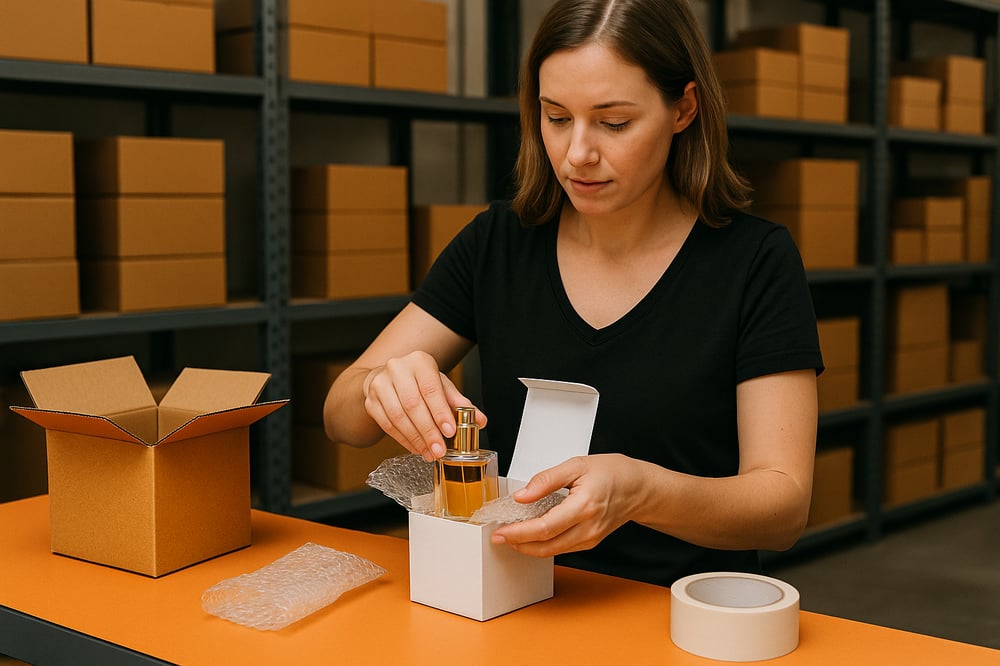
- Polythene Bags: Heat-sealed, 4-mil-thick polythene bags can contain leaks from the primary bottle.
- Absorbent Wrapping: Surround bottles with specialized absorbent materials designed for fragrance containment without degradation.
- Vacuum-Sealed Options: For high-value fragrances, vacuum–sealed bags provide visual confirmation of container integrity throughout the shipping process.
Protective Cushioning Materials
Once contained, perfume bottles require proper cushioning to prevent breakage during transit:
- Custom Foam Inserts: Precision-cut foam with bottle-shaped recesses prevents movement while distributing impact forces.
- Air Column Packaging: Air cushion systems provide excellent protection while minimizing weight and shipping costs.
- Shock-Absorbing Materials: High-density polyethylene foam offers superior protection compared to standard bubble wrap, which can deteriorate when exposed to leaked perfume.
Regulatory Compliance for Shipping Perfumes

Perfumes contain alcohol and other substances classified as hazardous materials by shipping regulations, making compliance a critical aspect of the shipping process.
Understanding Hazardous Materials Classification
Most perfumes fall under Class 3 Flammable Liquids in shipping regulations due to their alcohol content:
- Limited Quantity Provisions: Perfumes under 1 liter often qualify for limited quantity exceptions, reducing documentation requirements while still mandating proper packaging.
- Proper Shipping Names: Use the designated UN1266 (Perfumery Products) classification and appropriate shipping names on documentation.
- Carrier-Specific Requirements: Major carriers like FedEx, UPS, and USPS have specific perfume shipping protocols that must be followed precisely.
Documentation and Labeling Requirements
Proper documentation ensures regulatory compliance and smooth customs clearance:
- Safety Data Sheets: Maintain current SDSs for all fragrances being shipped.
- Hazard Labels: Apply appropriate diamond-shaped hazard labels to outer packaging.
- Declaration Forms: Complete hazardous materials declaration forms accurately, including UN numbers, proper shipping names, and quantity information.
International Shipping Considerations
Cross-border perfume shipping adds complexity through varying international regulations:
- Customs Documentation: Provide accurate descriptions, harmonized tariff codes, and values on customs forms.
- Country-Specific Restrictions: Research destination country restrictions—some nations limit perfume imports by concentration or quantity.
- IATA Compliance: For air shipments, adhere to the International Air Transport Association Dangerous Goods Regulations.
Temperature Control and Stability
Perfumes contain volatile compounds that can deteriorate or behave unpredictably under temperature extremes, making climate control essential during shipping.
Optimal Temperature Ranges
Maintain specific temperature ranges to preserve fragrance integrity and prevent leakage:
- Ideal Range: Ship perfumes between 55°F and 75°F (12°C-24°C) to maintain stability.
- Extreme Avoidance: Temperatures above 85°F can cause expansion and pressure buildup within bottles.
- Cold Weather Precautions: Freezing can crack glass bottles and alter fragrance compounds.
Climate-Controlled Shipping Options
Protect perfumes from temperature fluctuations during transit:
- Insulated Packaging: Thermal-reflective liners and insulated boxes maintain more consistent temperatures.
- Phase-Change Materials: Incorporate temperature–stabilizing packs that absorb or release heat as needed.
- Expedited Shipping: Reduce exposure to temperature fluctuations by choosing faster shipping methods.
Testing and Quality Assurance Protocols
Implementing robust testing procedures significantly reduces leakage incidents and ensures consistent quality control.
Pressure and Drop Testing
Verify packaging integrity before shipping:
- Simulated Altitude Testing: Test packaged perfumes in pressure chambers to simulate air transport conditions.
- Drop Testing Protocol: Subject packaged perfumes to standardized drop tests from 3-4 feet onto concrete surfaces from multiple angles.
- Vibration Testing: Use vibration tables calibrated to simulate common transportation conditions.
Leak Detection Methods
Identify potential leakage issues before items leave the warehouse:
- UV Detection: Add UV-reactive compounds to test packages to make even microscopic leaks visible under blacklight.
- Compression Testing: Apply standardized pressure to completed packages to identify weak points.
- Hold Periods: Implement a 24-hour hold period after packaging to check for slow leaks before shipping.
The 40-30-30 Rule for Leak-Proof Perfume Shipping

Here’s an industry insider technique that an experienced fulfillment company relies on but rarely shares publicly: the 40-30-30 rule for perfume packaging. This approach allocates resources proportionally to the three critical aspects of leak prevention:
- 40% Focus on Primary Sealing: The most effective leak prevention happens at the bottle level. Allocate extra time to properly seal bottle necks with specialized tools like torque-controlled cap sealers calibrated specifically for perfume bottles.
The industry standard is 15-20 inch–pounds of torque, significantly less than most inexperienced handlers apply, which can damage seals and cause leaks.
- 30% Focus on Material Compatibility: Not all packaging materials work with perfumes. Use only packaging components tested for chemical compatibility with high-alcohol solutions.
Many standard tapes, adhesives, and plastics will deteriorate within hours of exposure to perfume oils. The perfume warehousing sector maintains an internal database of compatible materials—always select packaging components rated “P3” or higher for alcohol resistance.
- 30% Focus on Temperature Stabilization: Allow packaged perfumes to “rest” in a temperature-controlled environment (68°F ±2°F) for a minimum of 8 hours before shipping.
This stabilization period allows any potential expansion/contraction cycles to occur in controlled conditions rather than during transit, dramatically reducing pressure-related leakage by up to 87% according to industry studies.
Handling Returns and Managing Leakage Incidents
Even with perfect prevention systems, occasional leaks happen. Having robust response procedures minimizes damage and maintains customer relationships.
Return Processing Protocols
Establish clear procedures for handling returned perfumes:
- Quarantine Areas: Designate specific areas for processing potentially damaged perfumes.
- Ventilation Requirements: Ensure proper ventilation in areas where leaking perfumes are handled.
- PPE Standards: Provide appropriate personal protective equipment for staff handling damaged goods.
Root Cause Analysis
Continuously improve by analyzing every leakage incident:
- Digital Documentation: Record details of each incident, including shipping conditions, packaging methods, and damage patterns.
- Pattern Identification: Review data regularly to identify recurring issues or seasonal factors.
- Process Refinement: Implement targeted improvements based on analysis findings.
Advanced Techniques for High-Volume Perfume Fulfillment
For operations shipping perfumes at scale, implementing systematic approaches ensures consistency and efficiency.
| Technique | Manual/Semi-Automated | Automated Systems |
| Leak Detection | Visual + hand inspection | Vision system + weight sensors |
| Batch Testing | Sample sniff test + shake method | AQL-based sampling + stress testing chambers |
| Packaging | Manual bottle capping + foam insertion | Semi-automated boxing + conveyor integration |
| Process Tracking | Paper logs or basic barcode scans | Full integration from fill line to shipment |
| Cost Efficiency | Lower setup cost, higher labor per unit | Higher setup cost, lower long-term cost per unit |
| Best Use Case | Small-to-mid volume with high product variety | Large-scale fulfillment with stable product line |
Batch Verification Methods
Implement statistical quality control for larger perfume shipments:
- Sampling Protocols: Test a statistical sample of each batch based on AQL (Acceptable Quality Limit) standards.
- Environmental Stress Testing: Subject sample packages to accelerated environmental conditions to predict performance.
- Documented Verification: Maintain testing records for each batch to quickly identify and resolve systemic issues.
Automation Considerations
Balance automation with necessary manual inspection:
- Automated Leak Detection: Implement vision systems and weight verification technology to identify potential leaks.
- Semi-Automated Packaging: Use automation for repetitive tasks while maintaining human oversight for critical inspection points.
- Integrated Tracking: Implement systems that track each perfume from filling through final packaging for complete process visibility.
Making the Right Choice for Perfume Logistics
Shipping perfumes safely requires specialized knowledge, materials, and processes beyond standard e-commerce beauty fulfillment capabilities. Whether handling fulfillment in-house or partnering with logistics providers, prioritize expertise in hazardous materials handling and fragrance-specific packaging protocols.
Consider factors like temperature-controlled storage, regulatory compliance capabilities, and specialized handling equipment when evaluating perfume shipping options.
The most cost-effective approach isn’t necessarily the cheapest initial quote—it’s the one that delivers products intact, complies with regulations, and maintains the luxury experience customers expect when purchasing fine fragrances.