
ShipHype’s own pitch leans hard on a growth story: a single warehouse in 2020 that’s since scaled into a multi-location US and Canada network built around fast-moving Shopify and Etsy sellers.
That framing sets the bar for this review. Here’s what holds up, what doesn’t, and how it stacks up on scalability, onboarding, and integrations.
Overview of ShipHype as a Fulfillment Provider
ShipHype is a tech-enabled 3PL built primarily around Shopify, Etsy, and multi-channel ecommerce sellers, with fulfillment centers across the US and Canada.
It runs on ShipHero’s warehouse management system and layers its own dashboard, account management, and fulfillment rules on top.
Main aspects of ShipHype’s offering include:
- A real-time dashboard for order status, with the ability to edit, hold, or modify orders mid-process
- Direct integrations across most major ecommerce platforms and marketplaces
- Same-day shipping for orders placed before a set daily cutoff
- Dedicated account managers assigned per brand
- Kitting, bundling, subscription box, and FBA prep support
- Returns processing and restocking
ShipHype Reviews: Pros and Cons
Feedback on ShipHype clusters fairly consistently around a few themes: strong onboarding and account support, solid platform coverage, and the usual growing pains that show up once volume or service complexity increases.
| Pros | Cons |
|---|---|
| Strong Shopify and Etsy platform support | Cost can rise as add-on services stack up |
| Same-day shipping cutoff | Support response can slow during peak periods |
| Real-time order dashboard with mid-process edits | Integration setup complexity varies by technical familiarity |
| Dedicated account managers | Newer, smaller network than the largest 3PLs |
| Broad integration coverage across marketplaces | Standard workflows fit better than highly custom ones |
Main Pros
- Multi-Channel Platform Support: Native connections across Shopify, Etsy, Amazon, WooCommerce, Walmart, and more keep orders flowing without manual reconciliation.
- Same-Day Shipping: Orders placed before the daily cutoff generally ship same-day, which matters for brands competing on delivery speed.
- Order-Level Control: The dashboard lets merchants edit, hold, or modify orders in progress rather than only viewing status after the fact.
- Dedicated Account Management: Reviews frequently cite a named account contact as a meaningful part of the onboarding and ongoing experience.
- Returns & Value-Added Services: Returns processing, kitting, and subscription support are built into the core offering rather than bolted on.
Biggest Cons
- Costs Can Add Up: Pricing is generally viewed as straightforward at the outset, but several brands note totals climbing as additional services get layered in.
- Peak-Period Support Variability: Response times are usually solid day-to-day but can slow when ticket volume spikes.
- Integration Setup Varies: Most connections are smooth, but brands without technical resources sometimes need more hand-holding to configure less common platforms.
- Smaller Network Than Legacy 3PLs: ShipHype’s footprint has grown quickly but is still smaller than the largest, longest-established fulfillment networks.
- Best Fit Is Fairly Standard Workflows: Highly customized or non-standard fulfillment needs take more configuration than ShipHype’s core model is built around.
ShipHype Scalability, Peak Season & Growth Support
For brands evaluating ShipHype specifically on scalability, growth is arguably the company’s whole pitch. Its own case studies lead with brands going from a few hundred orders a day to several thousand.
The question worth digging into is what that scaling actually looks like operationally.
Where ShipHype scales well:
- Order volume growth is handled through the same dashboard and account structure rather than forcing a system change as a brand grows.
- Multi-channel sellers can add new platforms (Shopify, Etsy, marketplaces) without standing up a separate fulfillment relationship for each.
- Custom shipping and fulfillment rules can be configured to handle more complex order logic as operations mature.
Where scalability gets tested:
- Peak-season volume spikes are where support response times are most likely to slow, based on recurring feedback themes.
- A newer, smaller warehouse network than the largest 3PLs means less built-in redundancy if one facility gets slammed during a surge.
- Brands scaling into more complex fulfillment needs (special handling, highly custom kitting) may need more account management attention to keep pace with standard turnaround times.
ShipHype Onboarding, Integrations & Platform Support
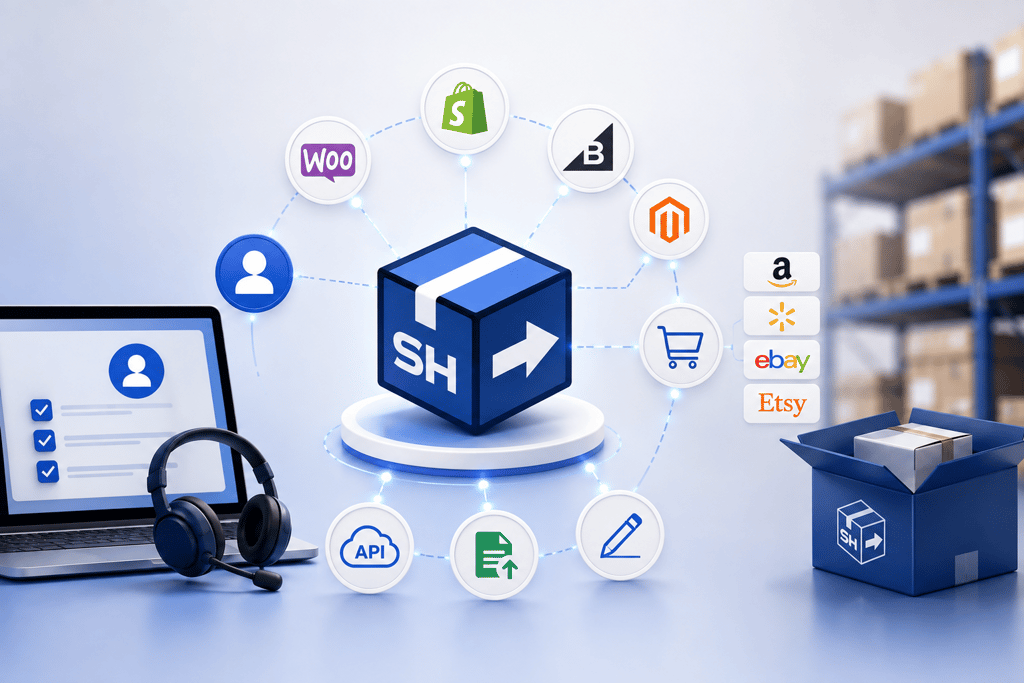
Onboarding is one of the more consistently praised parts of the ShipHype experience; reviewers regularly describe the initial setup and account manager introduction as smooth and well-guided.
On integrations, ShipHype connects directly with most major ecommerce platforms and marketplaces, with particular emphasis on Shopify and Etsy given its core customer base.
| Category | Examples |
|---|---|
| Ecommerce platforms | Shopify, WooCommerce, BigCommerce, Magento |
| Marketplaces | Amazon, Walmart, eBay, Etsy |
| Order intake alternatives | API, CSV upload, manual order entry |
| Fulfillment infrastructure | Built on ShipHero’s warehouse management system |
For Etsy sellers specifically, order routing is automated, which helps with the variation-heavy, personalization-driven listings that don’t always map cleanly to standard SKUs. For Shopify sellers, the integration syncs orders, inventory, and tracking directly into the dashboard.
Setup for these core platforms is generally described as straightforward; less common or highly customized integrations take more configuration and are where technical familiarity matters more.
What Customers Say About ShipHype

ShipHype generally holds a rating of 4.1 stars on Trustpilot across a modest number of reviews.
⭐⭐⭐⭐⭐ What customers appreciate:
- A smooth, well-guided onboarding process with a responsive account manager
- Reliable day-to-day order processing for standard ecommerce volume
- Positive feedback specifically from Shopify and Etsy sellers on platform integration and order routing
- Support for scaling order volume without switching systems
⭐ What customers complain about:
- Occasional mismatches between quoted shipping timelines and actual delivery, particularly for less common shipping scenarios
- Costs increasing as additional services are added on top of the base fulfillment rate
- Slower support responsiveness during high-volume or peak periods
ShipHype vs. Fulfyld: Side-by-Side Comparison
Legend: ✅ = Included/Strong offering · ⚠️ = Available but varies by use case or plan · ❌ = Not included/limited
| Capability | ShipHype | Fulfyld |
|---|---|---|
| Shopify & Etsy integrations | ✅ Core strength | ✅ Core ecommerce integrations |
| Same-day / fast shipping | ✅ Cutoff-based same-day shipping | ✅ 2-day guaranteed fulfillment |
| Order dashboard & mid-process edits | ✅ Included | ✅ Real-time visibility |
| Scalability for growth | ✅ Built around scaling brands | ✅ Designed to scale |
| Dedicated account manager | ✅ Included | ✅ Included |
| Pricing predictability | ⚠️ Can grow complex with add-ons | ✅ Flat, all-inclusive per-order rate |
| Support consistency during peak | ⚠️ Varies by ticket volume | ✅ Direct, human support |
| Onboarding experience | ✅ Generally smooth | ✅ Guided onboarding |
If ShipHype’s model doesn’t quite fit as your operations scale, Fulfyld offers a flat, predictable rate and hands-on support, including structured onboarding, platform integrations, and ongoing performance review against clear 3PL KPIs.
Growing Past ShipHype Doesn’t Mean Starting From Scratch
ShipHype earns its reputation with fast-growing Shopify and Etsy sellers — strong platform integrations, same-day shipping, and a genuinely smooth onboarding experience. Where it’s more likely to show strain is cost predictability as services stack up and support consistency once volume spikes.
If you’re evaluating ShipHype against other options, Fulfyld offers a flat, all-inclusive per-order rate, a dedicated account manager, and hands-on support built for growing ecommerce brands. Get a free quote today.
FAQs
Is ShipHype good for one-day or same-day shipping?
Yes, orders placed before ShipHype’s daily cutoff are generally shipped same-day, which is one of its more consistently cited strengths.
Actual delivery time to the customer still depends on carrier service level and destination, so same-day shipment isn’t the same guarantee as one-day delivery.
Does ShipHype integrate with Shopify and Etsy?
Yes, both are core integrations. Shopify orders, inventory, and tracking sync directly into ShipHype’s dashboard, and Etsy order routing is automated.
Who is ShipHype best for, and what are the alternatives?
ShipHype tends to fit fast-growing Shopify and Etsy sellers, along with multi-channel brands that need to add marketplaces without standing up separate fulfillment relationships.
Brands that want a flat, predictable per-order rate and consistent support at scale often compare it against Fulfyld. See more ShipHype comparisons and reviews.
How does ShipHype compare to Fulfyld on shipping speed and support?
Both offer fast fulfillment. ShipHype has a same-day cutoff; Fulfyld has guaranteed 2-day fulfillment, so the practical difference shows up more in support consistency than raw speed.
ShipHype’s support is generally responsive but can slow during peak periods; Fulfyld includes a dedicated account manager and direct human support as standard, aimed at keeping that experience consistent regardless of season.