

Most dropshipping stores fail for one boring reason: nobody counted the real cost of getting started. Ad spend, supplier fees, and apps add up faster than founders expect, and it gets expensive fast.
A solid business startup costs template turns that guesswork into a number you can actually plan around before you spend a dollar.
What’s Inside the Template and How to Fill It In
Our free startup costs Excel template is built for dropshipping stores rather than restaurants or franchises, and there’s no email required to download it.
One sheet, seven categories, and a total that adds itself up:
- Business Formation: business registration, legal fees, licenses, and permits
- Website and Technology: domain name, hosting, design and development, e-commerce platform subscription, SSL certificate
- Marketing and Advertising: initial campaign, social media advertising, email marketing software
- Inventory and Product: initial product samples, inventory management software
- Operational: office supplies, shipping materials, virtual assistant, or staff salaries
- Financial: accounting software, transaction fees
- Miscellaneous: contingency fund, other expenses
Fill in every row, including the ones you expect to be zero, and don’t let the vague ones stall you. Legal fees mean your terms and conditions and a privacy policy.
Licenses and permits depend entirely on what you sell and where you sell it. The row you skip is usually the one that breaks the budget in month three.
Use Both Cost Columns, Not Just One
The template gives you an Estimated Cost column and an Actual Cost column, and the second one is where the value is.
Your first pass is guesswork and belongs in Estimated. As real quotes and invoices land, fill in Actual and watch the gap.
That gap is the most useful number in the file. It tells you how far off your instincts run, and it’s what turns a wishlist into a business budget template you can defend to a partner or a lender.
Mark the Rows That Repeat Every Month
The template totals everything into one launch number, but several rows aren’t one-time costs at all.
Your platform subscription, email marketing software, inventory management software, accounting software, and any VA salary come back every single month.
Flag those as you fill them in, because a store needs two numbers rather than one:
- What it costs to open the doors: the one-time costs, totalled
- What it costs to keep them open: the recurring rows, multiplied by the months before you turn a profit
Then add extra to both numbers, because your first estimates are almost always too low:
| Bucket | How much to add |
| One-time rows | Add ~10% |
| Recurring rows | Add ~15% |
| Contingency fund row | 3 to 6 months of recurring costs |
What a Dropshipping Launch Actually Costs
Most startup cost advice is written for restaurants and food trucks, so the figures are useless to you. Here is roughly what the template’s own rows run for a dropshipping store right now:
| Template row | Typical 2026 range |
| Business registration | $50 to $500, plus $0 to $800 a year |
| E-commerce platform subscription | $29 a month billed annually, $39 billed monthly |
| Domain name | $8 to $20 a year |
| Initial product samples | $50 and up, per product |
| Inventory management software | $20 to $50 a month |
| Social media advertising | $300 to $1,000 a month to test properly |
| Transaction fees | Roughly 2.9% plus 30 cents per order |
Transaction fees are the row most founders leave blank, and it’s the costliest blank in the file.
At $10,000 in monthly sales across 150 orders, card fees run about $335, nearly nine times the platform subscription everyone frets over.
Add it all up and a lean launch on free traffic lands near $500 to $2,000.
Fund a proper three-month testing window with paid ads, plus a returns buffer for the 5% to 15% of orders that come back, and the realistic figure climbs to $3,500 to $8,000.
Neither is wrong; they answer different questions. Pick your version before you fill in a single cell, because the two produce a very different business budget template.
How Much Cash You Need Before Your First Profitable Month
The template tells you what a launch costs. It doesn’t tell you how long you’ll bleed before revenue covers it, and that gap is what actually closes stores.
Three things stretch it wider than the founders’ plan for:
- Ad testing losses, since most product tests never find a winner, and that spend buys information rather than profit
- Payment processor holds, because new merchants often fund their first orders before payouts are released
- Time itself, since profitability commonly takes two to six months of testing, which is two to six months of recurring rows with no revenue behind them
So the contingency fund isn’t a decorative row. It’s the runway that buys time to find a product that works, which is why you size it in months of recurring costs instead of a round number that feels safe.
How to Spend Less Without Underfunding Your Launch
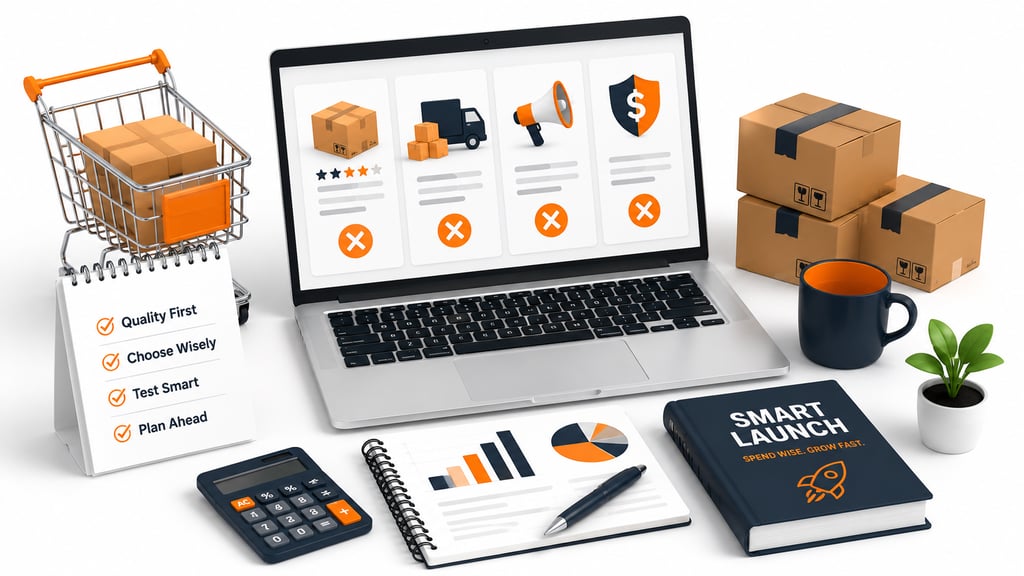
Cutting costs is easy. Cutting the wrong costs is what turns a cheap launch into an expensive failure. Four savings look smart on a spreadsheet and aren’t:
| Tempting cut | What it saves | What it can cost |
| Skip product samples | $50 and up per product | Refunds on quality you never checked yourself |
| Take the cheapest supplier | A few points of margin | Late deliveries, which cost more in refunds than the discount was worth |
| Pause ads to preserve cash | $300 to $1,000 a month | The test that would have found your winning product |
| Zero out the contingency fund | Nothing, it’s your own money | The store, in the first slow month |
Where the savings are real: compare supplier quotes across a few vendors before you commit, because every dollar off sourcing goes straight to margin.
Overseas suppliers usually win on unit price, though longer shipping, language barriers, and quality control at a distance can hand that saving straight back in refunds.
Traffic is the other honest lever. Social media, content marketing, and SEO cost hours instead of dollars, which is the trade a lean launch wants.
Partnering with influencers works the same way; free product in exchange for an honest review or a sponsored post buys visibility without ad spend.
Shift into paid once something converts on its own, then fold the savings back into your business budget template.
Turn Your Estimate Into a Working Budget
A launch number is a snapshot, and it goes stale the week you open. What keeps a store alive is filling in that Actual column every month, which is how a one-time estimate becomes a working business budget template.
Pair it with a break-even analysis to find the month you stop losing money, a burn rate tracker to watch the cash, and a profit and loss statement to see what you really earned.
Get the numbers honest early, and everything downstream gets easier, including handing fulfillment to a partner like Fulfyld once the volume shows up. Then what fulfillment costs become just one more row to fill in.
Templates track the work. We do the work.
This file will carry you a long way. But past a few hundred orders a month, tracking fulfillment in a spreadsheet becomes the bottleneck. That is the point of a 3PL: Fulfyld picks, packs, and ships every order under a formal SLA with automatic credits, one flat all-inclusive per-order price, and a dedicated account manager who knows your catalog.
Get a real quote