
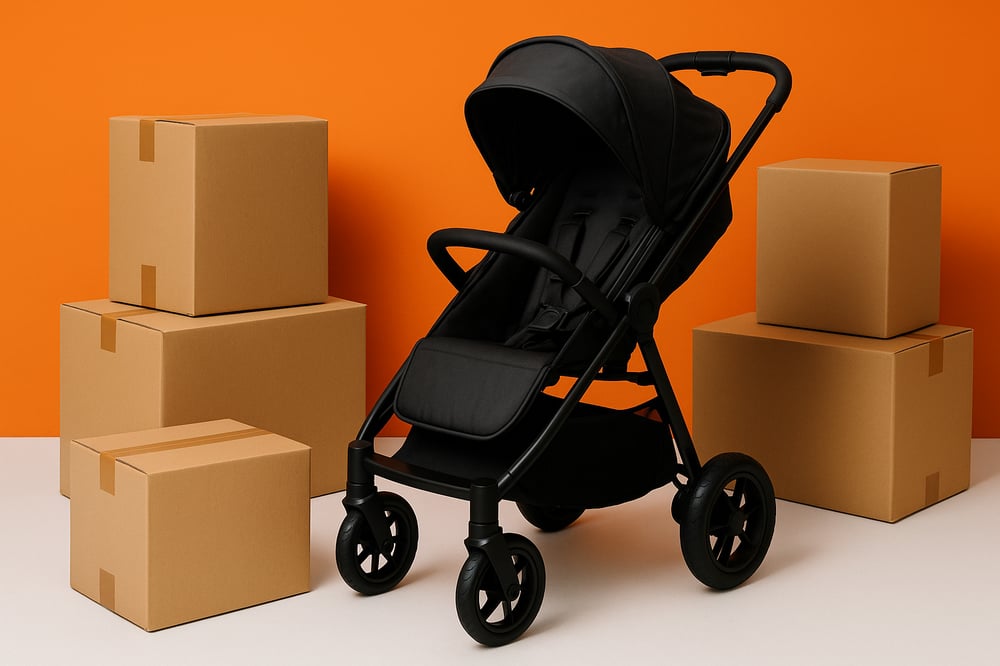
Baby strollers represent one of the most commonly shipped juvenile products in eCommerce, with over 4.2 million units shipped annually in the United States alone.
For retailers and direct-to-consumer brands, understanding how much it costs to ship a stroller is essential for maintaining healthy profit margins and setting accurate customer expectations.
The Average Cost to Ship a Stroller (By Carrier and Distance)
Shipping a stroller typically costs between $15 and $150, depending on the stroller type, weight, dimensions, shipping distance, and carrier selection.
This wide range exists because strollers vary dramatically in size and complexity, from lightweight travel models to heavy all-terrain systems.
Domestic Shipping Costs by Carrier
Here’s a breakdown of domestic shipping costs across major carriers to help you choose the most budget-friendly and reliable option:
| Carrier | Standard Stroller (15 lbs) | Double/Jogging Stroller (25+ lbs) |
| USPS | $20-45 (Priority Mail) | $40-80 (Priority Mail) |
| FedEx | $25-60 (Ground) | $45-90 (Ground) |
| UPS | $30-65 (Ground) | $50-95 (Ground) |
| DHL | $35-70 (eCommerce) | $55-100 (eCommerce) |
Note: Costs above represent estimates for continental U.S. shipping and may vary based on dimensional weight, fuel surcharges, and seasonal factors.
International Shipping Costs
International stroller shipments typically range from $85 to $250+, depending on:
- Destination country and shipping zone
- Import duties and taxes (typically 5-20% of declared value)
- Stroller weight and dimensions
- Selected shipping speed
- Carrier-specific international rates
Key Factors That Influence Stroller Shipping Costs

Several important factors, from stroller size to destination, play a key role in determining overall shipping costs.
Weight and Dimensional Weight
Most strollers weigh between 15-35 pounds, but the shipping cost is often calculated using dimensional (volumetric) weight rather than actual weight. Dimensional weight factors in the package size, which is particularly relevant for bulky items like strollers.
The standard formula most carriers use is:
Dimensional Weight = (Length × Width × Height) ÷ Divisor
The divisor varies by carrier:
- FedEx and UPS: 139 for domestic shipments
- USPS: 166 for domestic shipments
- International shipments: typically 139 or lower
Pro Tip: When shipping partially disassembled strollers, maintain a balance between reducing dimensional weight and ensuring product safety.
Removing wheels and folding the frame can reduce dimensional weight by up to 30% without compromising product integrity—but only if packaged correctly with appropriate internal supports.
Package Dimensions and Shape
Strollers present unique packaging challenges due to their irregular shapes. Standard stroller shipping boxes often measure approximately:
- Standard strollers: 24″ × 20″ × 10″
- Jogging strollers: 30″ × 24″ × 12″
- Double strollers: 36″ × 24″ × 15″
Oversized or oddly shaped packages may incur additional handling fees ranging from $12 to $25 per package.
Shipping Distance and Zones
Domestic carriers divide the United States into shipping zones (typically 1-8), with costs increasing as packages travel across more zones:
- Zones 1-2: Local/regional shipping (lowest cost)
- Zones 3-4: Mid-range shipping distances
- Zones 5-8: Cross-country shipping (highest cost)
For example, shipping a standard stroller from New York to Chicago (Zone 4) might cost $35, while the same stroller shipped to Los Angeles (Zone 8) could cost $60 or more.
Insurance and Valuation
Most strollers retail between $200-$1,000, making appropriate insurance coverage essential:
- Basic carrier liability (often limited to $100) is typically insufficient
- Additional insurance generally costs $0.80-$1.25 per $100 of declared value
- Third-party shipping insurance may offer better rates at $0.55-$0.85 per $100
Accessory Inclusion
When a stroller ships with additional accessories (rain covers, cup holders, bassinets, etc.), both weight and dimensional factors increase. Shipping a complete travel system (stroller plus car seat) typically adds $15-35 to the base shipping cost.
Cost-Efficient Stroller Shipping Strategies
Smart packing, carrier comparisons, and timing can help significantly reduce your stroller shipping expenses.
Carrier Selection Optimization
Different carriers excel for different stroller types and shipping distances:
- USPS Priority Mail: Often most economical for lightweight strollers (under 20 lbs) shipping to residential addresses
- FedEx Ground: Typically offers competitive rates for mid-weight strollers (20-30 lbs) shipping over longer distances
- UPS: Often preferred for heavier double strollers or travel systems, especially when shipping to commercial addresses
- Regional carriers: Can offer savings of 15-25% for short-distance shipments within their coverage areas
Negotiated Rates and Volume Discounts
Retailers shipping strollers regularly should pursue:
- Negotiated rates with preferred carriers (possible with as few as 10-15 weekly shipments)
- Shipping consolidation through a 3PL fulfillment partner
- Volume-based tier discounts (often starting at 20% savings and increasing with volume)
For example, a mid-sized baby products retailer shipping 50+ strollers weekly might negotiate rates 25-40% below published rates.
Packaging Optimization

Strategic packaging significantly impacts stroller shipping costs:
- Custom-sized boxes that minimize dimensional weight while maintaining adequate protection
- Right-sized cushioning materials (air pillows protect while adding minimal weight)
- Partial disassembly (removing wheels and accessories) where appropriate
- Poly bags instead of boxes for certain lightweight stroller models (saving 5-15% on shipping costs)
Multi-Unit Shipping Considerations
When shipping multiple strollers:
- Pallet shipment becomes economical at approximately 8-12 units
- LTL (less-than-truckload) shipping offers significant savings for larger quantities
- Freight consolidation services can reduce costs by 30-45% for international shipments
Special Considerations for eCommerce Stroller Retailers
Baby product fulfillment comes with unique challenges, especially when managing fragile, oversized items like strollers alongside smaller accessories or multi-item bundles.
This means that stroller sellers must account for packaging, bulk rates, and return logistics to keep shipping efficient and customer-friendly.
Free Shipping Thresholds
Given that most strollers retail above $200, many retailers incorporate shipping costs into product pricing and offer free shipping. The math typically works as follows:
- Average stroller shipping cost: $45
- Free shipping threshold set at: $199-299
- Percentage of orders qualifying for free shipping: 85-95%
- Average cart value increase from free shipping threshold: 15-30%
Return Shipping Policies
Stroller returns represent a significant expense for retailers. Best practices include:
- Clear restocking fees (typically 10-20% for opened products)
- Return label inclusion with prepaid postage (reduces customer friction)
- Return processing centers in multiple geographic regions (reduces zone-based return costs)
Dropshipping Considerations
For retailers using dropshipping models, especially those operating through platforms like Shopify:
- Manufacturer-direct shipping typically adds $15-25 to wholesale costs
- Multi-warehouse fulfillment can reduce shipping costs by 15-30% by minimizing shipping distances
- Branded packaging requirements may increase per-unit fulfillment costs by $3-8
International Fulfillment Optimization
For global stroller brands:
- Distributed inventory across strategic global locations can reduce international shipping costs by 40-60%
- Import duty considerations should factor into the market pricing strategy
- De minimis thresholds vary significantly by country (affecting duty and tax liability)
Comparing Fulfillment Models: Cost vs. Delivery Speed

Choosing the right fulfillment model can dramatically affect your shipping costs and delivery speeds, especially when dealing with bulky items like strollers.
Below is a breakdown of the three most common strategies used by modern eCommerce stroller brands, with key insights into cost, timing, and hidden considerations.
- Self-Fulfillment (In-House): Best for startups or small brands, this model offers full control over packaging and branding but comes with higher shipping costs (avg. $50/unit) and slower delivery (2–3 days) due to limited regional reach.
- 3PL Fulfillment Partner: Ideal for growing eCommerce brands, 3PLs reduce operational load while offering moderate costs (avg. $35/unit) and faster shipping (1–2 days). Great for scaling without managing warehousing in-house.
- Multi-Warehouse Fulfillment: Suited for established or international brands, this strategy leverages multiple distribution centers to cut delivery times (<48 hours) and costs (avg. $25/unit), especially for cross-country or global orders.
Planning Your Stroller Shipping Strategy
The most cost-effective approach to stroller shipping combines carrier diversification, strategic packaging, and volume-based negotiations.
Retailers should regularly audit shipping expenses as a percentage of gross sales, targeting 8-12% for domestic shipments and 15-20% for international orders.
By treating shipping not as a fixed cost but as a strategic opportunity, retailers can transform stroller shipping from a necessary expense into a competitive advantage.