
ShipCalm comes with published pricing with no shipping markup, month-to-month contracts, and a boutique support model built around two owned U.S. facilities plus partner warehouses abroad.
In this review, we’ll go into more depth about what ShipCalm actually delivers, where the model has limits, and how it holds up against Fulfyld.
About ShipCalm
Founded in 2017, ShipCalm built its business around an ecommerce-first, high-touch approach rather than trying to compete purely on network size.
It operates owned fulfillment centers in California and Indiana, supplemented by partner facilities for broader geographic and international coverage.
Here’s a summarized list of what ShipCalm’s offering includes:
- Order fulfillment, inventory management, and returns handling for D2C and omnichannel brands
- Large-scale kitting and custom packaging capability
- Published, transparent pricing without the shipping-rate markups
- Month-to-month contract terms rather than long-term lock-ins
- Dedicated account management teams
- Broad software integrations spanning ecommerce platforms, ERPs, and marketing/CRM tools
ShipCalm tends to attract fast-growing, omnichannel D2C and CPG brands that want account support without sacrificing the technology layer larger 3PLs offer.
ShipCalm Pros and Cons
Let’s compare the pros and cons that come with choosing ShipCalm as your fulfillment provider.
| Pros | Cons |
|---|---|
| Transparent, published pricing with no shipping markup | Smaller owned-facility footprint than the largest 3PLs |
| Month-to-month contracts, no long lock-in | International reach depends more on partner facilities |
| Dedicated, hands-on account management | Public review volume on major platforms is limited |
| Strong kitting and custom packaging capability | Occasional shipping delays noted in customer feedback |
| Broad integration coverage across ecommerce and back-office tools | Boutique model may feel less structured than enterprise-scale providers |
Pros
- No Hidden Shipping Markup: ShipCalm is frequently singled out for publishing real rates upfront, unlike other providers that add markups or surcharges after a contract is signed.
- Flexible Contract Terms: Month-to-month agreements lower the risk of switching, which matters for brands that have been burned by long lock-ins elsewhere.
- Hands-On Account Teams: Multiple customer testimonials describe ShipCalm’s account managers as acting like an extension of their own team rather than a distant vendor contact.
- Kitting and Packaging Depth: Large-scale kitting and custom packaging are treated as core capabilities.
- Reliable Reverse Logistics: Independent ratings on returns and reverse logistics handling are consistently strong.
Cons
- Smaller Owned Network: Two owned U.S. facilities is a leaner footprint than the largest distributed 3PLs, even with partner facilities filling gaps.
- International Coverage Relies on Partners: Overseas fulfillment isn’t run through ShipCalm’s own infrastructure the way domestic orders are, which is worth confirming directly for global sellers.
- Thinner Public Review Trail: ShipCalm doesn’t have the review volume on G2 or Trustpilot that bigger, longer-established 3PLs do, making it harder to verify consistency purely from public data.
- Occasional Delivery Delays: A recurring, if minor, theme in feedback is shipping delays during especially high-volume stretches.
ShipCalm Scalability, Peak Season & Growth Support
Scalability shows up less in ShipCalm’s spec sheet and more in how it operates once volume actually spikes.
The company leans on a consultative, exception-driven model: account teams work to flag shipping exceptions before they become customer-facing problems, rather than reacting after a promotion or peak period has already caused delays.
| Growth Scenario | How ShipCalm Approaches It |
|---|---|
| Sudden promotional spikes | Account teams monitor for exceptions proactively and communicate with the brand ahead of issues, rather than waiting for a support ticket |
| Holiday/peak season volume | Positioned as a stress point worth planning for directly with your account team — capacity isn’t unlimited, so early coordination matters more here than with larger, deeper-network 3PLs |
| Hybrid or hand-off scaling | Can support brands transitioning from an existing 3PL or in-house fulfillment, filling in specific roles rather than requiring an all-or-nothing switch |
| Steady, compounding growth | Continuous-improvement approach means processes are expected to evolve alongside order volume rather than staying fixed at onboarding-day settings |
ShipCalm Ecommerce & Platform Integrations
Integrations are a genuine strength for ShipCalm, spanning further into back-office and marketing tools than many fulfillment-only competitors.
| Category | Examples |
|---|---|
| Ecommerce platforms | Shopify, WooCommerce, Magento |
| Marketplaces | Amazon |
| ERP & inventory tools | Acumatica, Cin7, Brightpearl, DEAR Inventory |
| CRM & marketing tools | HubSpot, Klaviyo, Mailchimp, Salesforce, Gorgias |
What Customers Say About ShipCalm
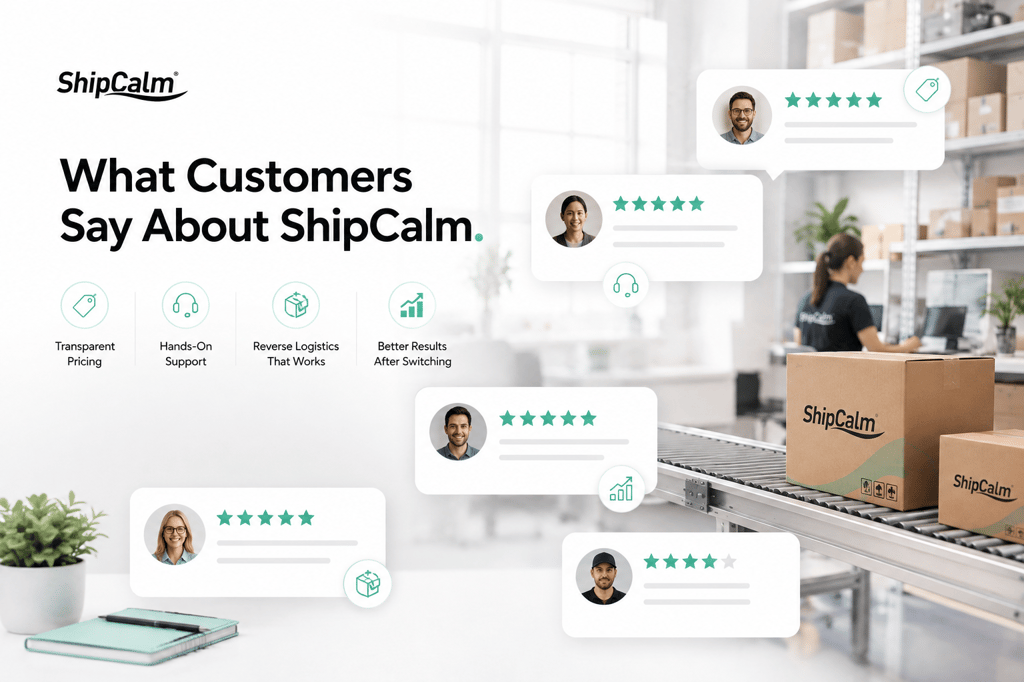
ShipCalm has a 3.7 rating on Trustpilot.
⭐⭐⭐⭐⭐ What customers appreciate:
- Transparent, published pricing without after-the-fact shipping markups
- Account teams described as feeling like an extension of the brand’s own operations
- Strong handling of returns and reverse logistics
- A noticeable improvement for brands switching from a worse prior 3PL experience
⭐ What customers complain about:
- Occasional shipping delays during high-volume periods
- A smaller international footprint than the largest global 3PLs
- Limited independent review data to compare against larger, more heavily reviewed competitors
ShipCalm vs. Fulfyld: Side-by-Side Comparison
Legend: ✅ = Included/Strong offering · ⚠️ = Available but varies by use case or plan · ❌ = Not included/limited
| Capability | ShipCalm | Fulfyld |
|---|---|---|
| Facility network | ⚠️ Two owned U.S. facilities + partners | ✅ Strategically located warehouses |
| Pricing transparency | ✅ Published, no shipping markup | ✅ Flat, all-inclusive per-order rate |
| Contract flexibility | ✅ Month-to-month | ✅ No long-term lock-in |
| Dedicated account manager | ✅ Included | ✅ Included |
| 24/7 human support | ⚠️ Business hours, dedicated teams | ✅ Direct, human support |
| Ecommerce & back-office integrations | ✅ Broad coverage | ✅ Core ecommerce integrations |
| Kitting & custom packaging | ✅ Core strength | ✅ Supported |
| International fulfillment | ⚠️ Via partner facilities | ⚠️ Varies by need |
Both companies lead with transparent pricing and hands-on account management, which makes Fulfyld a natural comparison point.
Where ShipCalm Fits and Where to Look Instead
ShipCalm earns its reputation on transparency and account access most 3PLs don’t offer upfront. These include no shipping markup, no long contract, a team that stays close to the account.
The tradeoff is a smaller owned network and a thinner public track record than the biggest names in the space.
If you want that same transparency and hands-on support with 24/7 human availability built in, Fulfyld offers a flat, all-inclusive per-order rate and a dedicated account manager for growing ecommerce brands. Get a free quote today.
FAQs
What is ShipCalm and who is it best for?
ShipCalm is a boutique, ecommerce-first 3PL founded in 2017, built around transparent pricing, month-to-month contracts, and hands-on account management.
It’s best suited for fast-growing, omnichannel D2C and CPG brands that value a closely involved fulfillment partner over the widest possible warehouse network.
Is ShipCalm legit and reliable?
Yes. Domain and business verification checks, direct client testimonials, and third-party comparison coverage all support ShipCalm as a legitimate, operating 3PL.
Its review footprint on major platforms is thinner than larger competitors, so it’s worth asking for references or a trial period directly rather than relying solely on public review counts.
How does ShipCalm pricing work?
ShipCalm publishes its pricing rather than requiring a sales call to get a number, and it markets itself specifically on not marking up shipping rates the way some competitors do after a contract is signed.
Actual costs still depend on order volume, storage needs, and service add-ons, so getting an itemized quote for your specific catalog is still the best way to compare it directly.
How does ShipCalm compare to Fulfyld on human 24/7 support?
ShipCalm’s dedicated account teams are consistently praised for being responsive and closely involved, but support isn’t marketed as a round-the-clock service.