

Pallet storage costs can quietly eat into your margins, especially when you’re paying a flat rate for space you don’t fully use. Run your numbers through the calculator below to see your real flexible cost versus a fixed contract, and find out exactly how much you could save.
How to Calculate Your Pallet Storage Costs
The calculator compares two ways of paying for storage: a flexible model, where you pay based on your actual average pallet count plus movement fees, and a conventional model, where you pay for your maximum pallet capacity every month regardless of use.
The math behind it looks like this:
Flexible Storage Cost = (Average Pallets x (Admission + Retrieval + Monthly Fee x Duration)) + (Monthly Movements x Duration x (Admission + Retrieval))
Conventional Storage Cost = Maximum Pallets x (Admission + Retrieval + Monthly Fee x Duration)
Here’s what that looks like with real numbers. Say you average 400 pallets but peak at 600 during busy months, over a 6-month storage window, with 20 pallet movements per month.
At a $3 admission fee, a $3 retrieval fee, and a $12 monthly storage fee per pallet, the numbers work out like this:
- Flexible Storage Cost: (400 x ($3 + $3 + $12 x 6)) + (20 x 6 x ($3 + $3)) = $31,920
- Conventional Storage Cost: 600 x ($3 + $3 + $12 x 6) = $46,800
- Potential Savings: $14,880, or 31.79%
This is the core reason on-demand storage tends to beat fixed contracts for businesses with seasonal or fluctuating inventory. You stop paying for capacity you don’t need in the slower months.
Conventional contracts, by contrast, lock you into your peak requirement year-round, whether you use that space or not. If you want to see how these numbers translate to an actual bill, take a look at how storage fee charges are broken down on a real invoice.
What Drives Your Pallet Storage Costs
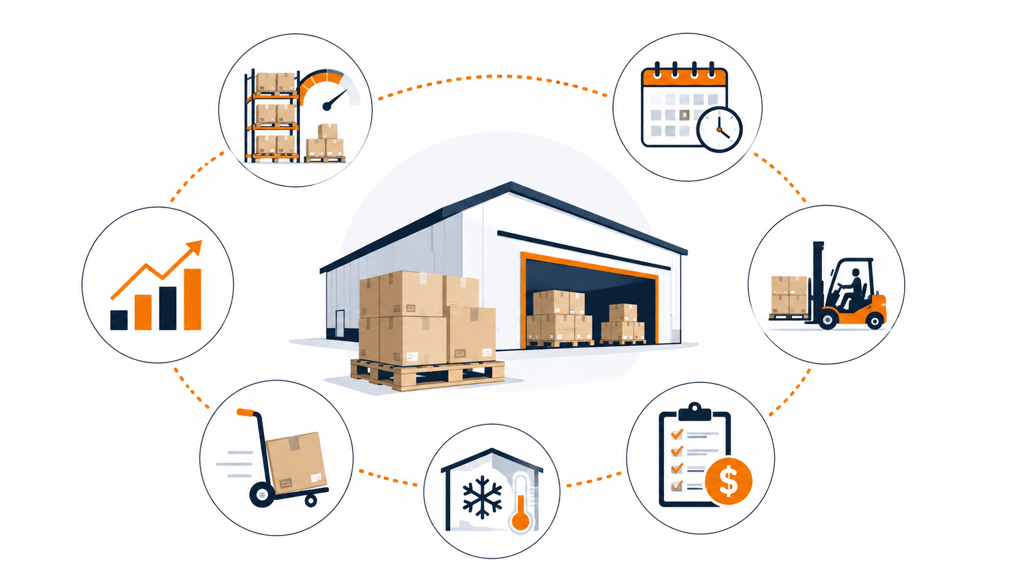
The calculator asks for seven numbers, and each one reflects a real cost driver you’d need to know before you can budget accurately.
- Average and maximum pallet count. Your average reflects typical usage, while your peak covers busy-season capacity. Businesses with steady, year-round volume usually see less of a gap between the two than seasonal operations do.
- Storage duration. Longer commitments generally lower your effective monthly rate, since warehouses favor guaranteed, predictable space usage over short-term stays. Slow-moving inventory that sits past a certain point can also trigger a long-term storage fee.
- Movements per month. Every time a pallet moves in or out, it triggers separate handling costs on top of the base monthly rate. Frequent movement adds up fast.
- Admission and retrieval cost per pallet. Most warehouses charge $4 to $8 per move for these fees, though the exact rate depends heavily on your warehouse’s location. These are typically itemized as receiving charges on your invoice.
- Monthly storage fee per pallet. This is usually the largest line item in your total cost. It varies by storage type, since temperature-controlled fulfillment runs well above standard dry storage rates.
Businesses that want predictable, lower-cost storage without running their own facility often turn to third-party logistics providers, which bundle storage, handling, and shipping into a single negotiated rate.
Average Pallet Storage Costs Per Month
Most U.S. warehouses charge somewhere between $18 and $25 per pallet per month for standard dry storage, with the national average sitting at $20.17 per pallet. That number has climbed steadily over the past several years, driven by rising labor, real estate, and utility costs.
| Year | Avg. Cost Per Pallet/Month |
| 2017 | $13.02 |
| 2020 | $14.58 |
| 2025 | $20.17 |
Rates also shift by industry and storage length. Retail businesses typically pay $10 to $15 per pallet per month, with an average storage window of about 45 days.
Manufacturers tend to store longer, often 60 to 90 days, at $8 to $12 per pallet per month.
Pallet pricing isn’t the only model warehouses use. Some bills are by cubic foot, averaging $0.46 per month, for dense or irregularly shaped inventory. Others bill by square foot, averaging $1.73 per month, for dedicated space, or by bin, averaging $3.08 per month, for pick-and-pack operations.
If your goods sit on standard 40×48 pallets, per-pallet pricing is almost always the simplest and most predictable way to budget.
Pallets themselves are worth the investment, too, since palletized inventory is generally faster to move, count, and store than loose cartons. That’s part of why pallets remain critical to shipping and logistics despite the added storage cost.
Rates also vary by location and volume. Storing 500 pallets in California averages around $25 per pallet, compared to about $18.50 in the Midwest.
Volume matters too. Small-volume shippers around 50 pallets a month often pay closer to $22.50 per pallet, while enterprise volumes around 500 pallets can drop to roughly $14 per pallet.
Businesses evaluating 3PL services in the USA can typically negotiate better volume pricing than they’d get by storing pallets on their own.
Take Control of Your Pallet Storage Costs
Pallet storage costs vary widely by location, contract type, and how often your inventory moves, but the fastest way to know your real number is to run it.
Plug your figures into the calculator above to see your Flexible Storage Cost, your Conventional Storage Cost, and your Potential Savings.
Ready to stop overpaying for storage you don’t use? Get a free fulfillment quote from Fulfyld and see how flexible 3PL warehousing pricing compares to what you’re paying now.