
Glass shipments account for nearly 11% of all damaged freight claims in e-commerce, with an average replacement cost of $175 per broken item.
For businesses shipping glassware, art, or delicate glass products, each broken piece represents not just lost revenue but potential customer dissatisfaction.
Knowing how to ship glass items without breaking is more than a helpful skill—it’s essential for protecting your reputation and ensuring long-term profitability.
6 Steps to Follow for Shipping Glass Items Without Breaking
Following a systematic approach to packaging glass items significantly reduces breakage risk:
1. Prepare the Item
- Clean and dry the glass completely. Residue can cause scratches during transit.
- Remove any removable parts and package them separately.
- If applicable, apply painter’s tape in an “X” pattern across glass surfaces to reinforce and minimize shattering if breakage occurs.
2. Apply the First Layer of Protection
- Wrap the entire glass item in packing paper, covering all surfaces completely.
- Secure with tape, being careful not to apply tape directly to the glass surface.
- This layer protects against scratches and provides basic cushioning.
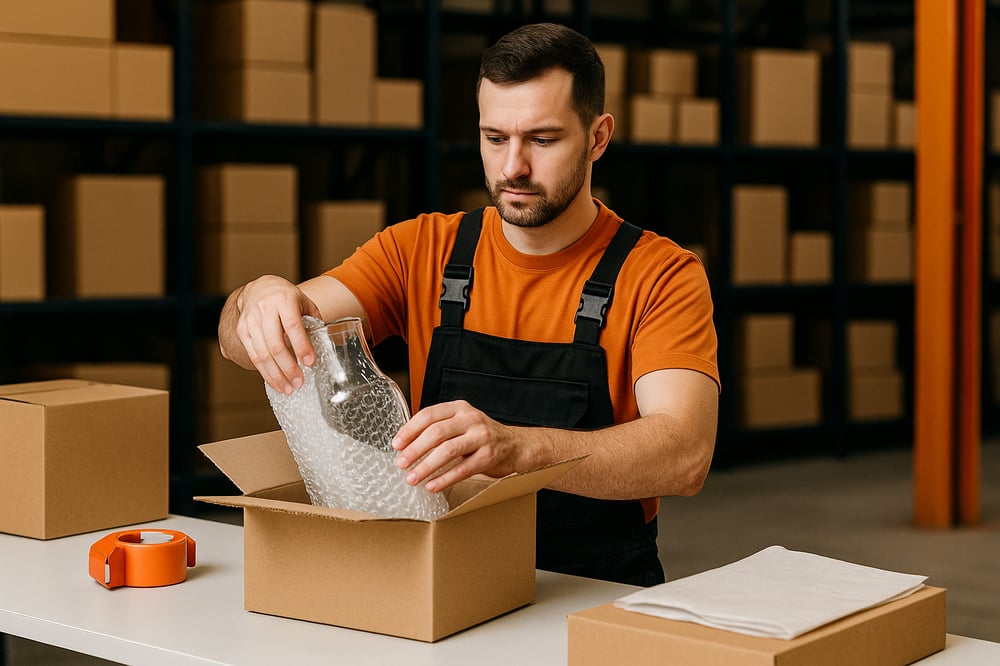
3. Add Bubble Wrap Protection
- Wrap the paper-protected item in at least two layers of bubble wrap, with bubbles facing inward.
- Ensure complete coverage with 2-3 inches of overlap at all seams.
- Secure firmly but not too tightly with packing tape.
- For stemware or items with protruding parts, add extra bubble wrap to these vulnerable areas.
4. Prepare the Shipping Box
- Assemble a double-walled corrugated box that allows for 2-3 inches of cushioning on all sides.
- Line the bottom of the box with at least 3 inches of void fill material or crumpled packing paper.
- For multiple glass items, prepare dividers to keep items separated.
5. Position the Item and Fill Voids
- Place the wrapped glass item in the center of the box, away from the walls.
- Fill all empty spaces completely with void fill material to prevent any movement.
- The item should be suspended in packaging material with no direct contact with the box walls.
6. Box Closure and Labeling
- Close the box and shake gently to detect any movement inside. If movement is detected, open and add more void fill.
- Seal thoroughly with 2-inch wide packing tape in an H-pattern (all seams plus reinforcement).
- Apply “FRAGILE” and “HANDLE WITH CARE” labels on all sides of the package.
- Include “THIS SIDE UP” arrows if the orientation is important.
Essential Materials for Shipping Glass Items Safely

The foundation of successful glass shipping lies in choosing the right packaging materials.
Primary Packaging Materials
- Double-walled corrugated boxes: These provide 40% more crush resistance than standard single-wall boxes. Always choose boxes at least 2 inches larger than your glass item on all sides.
- Bubble wrap (3/16″ or larger bubbles): Larger bubbles provide better shock absorption than smaller bubbles. The air cushions act as miniature shock absorbers during transit.
- Packing paper: Unprinted newsprint or kraft paper creates a protective initial layer that prevents scratches and provides basic cushioning.
- Void fill: This includes packing peanuts, air pillows, or crumpled paper that fills empty space and prevents movement.
- Foam corner protectors: These are essential for glass items with corners, such as frames or glass panels.
- Fragile warning labels: Studies show packages marked as fragile receive approximately 20% more careful handling.
Specialty Materials for High-Value Glass
- Custom foam inserts: For valuable or irregularly shaped glass items, custom-cut foam inserts provide tailored protection.
- Suspension packaging: This suspends the glass item in the center of the box using tensioned film, keeping it away from the outer walls.
- Thermal indicators: For temperature-sensitive glass, these indicators alert recipients if the package has been exposed to extreme temperatures.
The Temperature Conditioning Secret
Here’s an insider technique used by elite glass shippers but rarely discussed: temperature conditioning. Glass that experiences rapid temperature changes during shipping becomes significantly more susceptible to breakage due to thermal stress. To prevent this:
- Store packaged glass items at a moderate temperature (65-75°F) for 24 hours before shipping.
- Avoid shipping glass during extreme temperature weeks if possible.
- For high-value shipments, include phase-change materials in the package that absorb or release heat to maintain stable temperatures.
- Schedule deliveries for the morning in hot climates and midday in cold climates to minimize temperature extremes.
This technique is particularly valuable for colored or thick glass, which is more susceptible to thermal stress fractures. Fulfillment centers that implement temperature conditioning protocols report 22% fewer cold-weather breakage claims during winter months.
Shipping Carrier Selection and Insurance

The choice of shipping carrier significantly impacts glass delivery success:
Carrier Considerations
- Premium carriers with higher costs often provide superior handling, offsetting the price difference through reduced damages.
- Regional carriers sometimes offer more careful handling than national carriers due to fewer transfer points.
- For high-value glass, consider specialty carriers that focus exclusively on fragile items.
Insurance and Declared Value
- Always purchase additional shipping insurance for glass items.
- Declare the full replacement value, not just the wholesale cost.
- Document the condition of glass items with photographs before packaging.
- Keep detailed records of packaging types and methods used.
Establishing a Glass Shipping Program
For businesses that regularly ship glass items, developing a systematic program yields consistent results:
- Create standardized packaging procedures specific to each type of glass product.
- Track breakage rates by product type, packaging method, carrier, and season.
- Train packaging staff specifically on glass handling techniques.
- Audit packaging compliance regularly to ensure standards are maintained.
- Test new packaging methods on a small scale before full implementation.
Advanced Techniques for Fragile Glass Shipping
For exceptionally delicate or valuable glass items, standard packaging may not be sufficient. These advanced techniques provide additional protection:

Double-Boxing Method
This premium technique creates a box-within-a-box system that significantly reduces impact forces:
- Package the glass item as described above in an appropriately sized inner box.
- Select an outer box that allows for 2 inches of cushioning on all sides around the inner box.
- Fill the bottom of the outer box with shock-absorbing material.
- Place the sealed inner box inside and fill all spaces with cushioning material.
- Seal the outer box using the H-pattern taping method.
This method creates a double-shock absorption system that substantially reduces breakage rates. Analysis of shipping data shows double-boxing reduces glass breakage by approximately 60% compared to single-box methods.
Corner Protection Systems
Glass items with corners are particularly vulnerable to damage:
- Apply specialized foam corner protectors to all corners of rectangular glass items.
- For framed glass, use specialized frame protectors that cover all corners and edges.
- Consider rigid corner boards on the exterior of the box for additional protection.
Suspension Packaging
For high-value glass items, suspension packaging creates a floating effect:
- The glass item is secured between two frames of plastic film.
- The tension in the film suspends the item in the center of the box.
- This prevents contact with box walls and absorbs shock through the tensioned film.
Packing with Care, Shipping with Peace of Mind
Shipping glass items doesn’t have to be a source of anxiety or financial loss. By implementing these professional techniques, particularly the multi-layer protection approach and temperature conditioning, businesses can dramatically reduce breakage rates and enhance customer satisfaction.
The investment in proper packaging materials and methods typically yields a 3-5x return when factoring in the costs of replacements, customer service hours, and reputation damage from broken items.
Finding the right 3PL partner to ship glass products doesn’t just prevent damage—it often delivers a 3–5x return by protecting your bottom line and your brand.