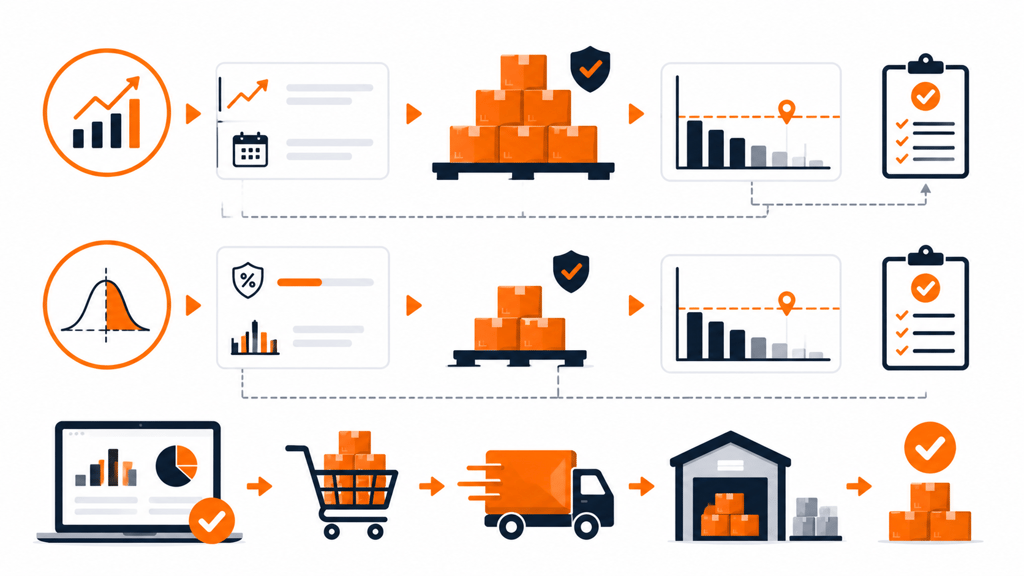
Safety Stock Calculator: Instantly Find the Right Buffer to Prevent Costly Stockouts

Worried your stock levels might be off and it’s costing you sales or cash? The Safety Stock Calculator takes the guesswork out of inventory buffers and shows exactly how much backup stock you really need to stay protected.
Whether you’re dealing with supplier delays, seasonal spikes, or fluctuating demand, this tool gives you instant clarity on how to prevent stockouts without overstocking.
Use it now to strike the perfect balance between availability and efficiency; no spreadsheets, no stress – just smarter, leaner inventory planning at your fingertips.
Understanding Every Component of the Safety Stock Calculator + Real-World Business Scenarios
Here’s a comprehensive breakdown of each element in the Safety Stock Calculator, featuring practical examples and business scenarios to help you optimize your inventory buffer strategy and prevent costly stockouts while maintaining efficient operations.
1. Method Selection Toggle (Basic vs. Statistical)
Choose between simplified calculations for quick estimates or advanced statistical models for precise demand variability analysis.
Basic Method Examples:
- Small E-commerce Store: Quick safety stock estimates using historical peaks
- Startup Brand: Simple calculations when limited historical data exists
- Seasonal Retailer: Straightforward buffer planning for predictable patterns
Statistical Method Examples:
- Enterprise E-commerce: Advanced demand forecasting with service level targets
- Multi-SKU Operations: Precise calculations for hundreds of product variations
- Supply Chain Optimization: Data-driven approach for complex logistics networks
Why It Matters: Method selection determines calculation sophistication and accuracy levels based on your business complexity and data availability.
2. Average Daily Usage Input
This field captures your typical daily sales velocity, forming the foundation for all safety stock calculations and reorder point planning.
Examples:
- Electronics Retailer: 45 units/day (smartphones, accessories)
- Fashion Boutique: 12 units/day (apparel, seasonal items)
- Health Supplement Brand: 85 units/day (high-velocity consumables)
- Furniture Store: 3 units/day (high-value, slower-moving inventory)
Why It Matters: Accurate daily usage ensures realistic buffer calculations and prevents both overstocking and dangerous inventory shortages.
3. Average Lead Time Input
Your standard replenishment timeline from order placement to inventory receipt, critical for timing safety stock requirements.
Examples:
- Domestic Supplier: 7-10 days (local manufacturing, quick fulfillment)
- International Sourcing: 21-35 days (overseas production, shipping delays)
- Drop-shipping Partner: 3-5 days (direct supplier fulfillment)
- Custom Manufacturing: 45-60 days (made-to-order products)
Why It Matters: Lead time accuracy determines vulnerability windows when you’re dependent on existing inventory without replenishment options.
4. Maximum Daily Usage Input (Basic Method)
Your highest recorded daily demand captures peak sales scenarios that could exhaust inventory during lead times.
Examples:
- Holiday E-commerce Surge: 180 units (vs. 45 average) during Black Friday
- Viral Product Moment: 320 units (vs. 85 average) from social media exposure
- Seasonal Fashion Peak: 35 units (vs. 12 average) during spring launch
- Emergency Stockup: 15 units (vs. 3 average) during supply disruptions
Why It Matters: Peak demand planning prevents stockouts during high-opportunity periods when customer acquisition costs are lowest.
5. Maximum Lead Time Input (Basic Method)
Your worst-case delivery scenario, accounting for supplier delays, shipping disruptions, and operational challenges.
Examples:
- Weather Delays: 14 days (vs. 7 average) during storm seasons
- Supply Chain Disruption: 45 days (vs. 21 average) during global logistics issues
- Quality Control Holds: 8 days (vs. 3 average) for failed inspection batches
- Customs Complications: 75 days (vs. 45 average) for international shipments
Why It Matters: Maximum lead time planning ensures inventory security during operational disruptions and external challenges.
6. Service Level Selection (Statistical Method)
Your target availability percentage determines how often you want inventory in stock when customers demand it.
Service Level Examples:
- 90% Service Level: Budget-conscious approach, occasional stockouts acceptable
- 95% Service Level: Balanced optimization for most e-commerce operations
- 97.5% Service Level: Premium customer experience focus
- 99% Service Level: Mission-critical inventory for high-value customers
- 99.5% Service Level: Luxury brands, zero-tolerance stockout strategy
Why It Matters: Service level selection balances customer satisfaction against inventory holding costs and operational complexity.
7. Z-Score Display (Statistical Method)
Shows the statistical multiplier corresponding to your chosen service level, automatically calculated for precision forecasting.
Z-Score Examples:
- 1.28 (90%): Conservative buffer for cost-sensitive operations
- 1.65 (95%): Industry-standard balance for most businesses
- 1.96 (97.5%): Enhanced reliability for competitive markets
- 2.33 (99%): Premium positioning with maximum availability
- Custom Z-Score: Advanced users with specific statistical requirements
Why It Matters: Z-scores translate business objectives into mathematical precision for optimal buffer calculations.
8. Standard Deviation Input (Statistical Method)
Measures demand variability during lead times, capturing the unpredictability requiring safety stock buffers.
Examples:
- Stable Product: 15 units deviation (predictable daily sales patterns)
- Trending Item: 45 units deviation (viral growth, seasonal spikes)
- New Launch: 65 units deviation (uncertain market response)
- Auto-Calculated: 15% of average demand (when historical data unavailable)
Why It Matters: Demand variability quantification enables precise buffer sizing rather than guesswork-based inventory planning.
9. Calculate Safety Stock Button
Triggers instant computation using industry-standard formulas tailored to your selected method and business parameters.
Calculation Process:
- Basic Method: (Max Usage × Max Lead Time) – (Avg Usage × Avg Lead Time)
- Statistical Method: Z-Score × Standard Deviation of Lead Time Demand
- Real-time validation and error checking
- Instant results with actionable recommendations
Why It Matters: Enables immediate strategic decisions for inventory optimization and stockout prevention.
10. Safety Stock Results Display
Shows your required buffer inventory with contextual analysis and practical implementation guidance.
Result Examples:
Low Safety Stock (15-30 units):
- Fast-moving consumables: Quick replenishment, predictable demand
- Efficient optimization with minimal holding costs
Moderate Safety Stock (75-150 units):
- Seasonal products: Balanced protection against demand spikes
- Standard e-commerce operations with reasonable buffers
High Safety Stock (300+ units):
- Long lead times: International sourcing, complex manufacturing
- High-variability products: Trending items, unpredictable demand
Why It Matters: Provides actionable buffer targets for purchasing decisions and inventory planning processes.
11. Summary Analysis & Recommendations
Delivers strategic insights, translating safety stock calculations into practical business actions and reorder point guidance.
Example Scenarios:
Optimized Operations:
- “Maintain 125 units as safety stock for a 95% service level.”
- Reorder point: 485 units (360 normal demand + 125 buffer)
- Strategic advantage: Balanced cost-efficiency with stockout protection
High-Risk Situation:
- “Current 50-unit buffer insufficient for demand variability”
- Recommended increase: 180 units for adequate protection
- Risk mitigation: Prevent lost sales during peak periods
Over-Stocked Scenario:
- “300-unit safety stock exceeds requirements for stable demand.”
- Optimization opportunity: Reduce to 150 units, free up capital
- Cash flow improvement: Redirect investment to growth initiatives
12. Action Buttons (Reset, Copy Results)
Provides workflow efficiency tools for iterative planning and result sharing across teams and stakeholders.
Use Cases:
- Reset Calculator: Quick scenario testing with different parameters
- Copy Results: Share findings with procurement, finance, and operations teams
- Collaborative Planning: Enable cross-functional inventory optimization
Why It Matters: Streamlines decision-making processes and facilitates data-driven inventory management across organizations.
Complete Analysis Example
Scenario: Health & Wellness E-commerce Brand
Input Values:
- Method: Statistical (95% service level)
- Average Daily Usage: 75 units
- Average Lead Time: 18 days
- Standard Deviation: 35 units
- Z-Score: 1.65 (auto-filled)
Results:
- Safety Stock Required: 58 units
- Normal Demand During Lead Time: 1,350 units (75 × 18)
- Reorder Point: 1,408 units (1,350 + 58)
- Service Level: 95% availability target
Analysis: An Efficient safety stock strategy balances customer satisfaction with inventory costs. The 58-unit buffer protects against demand variability while maintaining capital efficiency for growth investment.
Strategic Recommendations:
- Implement automated reordering at a 1,408-unit threshold
- Monitor demand patterns for seasonal adjustment opportunities
- Test higher service levels during peak seasons for competitive advantage
- Review supplier reliability to potentially reduce lead time buffers
Understanding these calculator components empowers inventory managers and business owners to make informed decisions about buffer optimization, stockout prevention, and operational efficiency while ensuring accurate risk assessment for sustainable growth and customer satisfaction.
Industry-Specific Safety Stock Benchmarks: What Top Performers Actually Keep in Reserve
Stop guessing your safety stock needs. Here’s exactly how much buffer inventory successful companies maintain across different industries, based on real operational data from market leaders.
E-commerce & Online Retail: The 2-4 Week Sweet Spot
Fast-moving digital commerce requires agile inventory management with enough buffer to handle demand spikes without drowning in holding costs.
Optimal Range: 2-4 weeks of average inventory
- High-velocity products: 2-3 weeks (electronics, consumables, trending items)
- Seasonal merchandise: 3-4 weeks (holiday items, fashion accessories)
- New product launches: 4+ weeks (uncertain demand patterns)
- Dropshipping items: 1-2 weeks (supplier-dependent fulfillment)
Success Factors: E-commerce leaders maintain flexible buffer levels that adjust based on supplier reliability, seasonal patterns, and product lifecycle stages.
Manufacturing & Production: Lean but Protected
Just-in-time manufacturing demands minimal safety stock while ensuring production never stops due to material shortages.
Optimal Range: 1-2 weeks of raw materials
- Critical components: 2 weeks (single-source suppliers, long lead times)
- Commodity materials: 1 week (multiple suppliers, predictable delivery)
- Seasonal inputs: 3+ weeks (weather-dependent, harvest-based materials)
- Custom components: 2-4 weeks (specialized suppliers, quality control delays)
Success Factors: Manufacturing excellence balances minimal inventory investment with maximum production uptime through strategic supplier partnerships.
Fashion & Seasonal Retail: Timing is Everything
Trend-driven industries require substantial safety stock buffers to capitalize on peak selling seasons and fashion cycles.
Optimal Range: 6-8 weeks before peak seasons
- Fast fashion: 4-6 weeks (rapid trend cycles, quick obsolescence)
- Luxury fashion: 8-12 weeks (premium positioning, extended selling seasons)
- Holiday merchandise: 10-14 weeks (concentrated selling period, high stakes)
- Back-to-school items: 6-8 weeks (predictable timing, competitive market)
Success Factors: Fashion leaders use predictive analytics to build substantial buffers before peak seasons while minimizing post-season excess inventory.
Electronics & Technology: Racing Against Obsolescence
Rapid product evolution means electronics companies must balance adequate stock levels against the risk of technological obsolescence.
Optimal Range: 3-5 weeks due to rapid obsolescence
- Cutting-edge products: 2-3 weeks (frequent updates, short lifecycles)
- Established products: 4-5 weeks (stable demand, predictable patterns)
- Accessories & peripherals: 5-7 weeks (longer lifecycles, consistent demand)
- Refurbished items: 1-2 weeks (limited shelf life, price-sensitive)
Success Factors: Tech companies excel by maintaining dynamic safety stock levels that decrease as products approach end-of-life stages.
Pharmaceuticals & Healthcare: Compliance-Driven Buffers
Regulatory requirements and critical patient needs demand substantial safety stock levels despite high holding costs.
Optimal Range: 4-6 weeks for regulatory compliance
- Life-critical medications: 6-8 weeks (zero stockout tolerance)
- Prescription drugs: 4-6 weeks (regulatory compliance, patient safety)
- OTC medications: 3-4 weeks (predictable demand, competitive market)
- Medical devices: 5-7 weeks (quality control, sterilization requirements)
Success Factors: Pharmaceutical leaders prioritize patient safety over cost optimization, maintaining generous buffers while managing expiration dates effectively.
Turn Your Safety Stock Strategy Into an Unbeatable Competitive Weapon
Transform your inventory buffers from a necessary cost into a strategic advantage that drives customer loyalty, captures market share, and builds unshakeable market leadership.
Customer Experience Excellence: When Availability Drives Loyalty
Consistent product availability creates customer confidence and transforms one-time buyers into lifetime advocates who choose you over competitors.
Key Strategies:
- 99%+ availability on top-selling items builds customer trust
- Stockout recovery plans minimize damage when buffers fail
- Proactive communication about availability builds transparency
- Priority fulfillment for loyal customers during shortages
Pro Tip: Track your customer lifetime value by availability rate. Customers who never experience stockouts spend 40-60% more over time than those who face frequent unavailability.
Market Share Protection: Winning When Competitors Fail
Strategic safety stock positioning allows you to capture competitor customers during their stockout periods and defend your market position.
Competitive Strategies:
- Monitor competitor inventory levels through price tracking and availability alerts
- Increase safety stock on products where competitors frequently stock out
- Aggressive marketing during competitor stockout periods
- Customer acquisition campaigns targeting competitor stockout victims
Pro Tip: Create “stockout alerts” for your top 5 competitors. When they’re out of stock, immediately increase marketing spend on those products to capture their frustrated customers.
New Product Launch Success: Mastering Uncertain Demand
Generous safety stock buffers for new products prevent lost sales during viral moments and provide flexibility to capitalize on unexpected success.
Launch Strategies:
- Conservative forecasting with generous safety stock (50-100% buffer)
- Rapid replenishment plans for unexpected viral success
- Flexible supplier agreements for quick scaling
- Test market data to refine the national rollout inventory
Pro Tip: Plan for 3x your initial forecast in safety stock for new products with viral potential. The cost of excess inventory is far less than the opportunity cost of missing a breakthrough moment.
Economic Downturn Resilience: Strategic Buffer Adjustments
Smart safety stock management during economic uncertainty protects cash flow while maintaining competitive advantage when markets recover.
Recession-Proof Strategies:
- Essential product focus with maintained safety levels
- Luxury item reduction to preserve cash flow
- Supplier renegotiation for flexible terms and shorter lead times
- Market opportunity identification where competitors cut too deep
Pro Tip: While competitors slash inventory during downturns, maintain safety stock on recession-resistant products. This positions you to capture market share when demand recovers and competitors are caught short-stocked.
Master Demand Fluctuations Before They Cost You
Don’t let unpredictable demand or supplier delays put your business at risk. With the Safety Stock Calculator, you now have the clarity to plan smarter, act faster, and stay in stock when it matters most.
Whether you’re running lean operations or scaling rapidly, this tool empowers you to set the right buffer, backed by data, not guesswork. Start optimizing your inventory today and turn uncertainty into a competitive edge.