Quick answer: Perfect Order Rate is a supply chain KPI that measures the percentage of orders fulfilled without a single error: delivered on time, in full, undamaged, and with accurate documentation. It’s one of the most comprehensive measures of fulfillment performance.
What Is the Perfect Order Rate?
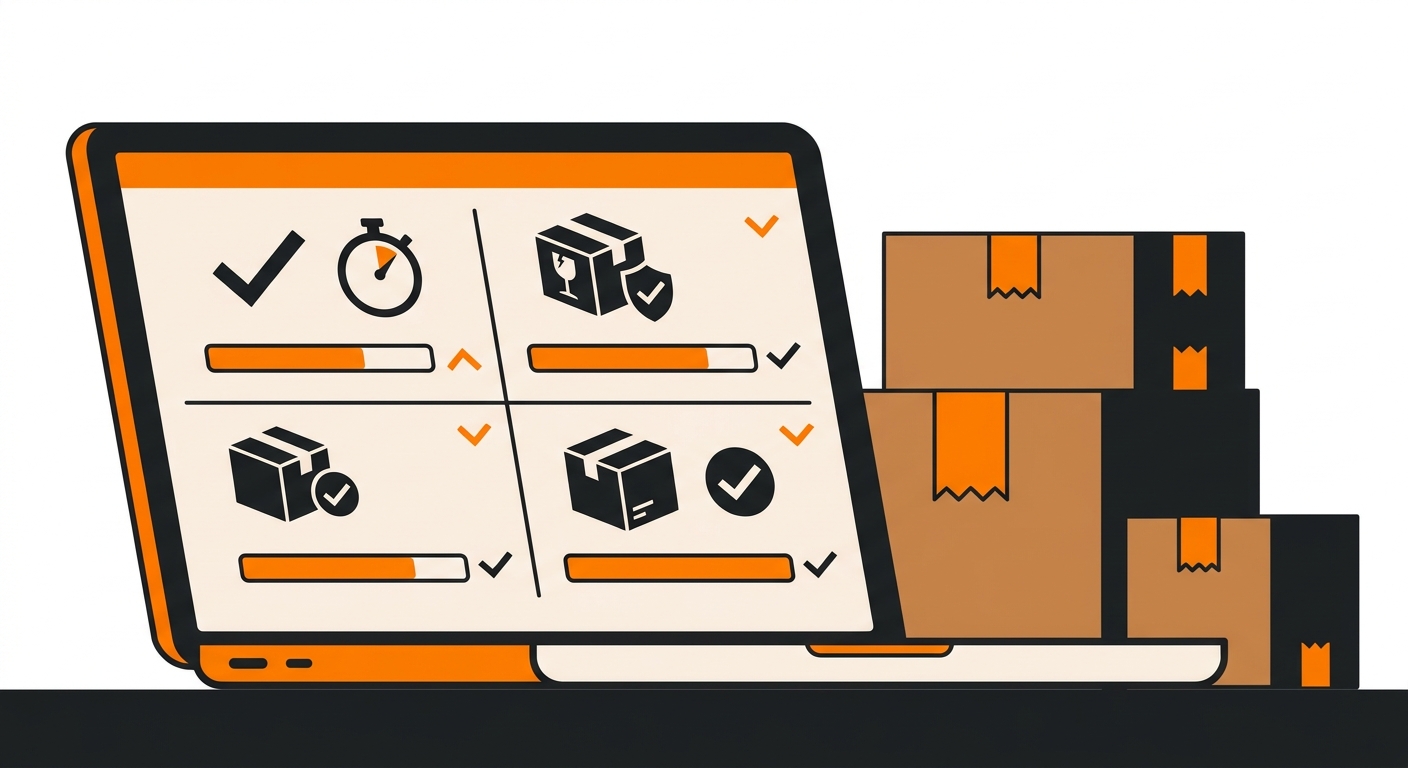
The perfect order rate tracks what percentage of your total orders meet all four conditions at once:
-
On time: the order arrives within the promised delivery window;
-
In full: every item is included in the correct quantity;
-
Undamaged: the product arrives in sellable condition;
-
Accurately documented: invoices, packing slips, and other paperwork are correct.
If even one condition fails, the order doesn’t count as perfect. That’s what makes this metric valuable: it doesn’t let partial success pass as good performance.
The Perfect Order Rate Formula
Perfect Order Rate = (% On Time) × (% In Full) × (% Damage-Free) × (% Accurate Docs) × 100
For example, if your rates are 96%, 97.5%, 98.5%, and 99% across those four conditions, your perfect order rate is approximately 91.4%.
What’s a Good Perfect Order Rate?
Most eCommerce and 3PL operations aim for 95% or above. World-class performance is typically 98% or higher.
Brands processing high volumes of orders often target 97%+ because even small error rates compound quickly at scale and the downstream costs (reshipping, customer service, returns) add up fast.
Why It Matters for eCommerce Brands

Every imperfect order has a cost: sometimes directly (reshipping, refunds), sometimes indirectly (lost repeat customers, negative reviews). Tracking your perfect order rate helps you:
-
Identify exactly where in your fulfillment chain errors are happening;
-
Hold your 3PL partner accountable to measurable performance standards;
-
Reduce cost-per-order by eliminating preventable mistakes;
-
Improve customer satisfaction and retention over time.
How to Improve Your Perfect Order Rate
Fix the Biggest Failure Category First
Break your imperfect orders down by type: late deliveries, incomplete shipments, damage, and documentation errors. Fix the largest source of failures before spreading attention across all four.
Tighten Inventory Accuracy
Incomplete orders often trace back to inventory discrepancies. Regular cycle counts and a reliable warehouse management system keep your stock records in sync with physical reality.
Audit Your Pick and Pack Process
Wrong items and missing quantities happen at the warehouse level. Barcode scanning, pick confirmation, and double-check packing workflows reduce these errors significantly. A well-run pick and pack operation should have error rates well below 1%.
Standardize Packaging for Damage Prevention
Damage in transit is often a packaging problem, not just a carrier problem. The right box size, adequate void fill, and product-specific standards, especially for fragile items, reduce claims.
Choose a 3PL With Defined SLAs
Your perfect order rate is only as good as the partner executing your fulfillment. Look for a provider that offers transparent performance reporting, guaranteed accuracy, and dedicated account support, not just a platform with a login.
Making Every Order a Perfect One
A 96% on-time rate sounds excellent until you realize it means 40 late orders out of every 1,000. Multiply that across a growing brand, and the impact becomes clear.
The perfect order rate keeps you honest about the full customer experience. Measure each of the four components separately, find where your operation is losing points, and fix it systematically.