EDI compliance in retail means exchanging purchase orders, invoices, advance ship notices, and other documents with trading partners in a standardized electronic format, with no manual re-entry or email workarounds.
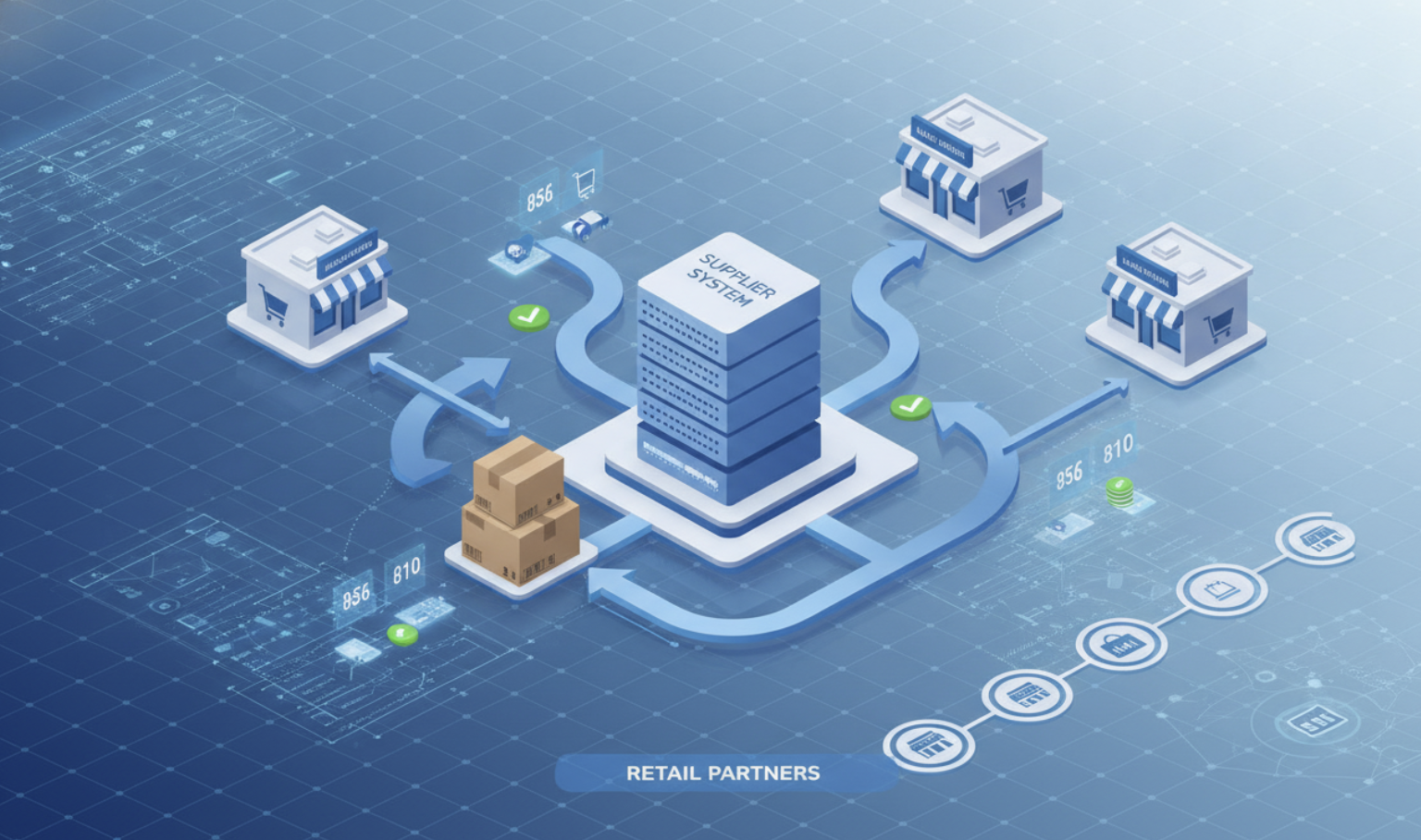
Common Retailer EDI Mandates and Requirements
While every retailer publishes its own EDI implementation guide, most trading partners require the same core capabilities.
Vendors are typically expected to support specific transaction sets, transmit documents within defined time windows, use approved communication methods such as AS2 or VAN connections, and follow retailer-specific labeling and packaging standards.
Retailers may also require certification testing before allowing live transactions.
Common requirements include:
-
Support for required EDI transaction sets such as 850, 856, and 810
-
Advance Ship Notices (ASNs) sent before shipments arrive
-
GS1-128 carton and pallet labeling
-
Functional acknowledgments (997/999)
-
AS2 or VAN connectivity
-
Retailer certification testing
-
Accurate product, quantity, and pricing data
-
Compliance with shipment timing requirements
What EDI Compliance in Retail Means
EDI compliance in retail means your business can send and receive structured electronic documents (purchase orders, invoices, shipping notices) in the exact format a trading partner requires, without manual data entry on either side.
Understanding what is EDI compliance retail comes down to one practical reality: your retail buyer sets the rules, and you either meet their technical specifications or your orders don’t process.
Managing EDI requirements across multiple retailers can be challenging because each trading partner maintains its own implementation guide and compliance standards.
Each retail giant publishes its own unique bible of standards, dictating everything from data field formats to the exact transmission protocols they’ll accept.
3PL operators and warehouse managers deal with these requirements every time a new wholesale or retail channel comes online.
Why EDI Compliance Matters for Your Fulfillment Operation
Non-compliance chargebacks from major retailers average 1-3% of invoice value per violation, and during peak windows like Black Friday or a subscription-box renewal cycle, those fees compound fast. A single mislabeled ASN can trigger a chargeback on an entire purchase order, not just the affected line items.
The operational damage runs deeper than the fine. When a trading partner rejects your EDI transaction set, your order goes into manual review, pushing dock-to-stock timelines out by 24-72 hours and directly hitting your fill-rate scorecard.
-
Chargebacks recovered through corrected EDI mapping represent 2-4% of gross wholesale revenue annually
-
Your 3PL’s ability to generate compliant EDI documents at the order level determines whether you stay on a retailer’s approved vendor list
How EDI Compliance Works in Retail
Here is how EDI compliance works in retail:
Trading partner setup and mapping
Before any transaction occurs, you and your retail partner exchange EDI specifications, typically a vendor compliance guide that defines which transaction sets are required (850 for purchase orders, 856 for advance ship notices, 810 for invoices). Your EDI software or third-party provider maps your internal data fields to those specifications.
Document generation and transmission
When a purchase order arrives, your order management system (OMS) triggers the creation of a corresponding EDI document. That document is transmitted over a value-added network (VAN) or direct AS2 connection to the retailer’s system, usually within minutes of order receipt.
Acknowledgment and validation
The retailer’s EDI system returns a 997 functional acknowledgment confirming receipt. Failed validations, a mismatched UPC, or incorrect carton count generate rejection codes that require correction before retail order fulfillment continues.
Fulfillment and ASN transmission
Once the order ships, your warehouse management system (WMS) generates the 856 advance ship notice with carton-level detail, including GS1-128 labels, and sends it before the shipment arrives at the retailer’s dock. Missing this window is the single most common source of chargebacks.
Invoice reconciliation
Your system transmits an 810 invoice after shipment, which the retailer matches against the original PO and ASN. Discrepancies in quantity or pricing trigger deductions automatically.
Who Needs EDI Compliance?
EDI compliance is commonly required for manufacturers, wholesalers, distributors, brand owners, and ecommerce businesses that sell through major retail channels.
Any company fulfilling purchase orders for large retailers may need to support EDI transactions as part of the retailer’s vendor onboarding requirements.
Businesses often encounter EDI requirements when expanding into wholesale distribution, big-box retail, grocery chains, or other high-volume sales channels where automated document exchange is necessary.
Stay Compliant Across Every Retail Channel
As you expand into wholesale and retail distribution, EDI compliance quickly becomes a requirement rather than an option.
Fulfyld helps brands meet retailer-specific EDI requirements, generate compliant ASNs and invoices, and reduce costly chargebacks through integrated fulfillment and inventory management solutions.
Contact Fulfyld to learn how we can support your retail compliance needs.