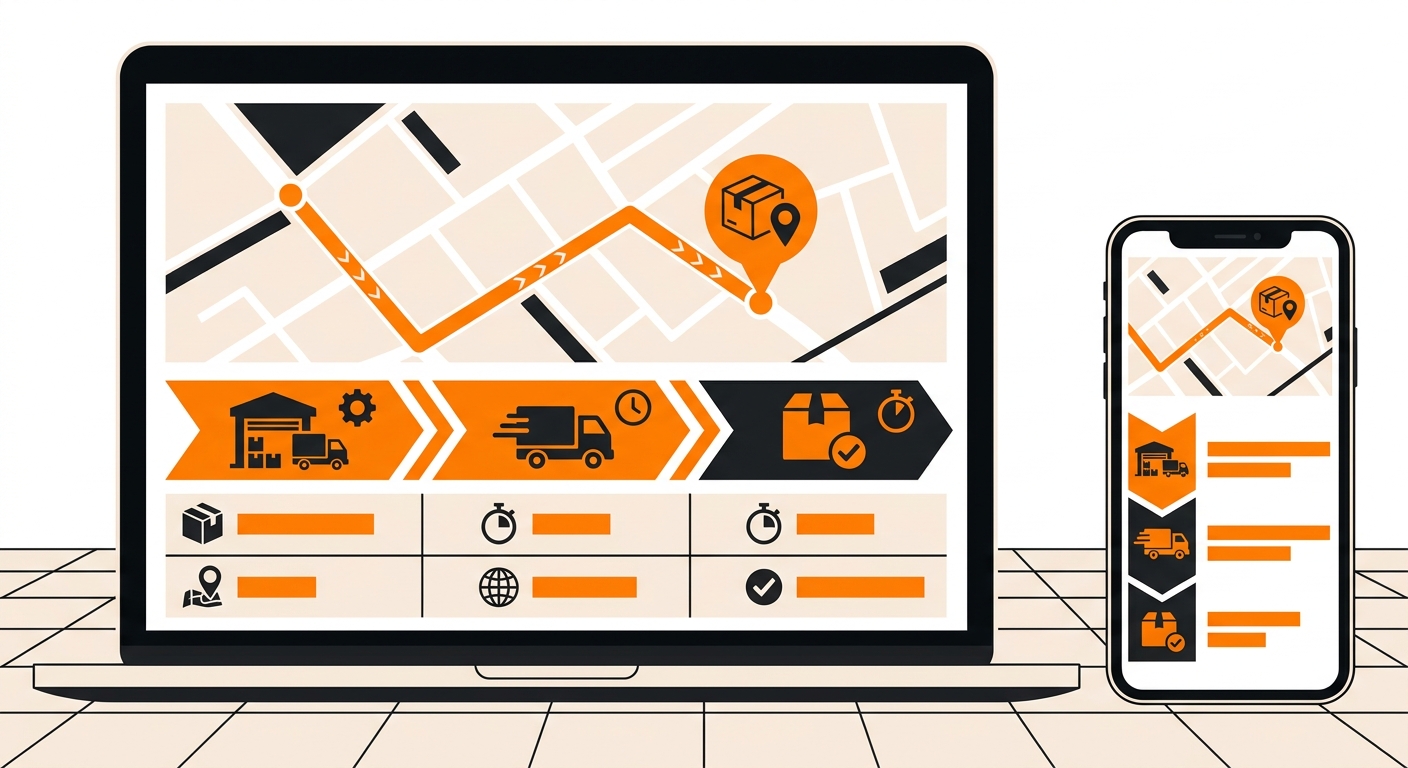
Real-time tracking in shipping refers to the ability to monitor a package’s status as it moves through a carrier’s network using scan-based updates triggered at key checkpoints.
What “Real-Time Tracking” Means
Despite the name, real-time tracking in shipping does not mean continuous live GPS tracking of a package.
Instead, carriers provide event-based tracking, where updates are generated only when a package is scanned at key points in the network.
These scan points typically include pickup, sorting hubs, transit facilities, and final delivery. Between these events, there are no updates, even though the package is still moving.
How Tracking Data Is Created
Understanding how tracking data is generated helps explain both its strengths and its gaps.
Barcode scanning at facility checkpoints.
Every time a package passes through a carrier facility, a pickup scan, a sort scan, a transfer scan, an arrival scan, or a handheld or conveyor-mounted scanner reads the barcode on the shipping label and records the event in the carrier’s system with a timestamp and location code.
This event is then pushed to the carrier’s tracking database, where it becomes visible on the tracking page and available via API.
GPS on delivery vehicles.
Carrier delivery vehicles are equipped with GPS, which feeds into the carrier’s route management and tracking systems.
During the out-for-delivery leg, GPS data allows carriers to provide more granular location estimates; in some cases, showing the package moving toward the customer’s address on a map.
This data is typically processed and averaged rather than being a raw second-by-second feed.
Driver scan at delivery.
The final delivery scan, when a driver scans the package at the delivery address or records a delivery exception, is the most critical scan event from a customer perspective. This scan triggers the delivered status update.
In cases where the driver’s device has intermittent connectivity, this scan may be uploaded in batch after the driver returns to the facility, creating a lag between actual delivery and the status update.
RFID and automated sortation.
Larger carriers use RFID (radio frequency identification) at some high-volume sorting facilities to read multiple packages simultaneously as they move through automated conveyor systems.
This produces faster, higher-volume scan data than handheld scanning but is still event-driven at facility checkpoints rather than continuous.
Electronic data interchange with airlines and customs.
For international shipments and air freight, carriers exchange electronic data with airlines and customs systems at origin and destination.
This is what generates events like “departed origin facility,” “in transit to destination country,” and “customs clearance” on international tracking pages.
How Tracking Data Reaches Customers
Generating the tracking event is one thing. Delivering it to the right people quickly is another. The data flow from a carrier scan event to a customer notification involves several systems working together.
-
Carrier API. Every major carrier exposes a tracking API that allows shippers, 3PLs, and third-party platforms to query tracking events or receive them via webhook.
-
A webhook is a push notification. Instead of polling the carrier’s API repeatedly to check for updates, the 3PL or shipping platform registers a URL with the carrier, and the carrier sends new tracking events to that URL automatically as they occur.
-
3PL and WMS integration. When a shipping label is generated, the tracking number is associated with the order record in the system. As the carrier pushes tracking events, those events update the order status and are pushed back to the connected sales channel.
-
Storefront and notification layer. When the tracking order number is pushed to the sales channel, the storefront triggers its own customer notification workflow, typically a shipping confirmation email with the tracking link.
-
Third-party tracking aggregators. Many e-commerce brands and 3PLs use tracking aggregator platforms, services that connect to multiple carrier APIs, normalize tracking data into a consistent format, and power branded tracking pages and notification systems.
Get Help With Real-time Shipment Tracking Through Fulfyld
Your fulfillment partner should give you live carrier data, proactive exception alerts, and a dedicated account manager who catches problems before your customers do.
Fulfyld connects order fulfillment with live carrier tracking updates across the entire delivery journey.
Talk to a Fulfyld fulfillment specialist about real-time tracking, shipping, and how it connects to your broader 3PL fulfillment setup.