

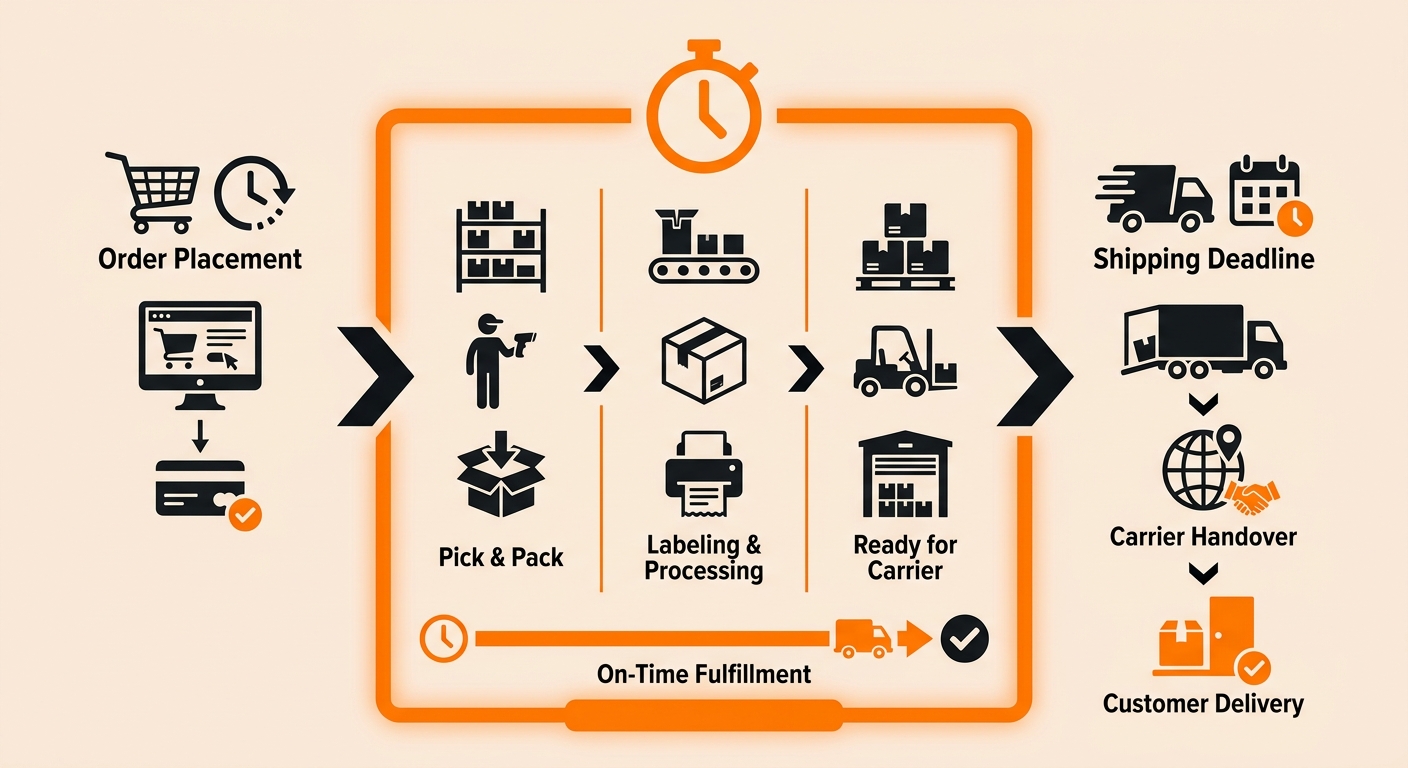
How a Ship Window Works

Ship windows are issued by the retailer as part of a purchase order (PO). The supplier is expected to ship within that window, not before the start date, not after the cancel date.
The logic is straightforward: retailers plan floor sets, promotional calendars, and warehouse receiving schedules around specific timing. When product arrives outside that window, it disrupts the entire downstream operation.
Most ship windows are communicated through EDI (Electronic Data Interchange), specifically the 850 Purchase Order transaction set, and must be honored exactly as stated.
Compliance Rules and Chargeback Risk
Retailers treat ship window adherence as a hard requirement, not a guideline. Common compliance rules tied to ship windows include:
-
Shipping before the start date: product may be refused or held at the supplier’s expense;
-
Shipping after the cancel date: the order can be cancelled outright or accepted with a chargeback;
-
Partial shipments outside the window: treated the same as a full miss, depending on the retailer’s routing guide.
The financial consequences vary by retailer. Some apply a flat chargeback fee, others calculate it as a percentage of the PO value. Either way, repeat violations put the supplier relationship at risk.
Brands working with major retail chains, Target, Walmart, Costco, and similar, should treat the cancel date as a non-negotiable cutoff, not a soft deadline.
Ship Window vs. Delivery Window
A comparison-style image showing different types of ship windows used on marine vessels, such as round porthole-style and rec
These two terms are often confused, but they refer to different requirements.
A ship window controls when the supplier hands the product off to the carrier. A delivery window (also called a receipt window or must-arrive-by date) controls when the product must physically arrive at the retailer’s distribution center or store.
Both can exist on the same PO, and both carry compliance risk. A supplier can ship within the correct window and still incur a chargeback if the carrier delivers outside the arrival window,, which is why carrier selection and transit time planning matter as much as the ship date itself.
Who Needs to Manage Ship Windows
Any brand selling through wholesale or retail distribution channels, brick-and-mortar retail, big-box, or specialty, will encounter ship windows. They’re standard practice in B2B fulfillment and become more complex as order volume and retailer count grow.
For growing brands, managing ship windows manually (spreadsheets, email reminders) creates real operational risk. As SKU count and PO volume increase, so does the likelihood of a missed window, especially when production delays or carrier issues enter the equation.
Having a fulfillment partner with built-in EDI compliance capabilities and automated PO tracking is one of the more reliable ways to keep ship window adherence consistent across retailers without dedicated logistics headcount.