Quick answer: Every carton and pallet shipped to Fulfyld’s warehouse must be labeled with your replenishment ID, generated in Shipedge when you submit your replenishment, along with any other fields specified in the label template from your onboarding Demo Follow-up Email. Carton labels go on one exterior face. Pallet labels go on all four sides. Labels must be applied before freight is picked up or dropped off.
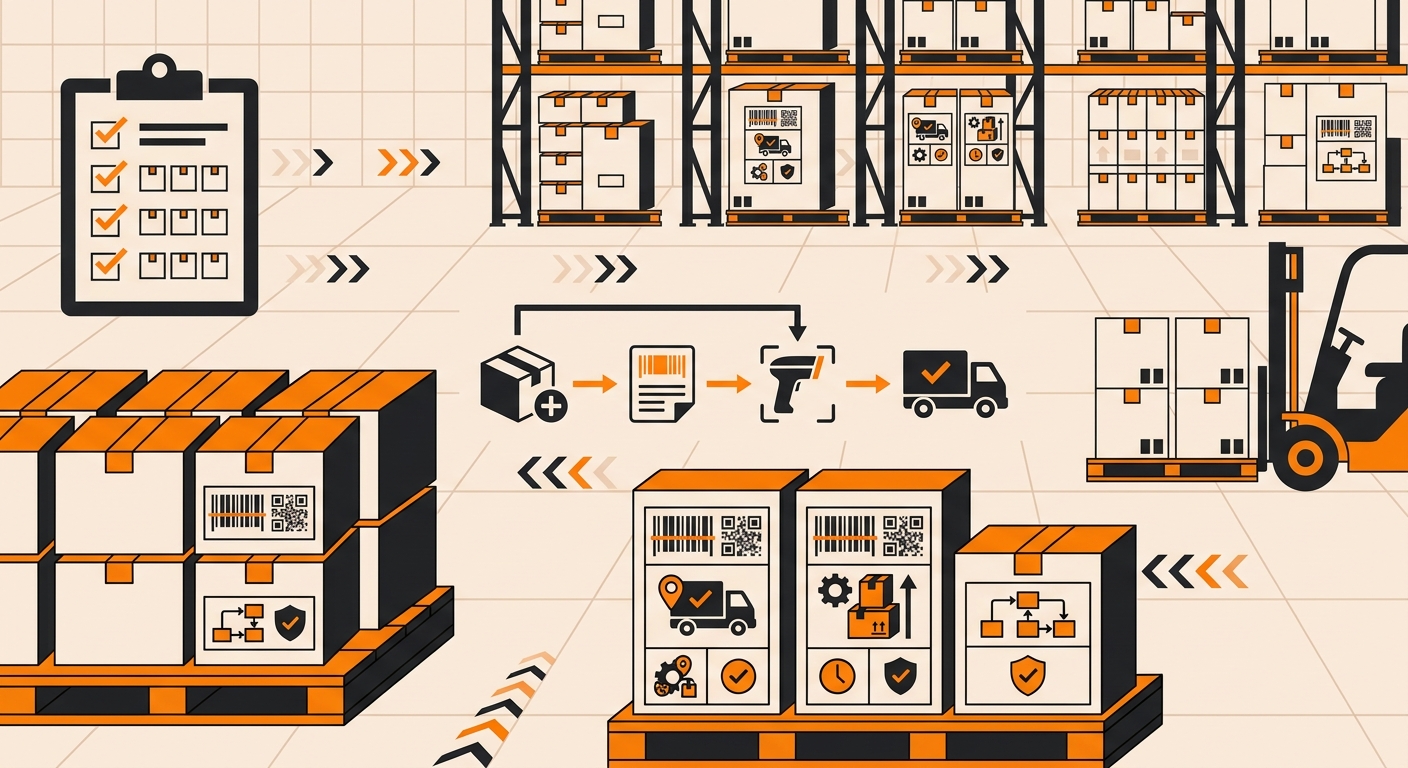
Before You Label Cartons and Pallets: Two Things You Need
You cannot label your cartons or pallets correctly without these two things in hand first.
Your replenishment ID. This is generated automatically by Shipedge when you submit a replenishment. It’s the unique identifier that ties your physical freight to your account record in the system.
Your label template. The specific fields required on a Fulfyld receiving label are documented in the Demo Follow-up Email sent after your onboarding Demo Call. This email includes the label template and outlines every field the warehouse team needs to see.
How to Label Cartons and Pallets for Fulfyld Receiving, Step by Step
Follow these steps for every inbound shipment.
Step 1: Submit Your Replenishment in Shipedge First
Log in to your Fulfyld client portal, navigate to Replenishment, and submit a replenishment for this shipment if you haven’t already. Once submitted, Shipedge generates your replenishment ID. Copy it exactly.
If you’re sending multiple separate shipments arriving on different days, each one needs its own replenishment submission and its own replenishment ID. Do not use the same ID across multiple distinct deliveries.
Step 2: Complete the Label Using Your Template
Open the label template from your Demo Follow-up Email and fill in all required fields. The replenishment ID is the most critical field; it must be present, accurate, and legible on every label. Complete the remaining fields exactly as the template specifies.
Print labels on standard label stock at a size that allows all fields to be read clearly without magnification. If you’re printing on plain paper and taping it to the box, make sure it’s flat, fully adhered, and covered with clear tape to protect it from moisture and handling damage in transit.
Step 3: Apply Carton Labels
Apply one label to the exterior of each carton. Place it on the flat face of the box. The label needs to be fully flat and fully readable.
Avoid placing carton labels on the bottom of the box. Labels on the bottom are often inaccessible once boxes are stacked and are easily damaged when cartons are set down on hard surfaces.
If a carton contains a single SKU, note the SKU and quantity on the label or on a secondary handwritten notation on the carton exterior. This speeds up receiving when the team is cross-referencing against the replenishment.
Step 4: Apply Pallet Labels
Apply the label to all four sides of every pallet; one label per side, positioned at approximately eye level and centered on each face. This ensures the replenishment ID is readable from any direction when the pallet is unloaded from the truck or moved through the receiving area with a forklift or pallet jack.
Do not apply pallet labels only to one or two sides. Pallets are often unloaded and repositioned in ways that obscure specific faces. Four-sided labeling eliminates this problem.
Step 5: Protect Labels from Transit Damage
Labels that become unreadable in transit are as good as missing. Before your freight ships, check each label and make sure:
-
The label is fully adhered with no lifted edges or bubbles
-
Any plain-paper labels are covered with clear tape or a protective overlay
-
Labels are not placed where strapping, shrink wrap seams, or handling grip points will cover or damage them
-
Labels are not placed on surfaces that are wet, dusty, or oily
Step 6: Verify Before Pickup
Before your carrier picks up the shipment, or before you drop it off, do a final walk-through of every carton and pallet:
-
Every carton has a label on an accessible, flat exterior face
-
Every pallet has a label on all four sides
-
Every label shows the correct replenishment ID
-
Every label is legible and undamaged
-
No label is placed on a seam, corner, or bottom, or covered by strapping
If You’re Shipping via a Supplier Directly to Fulfyld
If your inventory is shipping from a manufacturer or supplier to Fulfyld without passing through your own facility, you are still responsible for making sure it arrives correctly labeled.
Suppliers, particularly overseas manufacturers shipping via freight forwarder, sometimes have their own carton marking conventions that don’t include the information Fulfyld needs. Brief them specifically on the Fulfyld label requirements.
A shipment that arrives from an overseas supplier without replenishment IDs is difficult and time-consuming to resolve.
Still Have Questions?
For help with labeling requirements or to retrieve your label template, contact your dedicated account manager directly, or reach the Fulfyld team at hey@fulfyld.com or (256) 716-8241.