

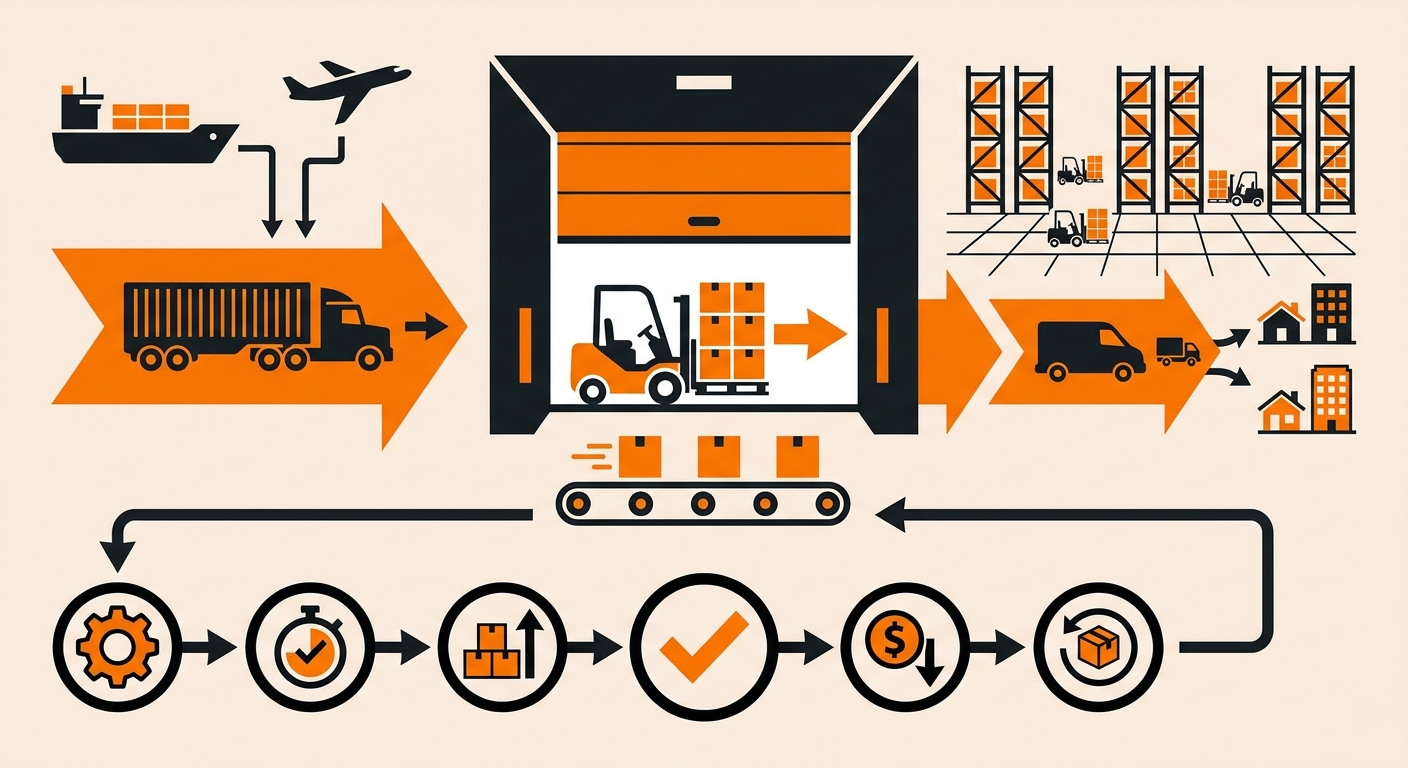
A dock door is the opening in a warehouse or fulfillment center wall where trucks back up to load or unload freight. It’s the physical handoff point between your inbound supply chain and your outbound shipping operation; every pallet, carton, and unit that moves through your 3PL passes through one.

Why a Dock Door Matters for Your Fulfillment Operation
Every loading bay entrance in your warehouse is a revenue checkpoint. When freight sits waiting because a dock door is occupied, your dock-to-stock cycle time stretches, and that directly delays pick-and-pack for orders already in queue.
During Black Friday peak, a single blocked receiving bay can back up inbound pallets by four to six hours. That ripple hits your available inventory count inside the WMS before a single order ships.
-
Warehouses with fewer than four active loading bays report up to 23% longer dock-to-stock times during high-volume periods, according to supply chain benchmarking data
-
Delayed inbound receipts inflate WISMO calls when customers order items that appear in-stock but haven’t cleared receiving
-
Subscription-box renewal cycles require precise inbound scheduling; a missed receiving window can delay an entire month’s kitting run
How a Dock Door Functions in a Fulfillment Operation
-
Appointment scheduling and dock assignment: Before a truck arrives, your warehouse management system (WMS) assigns it to a specific door based on load type, carrier, and available dock capacity. This prevents traffic jams on the dock floor and keeps inbound and outbound freight from mixing.
-
Vehicle positioning and leveling: The truck backs into the door and the dock leveler, a hinged steel plate, bridges the gap between trailer bed and warehouse floor. Without this step, forklifts can’t safely cross the threshold.
-
Inbound and outbound load processing: Once the trailer is secured, warehouse staff begin unloading or loading freight while the WMS tracks pallet movement in real time. Inbound pallets are scanned against open purchase orders and assigned putaway tasks, while outbound orders are directed to designated staging lanes before carrier loading begins.
-
Door release and trailer departure: Once the load is confirmed in the WMS, the dock door is cleared and the appointment slot is marked complete. Some facilities use dock management software as a separate module; others handle this directly inside their WMS.
Key Components of a Dock Door
The Door Opening and Frame
The door opening is the structural cutout in the warehouse wall that determines what equipment and freight can physically pass through. Standard openings run 8 feet wide by 10 feet tall, though high-cube operations handling pallet loads over 96 inches often spec 9-by-10 or 10-by-12 openings.
The Dock Leveler
A dock leveler bridges the height gap between the warehouse floor and a truck bed, which can vary by as much as 12 inches depending on vehicle type and load weight. Without it, forklifts can’t safely cross, and manual pallet jacks risk tipping.
The Dock Seal or Shelter
A dock seal compresses against the trailer body to close the gap between truck and building, blocking weather, pests, and temperature loss. Climate-controlled facilities lose measurable energy without a functioning seal.
The Vehicle Restraint
A vehicle restraint locks onto the truck’s rear-impact guard to prevent trailer creep during loading. Trailer creep is the leading cause of dock-related forklift accidents, making this component non-negotiable for any operation moving palletized freight.
Ready to Put Your Dock Capacity to Work
Understanding how loading dock infrastructure affects throughput is one thing. Putting that knowledge into action, or choosing a 3PL whose dock operations won’t become your bottleneck, is where the real difference shows up.
Fulfyld’s fulfillment centers are built around dock efficiency, structured door assignments, carrier scheduling, and receiving workflows that keep inbound freight moving without disrupting outbound order flow. Talk to a Fulfyld specialist about your dock and fulfillment needs.