

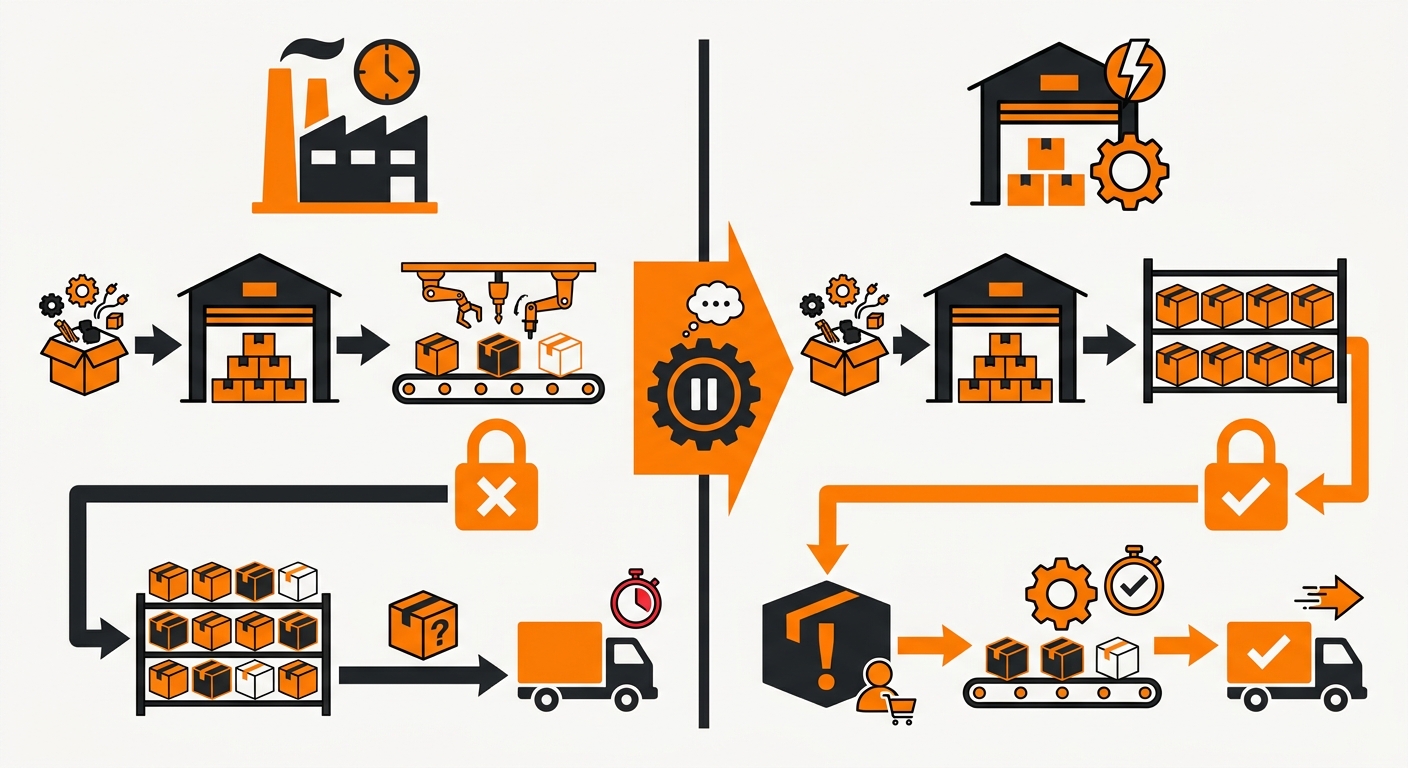
Postponement strategy is a supply chain approach where you delay the final configuration, assembly, or distribution of a product until actual customer demand is confirmed, rather than committing inventory to a finished state in advance based on forecasts.
Why Postponement Strategy Matters for Your Fulfillment Operation
Brands that hold fully committed inventory before demand is confirmed tie up an average of 20–30% of working capital in SKUs that may never move at full margin.
The downstream effects hit your 3PL fulfillment operation hard. When a product variant sits unneeded in a pick zone while another stockouts, your team processes more exception orders, fields more WISMO calls, and runs emergency kitting jobs that should have been scheduled weeks earlier.
How Postponement Strategy Works
Postponement doesn’t happen automatically. It requires deliberate decisions about where you hold inventory, when you commit to a final product configuration, and what triggers the last-mile differentiation.
Here’s how it runs in practice.
-
Hold inventory in a generic, undifferentiated state. Instead of receiving pre-kitted or fully labeled units, you store base SKUs, unbranded components, unlabeled bottles, or unconfigured bundles in your 3PL’s warehouse. Your WMS tracks these as generic stock rather than finished product variants.
-
Capture demand signals from your OMS. When a customer order comes in, your order management system reads the configuration details, size, color, bundle combination, regional label requirement, and passes that data to the fulfillment team as a work order, not just a pick ticket.
-
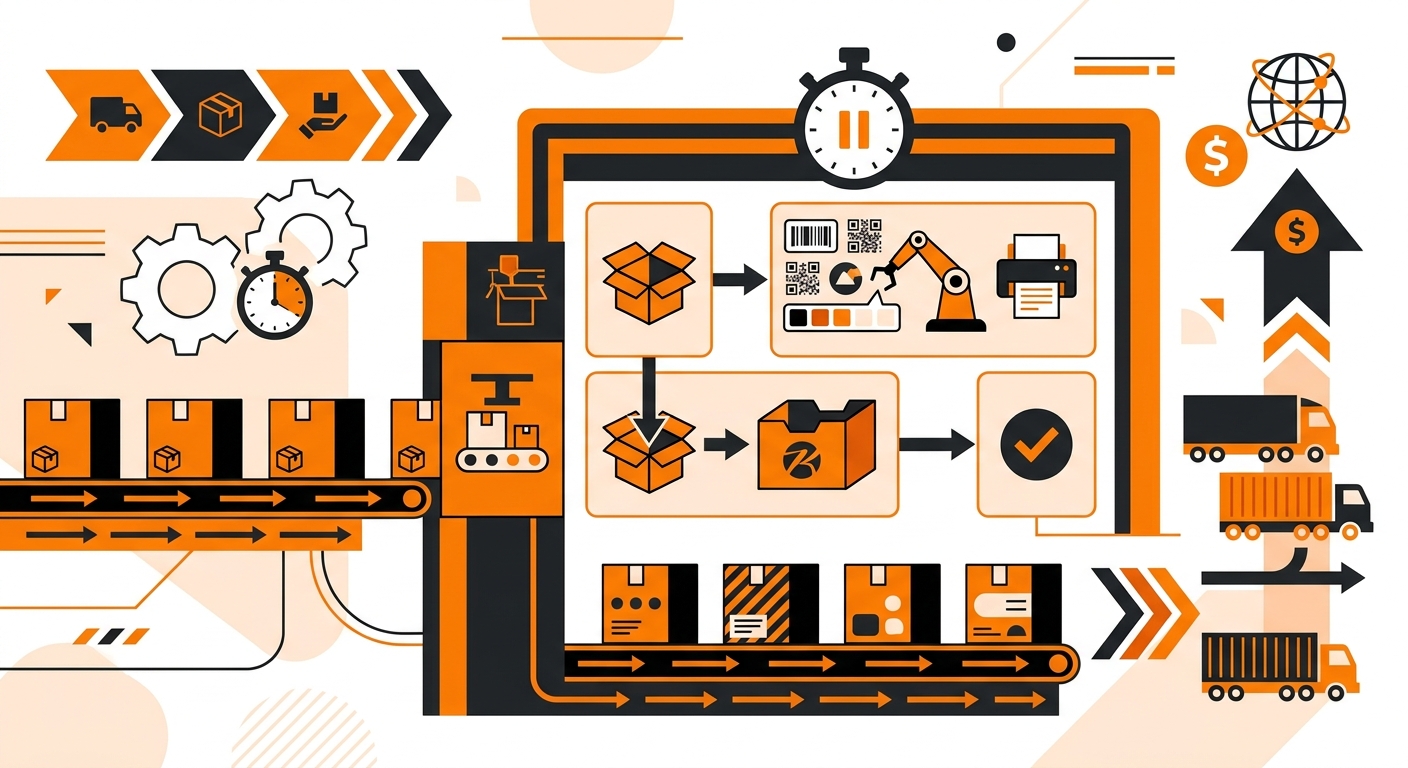
Final differentiation happens at the pack station. Instead of simply boxing products, the fulfillment team applies the exact configuration tied to the confirmed order, whether that means adding a German-language compliance label, assembling a custom 3-pack bundle, or inserting channel-specific packaging.
-
Ship the finished unit directly to the end customer. Once differentiated, the unit moves through your standard carrier routing, no secondary handling, no repack facility required.
Key Components of a Postponement Strategy
Decoupling Point
Think of the decoupling point as the boundary between forecast-driven activity and demand-driven execution. Everything upstream of that point, such as producing 100,000 blank units, operates on projected demand, while everything downstream waits for a confirmed customer order before moving forward.
Generic Inventory Buffer
This is the semi-finished or undifferentiated stock held at the decoupling point. A supplement brand might hold unlabeled bottles in bulk, enough to cover 3-4 weeks of demand, before applying SKU-specific labels at pack-out. The buffer absorbs demand variability without locking you into a finished configuration too early.
Differentiation Triggers
These are the conditions that initiate final assembly or customization: a confirmed order, a regional shipment threshold, or a promotional event. Without defined triggers, teams default to pushing finished goods early, which defeats the purpose.
Downstream Fulfillment Capacity
A professional operations team reviewing inventory, packaging, and order fulfillment data on a large screen in a modern offic
Postponement shifts work closer to the ship date, so your 3PL or warehouse must handle rapid kitting, labeling, or bundling at volume. If that capacity isn’t contracted and tested before peak season, the strategy creates bottlenecks instead of preventing them.
Best Practices for Postponement Strategy
-
Set a minimum order threshold before committing to final product configuration; don’t trigger kitting or labeling until demand signals confirm the variant mix.
-
Audit your generic SKU buffer levels monthly and adjust based on the previous 90 days of order data, not annual forecasts.
-
Avoid finalizing country-specific packaging until a purchase order clears your order management system.
-
Map every postponement step to a specific SLA window so warehouse staff knows exactly when differentiation must begin.
-
Test your postponement cutoff point quarterly; if late-stage customization is adding more than 4 hours to average order cycle time, move the trigger earlier.
-
Avoid applying postponement to high-velocity SKUs where pre-configuration is faster than real-time assembly.
Ready to Put Postponement Strategy Into Practice
Understanding postponement strategy is one thing. Building the fulfillment infrastructure to run it is another.
You need a 3PL partner who can hold undifferentiated inventory, execute late-stage customization at the pick-and-pack level, and ship within your SLA windows, without charging a premium every time the process changes.
Fulfyld works with eCommerce brands that need this flexibility. Talk to a Fulfyld specialist about postponement strategy and find out whether your current setup supports the deferral model your business needs.