

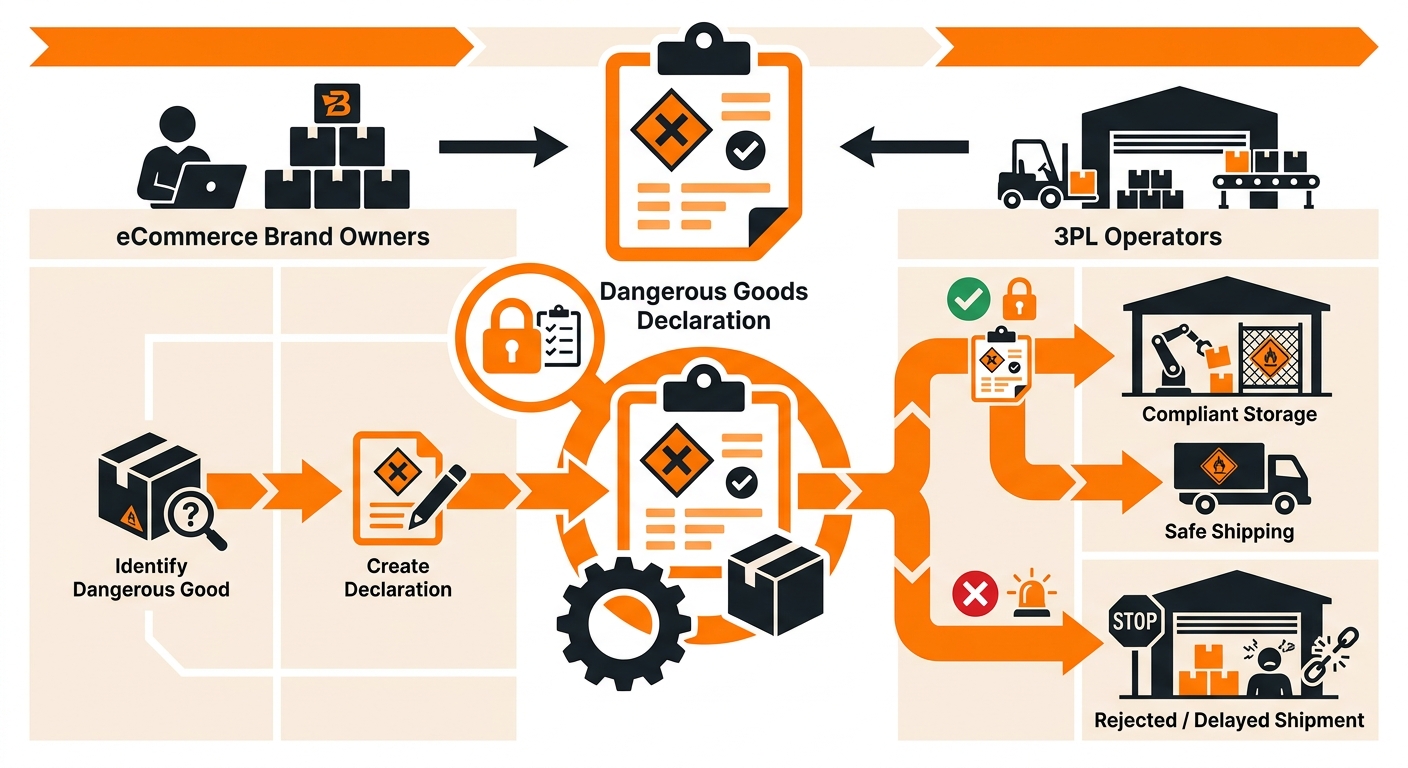
A dangerous goods declaration is a shipper-completed document that identifies hazardous materials, certifies they’ve been packaged and labeled to regulatory standards, and transfers legal liability to the carrier.

What the Document Must Include
Regulatory bodies- IATA for air, IMDG for ocean, DOT for domestic ground- use slightly different formats, but every valid declaration covers the same core elements:
-
UN number and proper shipping name
-
Hazard class and packing group
-
Net quantity per package and total quantity
-
Emergency contact number, active 24/7
-
Shipper’s signature with date and certification statement
The emergency contact catches eCommerce brands off guard: a business phone that goes to voicemail after 5 PM will get the shipment rejected.
When eCommerce Brands Need One
You need a declaration any time a shipment contains regulated hazardous materials, lithium batteries, flammable liquids, aerosols, compressed gases, or certain cleaning agents, whether shipping one unit or a full pallet.
Some products qualify as limited quantity or excepted quantity shipments with reduced documentation requirements, but that classification still requires correct labeling, not zero paperwork.
Why It Matters for Your Fulfillment Operation
A missing or inaccurate hazmat declaration doesn’t just slow down a shipment. It can trigger carrier rejection, regulatory fines, and full warehouse holds.
The compliance angle is direct: carriers like UPS and FedEx require shipper’s declaration for dangerous goods documentation before accepting hazmat freight. Without it, your 3PL fulfillment partner has no legal basis to tender the shipment. That’s not a delay; that’s a stopped order.
-
Incorrect declarations are cited in roughly 70% of hazmat-related carrier refusals
-
Fines from DOT or IATA violations can reach $84,425 per incident for willful non-compliance
-
Brands with pre-validated hazmat profiles at dock-to-stock intake see fewer than 2% shipment holds versus 11% for those without
How a Dangerous Goods Declaration Gets Processed
-
Classification and UN number assignment: Before anything ships, you or your 3PL identifies the hazardous material using the UN Model Regulations database. Each substance gets a four-digit UN number (for example, UN 1950 for aerosols), a packing group (I, II, or III), and a hazard class that determines which carrier restrictions apply.
-
Document preparation: The shipper completes the declaration form, either IATA’s Shipper’s Declaration for Air Transport or the IMO’s Dangerous Goods Form for ocean freight. Every field must match the physical label on the package exactly. A single mismatch between the form and the label is grounds for carrier rejection.
-
Carrier hand-off and acceptance check: The carrier’s dangerous goods desk reviews the declaration against their own approved commodities list. Ground carriers like UPS and FedEx run this check at acceptance; air carriers validate it again at the freight terminal.
-
Documentation retention: Regulations require shippers to retain completed declarations for a minimum of three months (air) or two years (ocean). Your WMS or order management system should archive these records automatically, tied to the shipment ID.
Key Components of a Dangerous Goods Declaration
Shipper and Consignee Identification
Every declaration names the responsible shipping party and the receiver. Shipper identification establishes legal accountability; if a carrier discovers undeclared hazardous material mid-transit, this field determines who faces the fine.
UN Number and Proper Shipping Name
The UN number is a four-digit code assigned to each hazardous substance; UN1263 for paint, UN3480 for lithium-ion batteries. The proper shipping name must match the UN number exactly; a mismatch is grounds for carrier rejection at the dock.
Hazard Class and Packing Group
A substance’s hazard class dictates the exact protective measures handlers need, while its packing group ranks the danger level on a simple scale; Group I is the highest risk, and Group III is the lowest.
Quantity and Net Weight
This field specifies the total quantity per package and the net weight of the hazardous substance, not gross shipment weight. Exceeding declared quantities by any margin can void your carrier agreement and trigger a full shipment hold.
Best Practices for Hazardous Material Shipping Documentation
-
Verify the UN number and packing group against the current IATA or DOT hazmat table before every shipment, not just at onboarding.
-
Attach the completed declaration to the outside of the package in a clearly visible, weatherproof sleeve; never fold it inside the box.
-
Train your warehouse team to reject any inbound hazardous SKU that arrives without a supplier-provided Safety Data Sheet on file.
-
Audit your SKU catalog for hazmat classification changes at least once per quarter, since formulations and regulatory thresholds shift without notice.
-
Avoid splitting a hazardous shipment across multiple carriers to cut costs; doing so multiplies your documentation burden and your compliance exposure.
-
Keep signed copies of all declarations for a minimum of two years, the retention window required under 49 CFR for domestic ground shipments.
Need a Fulfillment Partner That Handles Hazmat Compliance Correctly?
Dangerous goods shipping leaves very little room for error. From UN classification and documentation retention to carrier acceptance requirements, one incorrect declaration can stop orders before they ever leave the warehouse.
Talk to a Fulfyld specialist about building a fulfillment process that keeps dangerous goods moving without unnecessary shipment holds or compliance risk.