

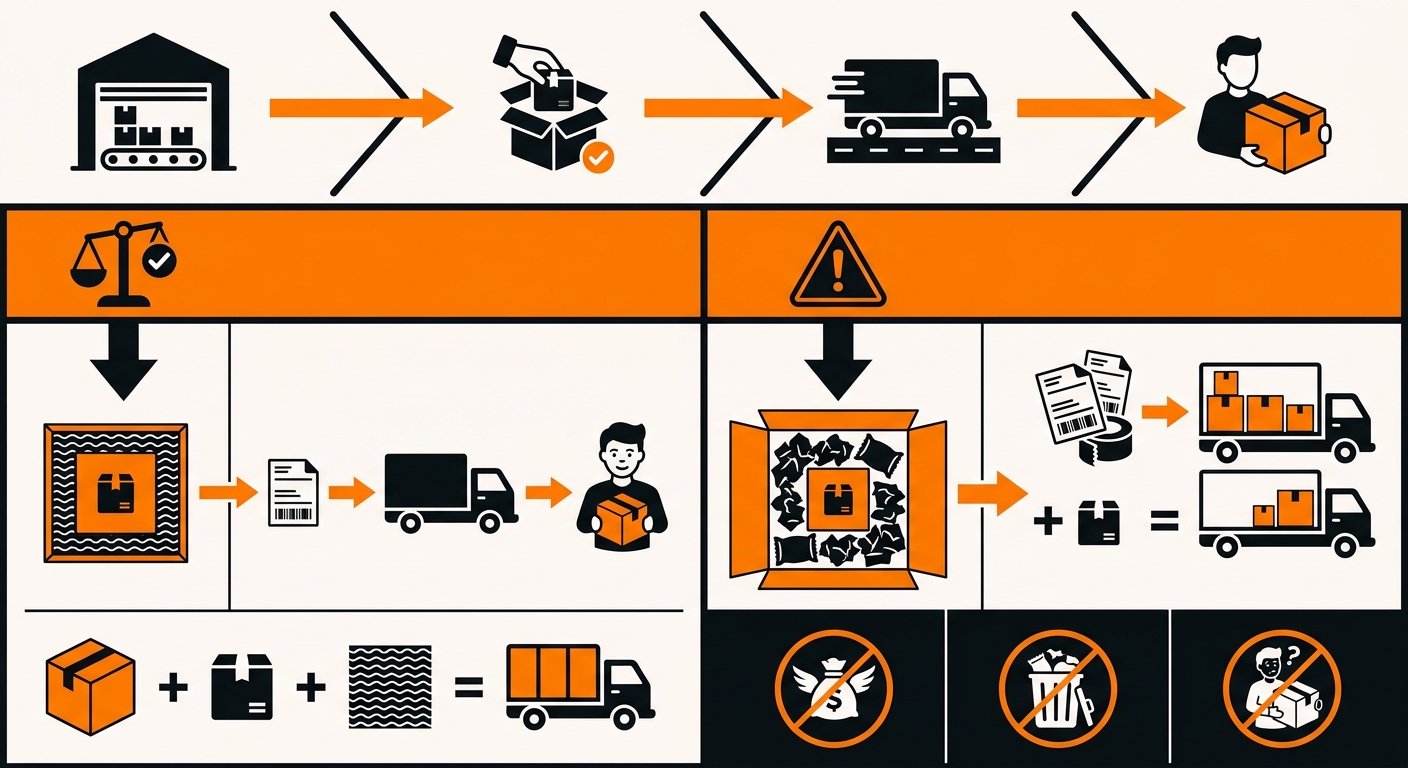
Over packaging is the practice of using more packaging material than an order actually requires, including excess box size, unnecessary void fill, redundant layers of wrapping, or oversized mailers for small, lightweight products.

Over Packaging in eCommerce Fulfillment
Overpackaging occurs when a product ships inside a box, mailer, or protective material that exceeds what the item needs for safe transit. It’s not just a sustainability issue; it’s a direct margin killer.
Why DIM Weight Makes This Worse
Carriers like UPS and FedEx charge whichever is greater, actual weight or DIM weight, calculated by dividing cubic inches by 139. A smaller box means lower DIM weight and lower cost.
Where It Typically Happens
-
Default box sizes never audited after the product catalog expanded
-
Kitting operations where components are bagged individually before going into an oversized master carton
-
Subscription box builds where void fill compensates for poor box selection
The exception: fragile or high-value items sometimes justify larger packaging, as damage claims cost more than the extra material.
Why Over Packaging Hurts Your Bottom Line
Excess packaging isn’t just a sustainability talking point. It’s a direct cost center that compounds across every order you ship. Dimensional weight pricing from carriers like UPS and FedEx means a box that’s 30% too large can push you into a higher rate bracket on every single shipment.
The financial bleed shows up in other places too:
-
Dead capital in materials: Brands that audit their packaging typically recover 15–20% of per-unit packaging spend by right-sizing void fill and box dimensions.
-
Higher return rates: Damaged goods from shifting product inside oversized boxes drive return spikes, especially during peak seasons like Black Friday when 3PL fulfillment centers process orders at maximum throughput.
-
Slower dock-to-stock cycles: Bulky, non-standard packaging slows receiving and putaway, adding labor minutes that scale painfully during subscription-box renewal cycles.
How Over Packaging Happens in a Fulfillment Operation
-
Order data enters the WMS without a matched carton profile. When an order management system (OMS) pushes a pick request to the warehouse management system, the WMS needs a pre-assigned box type for each SKU or kit. Without a carton profile, pickers default to the next available box, often one that’s 30–50% larger than the product requires.
-
The pick-and-pack station fills the gap with void fill. A packer receives an oversized carton and uses air pillows, paper, or foam to prevent item movement. The excess fill adds 0.3–0.8 lbs of dimensional weight, directly increasing carrier charges.
-
The shipping carrier calculates dimensional weight, not actual weight. Carriers like UPS and FedEx bill on whichever is greater: actual weight or DIM weight (length × width × height ÷ 139 for domestic). A product weighing 1 lb in a 12×10×8 box generates a 6.9 lb billable weight.
-
The cycle repeats because no system flags the mismatch. Without SKU-level carton rules enforced in the WMS, every shipment of that item ships oversized until someone audits carrier invoices manually.
Key Components of Over Packaging
Void Fill Volume
Void fill is the material used to occupy empty space inside a shipping carton. When fill volume exceeds what’s needed to prevent product movement during transit, it signals a packaging problem and drives up both dimensional weight and material costs.
Box-to-Product Size Ratio
The ratio between your carton’s internal dimensions and the product’s actual footprint determines how much excess space exists before you even add fill. A ratio above 1.5:1 by volume is a common threshold where carriers start charging you for air.
Material Layer Count
Layer count refers to how many distinct protective materials wrap a single SKU, bubble wrap, tissue, foam inserts, and outer carton combined. More than two layers on a non-fragile item is almost always unnecessary.
Dimensional Weight Trigger
Carriers calculate shipping cost using dimensional weight (length × width × height ÷ 139 for domestic UPS/FedEx) when it exceeds actual weight. Excess packaging is the primary reason DTC brands unknowingly pay the higher of the two figures on every shipment.
Sustainability Impact of Over Packaging
Overpackaging creates unnecessary waste throughout the supply chain. Larger boxes require more cardboard, more filler materials, and more transportation space, increasing the environmental footprint of every shipment.
Many consumers now expect brands to minimize packaging waste. Oversized boxes filled with excessive void fill can create a poor unboxing experience and may negatively affect customer perception of a brand’s sustainability efforts.
Reducing packaging size not only lowers shipping costs and dimensional weight charges but also decreases material consumption and transportation emissions, making fulfillment operations more environmentally responsible.
Stop Overpaying for Packaging That Hurts Your Brand
Excess packaging inflates dimensional weight charges and slows pick-and-pack throughput.
Fulfyld works directly with growing eCommerce brands to identify where excess packaging is eating into margins at the SKU level.
Talk to a Fulfyld fulfillment specialist about over-packaging and get a clear picture of where your current setup is costing you.